
Crowd Control Strategies for Large Events in Los Angeles: What Actually Works in 2026
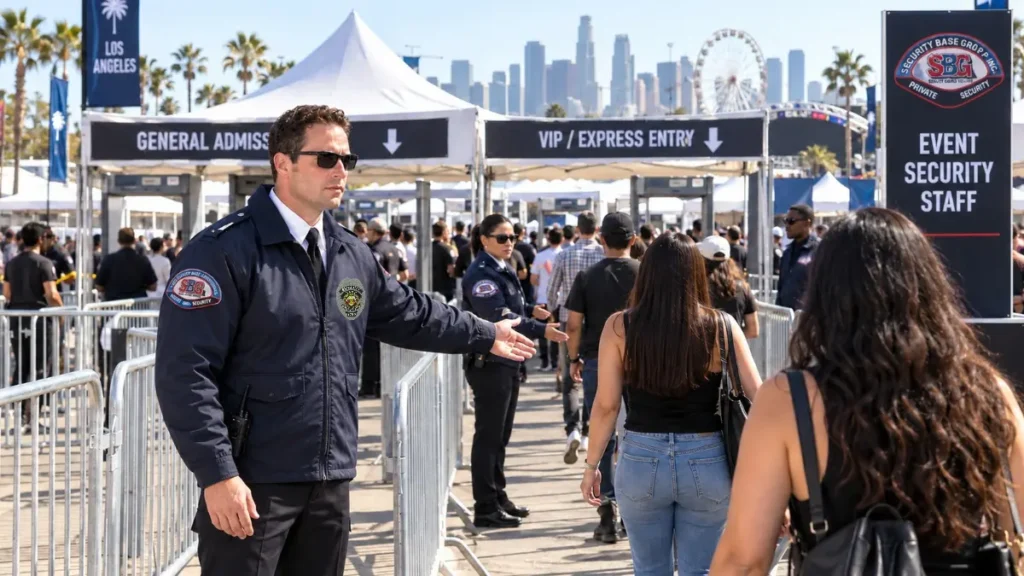
Most crowd problems don’t start with a dramatic moment. They begin with something ordinary: a few thousand people arriving within the same forty minutes, a single scanning lane that moves slower than expected, or a sidewalk that serves as both a queue and a walkway. By the time attendees notice the crush, the conditions that caused it have usually been in place for a while.
That is why Crowd Control Strategies for Large Events in Los Angeles need to be in place before the gates open. A detailed run-of-show, a good headliner, and a well-designed venue do not guarantee smooth movement. Concentrated arrivals, limited access points, and unclear queues can strain even well-prepared events.
This guide is written for event organizers, festival planners, concert promoters, trade show managers, and venue operators. It explains the local factors that shape crowd behavior, the principles behind effective planning, eight practical strategies, and the mistakes that most often undermine a good plan. Use it as a working reference when you plan your next event.
Why Crowd Control Is Uniquely Challenging in Los Angeles
Every venue is different, and no two events share identical risks. Still, several conditions come up often enough in Los Angeles to deserve attention during planning.
1. Concentrated Arrivals and High Attendance
Large events tend to produce arrival peaks rather than steady streams. Doors-open times, headliner schedules, and ticketing windows push people toward entrances at the same moment. The same happens in reverse at departure, when thousands of attendees try to leave through the same exits and transit points at once. Plans that only consider total capacity, and not the rate at which people actually arrive and leave, tend to underestimate pressure on entrances.
2. Traffic, Parking, and Rideshare Pickup Zones
Los Angeles is a car-dependent region, and event arrival patterns reflect that. Parking lots, drop-off lanes, rideshare pickup areas, and shuttle stops all feed pedestrians into the venue’s approaches. When these areas are poorly connected to the entry routes, people cut across traffic, gather in vehicle lanes, or stop on sidewalks that other attendees need to pass. Pedestrian planning therefore has to extend beyond the venue’s front door.
3. Entrances, Sidewalks, Corridors, and Bottlenecks
In dense urban locations, space outside the entrance may be limited and shared with the public, nearby businesses, and traffic. Inside, concourses, stairwells, and corridor junctions can narrow movement quickly. Wherever flows merge or cross, such as ticket scanning, bag checks, restrooms, and concessions, congestion can form.
4. Outdoor Conditions, Heat, and Changing Weather
Outdoor events in Southern California can involve long periods of sun exposure, and conditions can change during the course of a day. Heat and dehydration affect how people behave in queues, how quickly they tire, and how often medical attention is needed. Shade, water access, and shorter waiting times are crowd-management measures as much as comfort measures.
5. Emergency Vehicle Access and Coordination
Ambulances, fire apparatus, and other responders need clear routes in and out. Those routes should be agreed upon in advance with venue management and the relevant authorities, then kept open throughout the event. Organizers should verify current permit, fire-safety, and public-safety requirements with the appropriate agencies and the venue, since these vary by location and event type.
The Core Principles of Effective Crowd Control
Specific tactics change from one event to the next, but the underlying principles are consistent.
- Prevent dangerous density before it develops: Crowd risk is easier to manage when it is still a trend than when it has become a condition. Watching how quickly an area is filling, and acting early by pausing entry, opening another lane, or redirecting attendees, is far more effective than responding to a crush.
- Keep pedestrian flows from conflicting: People entering, leaving, and moving between amenities should not routinely cross each other’s paths. Conflicting flows slow movement and create friction between strangers.
- Watch for bottlenecks and pressure points: Narrow passages, merge points, stairs, and gates are where problems form first. These should be identified in advance and observed throughout the event.
- Communicate clearly and consistently: Signage, public address announcements, and staff instructions should all say the same thing. Mixed messages push people to improvise, and improvised movement is hard to manage.
- Keep exits and accessible routes clear: Emergency exits, ADA-accessible paths, and medical access lanes cannot be blocked by queues, vendors, equipment, or barriers.
- Use proportionate, calm de-escalation: Most crowd friction is resolved with a clear explanation and a courteous tone. Staff should escalate to supervisors when needed, rather than escalating the situation.
- Coordinate every team: Security personnel, event management, medical staff, and emergency responders should work from a shared plan and shared communication channels.
Proactive planning is generally preferable to reactive control for a simple reason: by the time a problem is visible to everyone, options have narrowed. Early observation keeps more of them available.
Pre-Event Planning: The Foundation of Success
A solid plan is usually what separates a well-managed event from a stressful one. Here is how organizers can approach it.
- Start with a venue-specific risk assessment: Walk the site, including approaches, parking, drop-off zones, entrances, concourses, and exits. Note where people will stop, queue, merge, or cross. A generic template is a starting point, but it cannot replace observation of the actual space.
- Estimate attendance and test entry and exit capacity: Consider expected attendance, arrival patterns, ticket scanning speed, bag-check procedures, and how many people can realistically pass through each access point per hour. Plan for the peak, not the average.
- Map the layout: Mark entrances, exits, queue areas, restricted zones, medical stations, and emergency routes on a single plan that every team can reference.
- Identify conflicts and potential bottlenecks: Look for places where queues could spill into walkways, where vehicles and pedestrians share space, or where lines for restrooms and concessions could block circulation.
- Determine staffing from the risk picture: There is no universal guard-to-attendee ratio that fits every event. Appropriate staffing depends on the venue layout, expected attendance, event type, alcohol service, the risk assessment, and any requirements set by the venue or authorities. A seated corporate gathering and an outdoor music festival with the same headcount will need very different deployments.
- Assign posts and reporting lines: Every guard should know their post, their responsibilities, who supervises them, and when to escalate. Supervisors need clear authority and reliable communication with event management.
- Prepare response procedures: Document medical response, evacuation, severe-weather, and lost-person procedures, and confirm who communicates what to whom.
- Brief personnel and test radios before opening: A briefing should cover the layout, expected peaks, escalation steps, and the points of contact. Radios and other communication tools should be tested at the posts where they will be used.
- Complete a final inspection before opening: Confirm that barriers are placed correctly, exits are clear, signage is visible, and medical and emergency access routes are open.
A practical planning sequence looks like this: assess the site, estimate demand, map flows, set staffing, assign roles, prepare procedures, brief and test, then inspect. Organizers who need experienced support at this stage can consult a provider of event security services in California to help translate the risk assessment into a staffing and deployment plan.
Proven Crowd Control Strategies That Work at Large LA Events
The eight strategies below address the issues that most often affect large events. For each one, the problem, practical steps, the role of security personnel, and a common mistake are covered.
1. Separate Entry, Exit, and Service Routes
- The problem: When attendees entering, leaving, and moving to restrooms or concessions share the same path, they collide, slow each other down, and create pressure in narrow spaces.
- Practical steps: Designate distinct routes for entry and exit wherever the layout allows. Keep vendor, staff, and delivery traffic away from attendee walkways. Use barriers, cones, and signage to make the separation obvious. Place restrooms and concession lines so their queues do not extend into main routes.
- Role of security: Guards positioned at route junctions keep flows moving, discourage shortcuts, and redirect people who head in the wrong direction.
- Common mistake: Creating separated routes on paper but not enforcing them, so attendees drift into whichever path looks fastest.
2. Design Queues to Prevent Crossflows and Bottlenecks
- The problem: Poorly designed queues can spill into walkways, intersect with other lines, or form tight clusters that cause discomfort and tension.
- Practical steps: Use serpentine or parallel lanes with enough room for an orderly line. Place ticket scanning and bag checks so that waiting areas do not block circulation. Plan overflow space in advance so that unexpected surges do not take over public walkways. Keep an accessible lane for attendees who need it, and position signage so that people know which line they belong in before they join it.
- Role of security: Guards monitor lane lengths, help attendees choose the correct line, and notify supervisors when a queue is growing faster than it is being processed.
- Common mistake: Designing queues for average arrivals instead of peak demand, with no overflow plan.
3. Position Security Guards at Critical Decision Points
- The problem: Crowd problems tend to form at specific locations, such as entrances, queue intersections, restricted-area boundaries, and corridor junctions, rather than evenly across a venue.
- Practical steps: Identify these decision points during the risk assessment and assign guards to them with defined responsibilities. Make sure each guard knows what to watch for, whom to report to, and when to call for backup.
- Role of security: A well-briefed security guard for crowd management at large events provides visible presence, guides attendees, observes changing conditions, relays information, and uses calm de-escalation when tension appears. Problems that cannot be resolved at the post are escalated promptly to a supervisor. Organizers looking for trained personnel can learn more about event security guards in Los Angeles and how staffing is typically matched to venue and event requirements.
- Common mistake: Placing guards where it is convenient rather than where risk actually concentrates, or posting them without clear instructions on what to do when conditions change.
4. Monitor Crowd Density and Emerging Pressure Points
- The problem: Density can build quickly in areas that looked fine an hour earlier, especially near stages, gates, and exits.
- Practical steps: Combine direct observation from elevated or well-placed vantage points with attendance counts, gate scan rates, and reports from the field. Where available, cameras and counting tools can add situational awareness. Define in advance what conditions will trigger action, such as slowing entry, opening another lane, or adjusting barriers.
- Role of security: Guards and supervisors are the people who interpret what they see and decide how to respond. Technology can help them see more, but it supports trained personnel and sound judgment rather than replacing them.
- Common mistake: Relying on a dashboard or camera feed without anyone assigned to act on what it shows.
5. Use Clear Signage, Announcements, and Real-Time Updates
- The problem: Confused attendees stop, double back, and ask staff for directions, all of which slow flow and add pressure.
- Practical steps: Install large, simple signage at decision points and at a height visible over a crowd. Coordinate public address messages, digital displays, social media updates, and staff scripts so they match. Announce changes, such as a gate closure or revised entry route, quickly and in plain language.
- Role of security: Guards reinforce the message verbally, answer routine questions, and report places where signage is being missed or misread.
- Common mistake: Making announcements that contradict signage or staff instructions, which leads attendees to choose their own route.
6. Manage Rideshare Pickups, Parking, and Pedestrian Movement
- The problem: What happens outside the venue directly affects what happens at the gate. Congested drop-off lanes, poorly marked pickup zones, and parking areas disconnected from entrances send crowds onto roadways and sidewalks.
- Practical steps: Work with venue management and the relevant traffic or public authorities to define pickup zones, shuttle stops, parking routes, and pedestrian crossings. Clarify who is responsible for each area, since public streets and private property may be managed by different parties. Signage should lead people from transportation points to the correct entrances.
- Role of security: Guards assist pedestrians, keep walkways clear, and report conditions to supervisors. Traffic direction on public roads is typically handled by the appropriate authorities or licensed traffic personnel, and responsibilities should be confirmed in advance.
- Common mistake: Planning only for what happens inside the gates and leaving external arrival areas unassigned.
7. Prepare for Medical Incidents and Rapid Escalation
- The problem: In a dense crowd, even a routine medical issue can be hard to reach and may draw onlookers who worsen congestion.
- Practical steps: Keep medical stations visible and accessible. Maintain clear lanes for responders. Establish a simple reporting process so any staff member can quickly alert a supervisor and the medical team. Provide water and shade at outdoor events, and plan for heat-related illness.
- Role of security: Guards report incidents promptly, create space around the person who needs help, guide responders to the location, and keep onlookers back. They coordinate with qualified medical personnel, who direct care.
- Common mistake: Treating medical response as a separate function that is not integrated into the crowd plan, so responders cannot reach people when it matters.
8. Adjust Staffing and Movement Plans as Conditions Change
- The problem: A plan that was ideal at 5 p.m. may not fit conditions at 8 p.m. Arrival peaks, weather, performance changes, and departure surges all alter movement.
- Practical steps: Schedule regular supervisor check-ins to reassess queues and crowd conditions. Be prepared to redirect attendees, open or close lanes, move staff from quiet posts to busy ones, and communicate changes through radios and announcements. Plan the departure phase as carefully as arrival.
- Role of security: Supervisors make and communicate adjustment decisions while guards carry them out and report back on their effect.
- Common mistake: Treating the staffing plan as fixed once the event starts.
Case Study: Zero-Incident Crowd Control at a Large Downtown LA Event
- Important note: The following is an illustrative scenario, not a documented Security Base Group project. It does not describe a real client, venue, attendance figure, or outcome, and no crowd management approach can guarantee an incident-free event. It shows how the strategies above could work together.
- The challenge: Imagine a one-day outdoor festival in a downtown area, expected to draw a large crowd, with two main entrances on public sidewalks, rideshare pickups on nearby streets, and a late-afternoon peak arrival period.
- Risks identified before opening: The organizer’s assessment would flag a narrow sidewalk at the main gate, a likely queue overlap near a concession area, exposure to afternoon sun, and the potential for departure congestion at the rideshare zone.
- Planned positions and queue arrangements: The plan might assign guards to each entrance, queue merge points, the restricted backstage boundary, and the rideshare zone. A supervisor would oversee each area. Parallel lanes with an overflow area away from the public walkway would handle peak arrivals, and an accessible lane would be kept open.
- Communication and monitoring: All posts would be briefed and radio-checked before gates open. Supervisors would observe from vantage points and track scanning rates. Event management, medical staff, and venue operators would share a communication channel.
- Responding to congestion: If a queue began to approach the walkway, a supervisor might open another scanning lane, send an announcement directing attendees to the overflow, and move guards to guide people into the correct line. Early action keeps the situation manageable.
- Lessons for organizers: Early assessment, defined roles, consistent messages, and active monitoring work together. None of these measures is sufficient alone, and each requires people who know what they are expected to do.
Common Crowd Control Mistakes to Avoid in Los Angeles
Most of the mistakes below are avoidable with planning and attention.
- Underestimating attendance or peak arrival periods. Consequence: entrances overwhelmed. Fix: plan around peak flow, include overflow capacity, and revisit estimates as ticket sales evolve.
- Understaffing entrances and other risk areas. Consequence: slow processing and unmonitored pressure points. Fix: base deployment on the risk assessment and put the strongest coverage where risk concentrates.
- Allowing queues to block pedestrian or emergency access. Consequence: delayed responders and conflict between lines. Fix: define queue footprints in advance and enforce them.
- Relying on barriers without monitoring. Consequence: barriers can concentrate pressure rather than relieve it. Fix: assign personnel to watch every barrier line.
- Giving unclear or inconsistent instructions. Consequence: confusion and improvised movement. Fix: use one message across signage, announcements, and staff.
- Failing to test communication equipment. Consequence: delayed escalation. Fix: test radios at post locations and set a backup channel.
- Ignoring medical access, heat, or accessibility. Consequence: slower aid and excluded attendees. Fix: keep water, shade, medical lanes, and accessible routes in the base plan.
- Neglecting briefings and documentation. Consequence: uneven performance and no learning for next time. Fix: brief every shift and record incidents. Using structured security guard daily activity reports helps teams keep a consistent record that supports post-event review.
Key Takeaways and Practical Checklist for Event Organizers
The main lesson of this guide is that crowd control works best when it is designed, not improvised. Assess the venue, plan for peak demand, separate flows, place trained people at critical points, communicate consistently, and keep adjusting as conditions change.
Event Organizer Checklist
- Complete a venue-specific crowd risk assessment.
- Estimate attendance and test entry and exit capacity at peak.
- Separate pedestrian flows and keep emergency routes unobstructed.
- Set staffing based on the risk assessment, with clear guard responsibilities and supervisors.
- Test communications and define escalation procedures.
- Confirm medical, evacuation, and severe-weather arrangements.
- Install clear signage and keep accessible routes open.
- Monitor density, queues, and pressure points actively throughout the event.
- Hold a post-event review and document incidents.
Effective crowd management begins before opening and continues until the last attendee leaves the venue safely.
Planning a Large Event in Los Angeles?
If your event calls for professional crowd monitoring, access control, queue management, and incident reporting, Security Base Group can help you evaluate your needs. Learn more about our event security services in California, then reach out through the website to discuss your venue, expected attendance, and security requirements.
Frequently Asked Questions
1. How many security guards do I need for a large event in Los Angeles?
There is no single number. Staffing depends on the venue layout, expected attendance, event type, alcohol service, risk assessment, and any venue or authority requirements.
2. What are crowd control strategies for Large Events in Los Angeles?
Guards monitor entrances and queues, guide attendees, keep routes clear, deter problems through visible presence, de-escalate tension calmly, and report developing issues to supervisors.
3. When should I start planning crowd control for my event?
Begin as early as possible, ideally during venue selection and layout design, so entrances, queues, and emergency routes can be shaped by the plan rather than patched afterward.
4. Do I need permits or approvals for a large event in Los Angeles?
Requirements vary by event type, location, and venue. Confirm current permit, fire-safety, and public-safety requirements with the relevant authorities and venue management.
5. Can technology replace on-site crowd control staff?
No. Cameras and counting tools improve awareness, but trained personnel are needed to interpret conditions and act on them.
 Previous Post
 Next Post


