
Security Guard Daily Activity Report (DAR): Examples & Best Practices
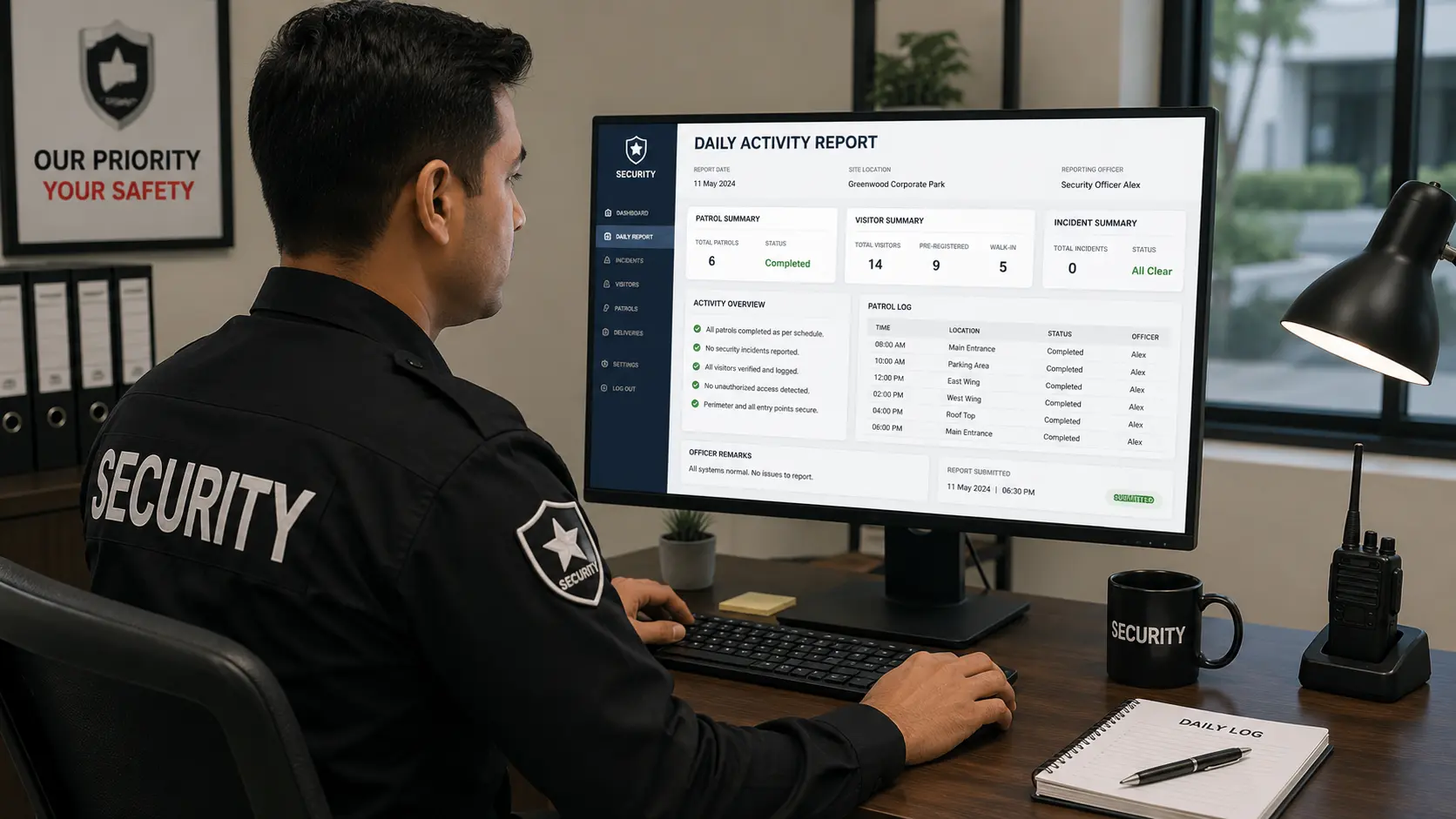
A single missed detail in a shift report can leave a property manager guessing about what actually happened overnight, whether a door was left unlocked, or why a vendor was on-site after hours. Good documentation closes that gap. The Security Guard Daily Activity Report (DAR) is the tool that turns a shift full of patrols, observations, and interactions into a clear, reviewable record. It tells clients and supervisors what was checked, what was found, and what was done about it. This guide walks through what a DAR should include, how to write one well, and what separates a report that’s actually useful from one that fills space.
What Is a Security Guard Daily Activity Report (DAR)?
A Security Guard Daily Activity Report (DAR) is a written or digital record that a security officer completes to document what happened during a shift. It’s typically filled out by the officer assigned to a post or patrol route, either continuously throughout the shift or at set intervals, and finalised before the officer clocks out.
A DAR generally captures patrol activity, visitor and vendor traffic, property conditions, safety concerns, communications with clients or supervisors, and any actions the officer took in response to something they observed. Supervisors, account managers, and sometimes the client themselves may review these reports to understand how a site was covered.
Requirements for DARs vary by company, contract, and jurisdiction, so it’s worth noting that not every property or assignment will have identical documentation standards. For California security operations, requirements can also depend on the applicable regulations and licensing rules administered by the California Bureau of Security and Investigative Services (BSIS). What stays consistent is the underlying purpose: an accurate, factual account of the shift that someone who wasn’t there can read and understand.
Why Are Security Daily Activity Reports Important?
A daily activity report isn’t paperwork for its own sake; it serves a different, practical purpose for everyone who touches it.
For Clients
Clients are paying for coverage they usually can’t observe directly. A well-written DAR gives them visibility into what their contracted security team actually did during a shift, from patrol frequency to how issues were handled.
For Security Officers
Officers benefit from a habit of clear documentation because it protects them. If a question comes up later about a specific time or event, an accurate report is the officer’s own record of what occurred and how they responded.
For Supervisors
Supervisors use DARs to spot patterns a door that keeps getting left unlocked, a lighting issue that hasn’t been fixed, a recurring visitor complaint that might not be obvious from a single shift.
For Security Companies
Consistent reporting supports communication between shifts, reinforces accountability across the account, and reflects directly on the quality of service a company provides to its clients.
What Should a Security Guard Daily Activity Report Include?
A useful DAR isn’t just a list of boxes to check; each section exists to answer a specific question a reader might have later.
Site and Shift Information
Every report should start with the basics: client or property name, site location, officer name, post assignment, date, shift, start and end time, and supervising officer if applicable. This context is what makes the rest of the report searchable and verifiable later.
Patrol and Post Activity
This section documents when patrols occurred and what was actually checked: entrances, exits, parking areas, the building perimeter, stairwells, and any restricted or high-value areas. Recording patrol times with specific checkpoints shows that coverage happened as scheduled, not just that a shift was worked.
Visitor, Vendor and Access Activity
Officers should log visitors, contractors, delivery personnel, and vendors who accessed the property, along with anything unusual about access: a badge that didn’t work, a person who couldn’t produce ID, or an attempt to enter a restricted area. This creates a record of who was on-site and when.
Safety, Maintenance and Property Conditions
Officers regularly notice things that aren’t security incidents but still matter to the property: a burned-out light in the parking lot, a propped-open door, damaged fencing, a blocked fire exit, or a water leak near an electrical panel. Documenting these conditions, even minor ones, helps the client address problems before they become bigger issues.
Unusual Activity and Incidents
Not every incident needs a full write-up in the DAR itself. When something significant happens a theft, an altercation, an injury most companies require a separate incident report. The DAR can still reference that the incident occurred and point to the incident report for full details, keeping the shift record complete without duplicating everything.
Actions Taken and Notifications
This is often the weakest part of a poorly written report. A useful entry answers four questions: What happened? What did the officer do? Who was notified? What happened afterwards? Skipping any of these leaves a gap that someone reading the report later has to guess about.
End-of-Shift Information
The report should close with anything the next shift needs to know: unresolved issues, follow-up items, equipment problems, or ongoing situations. This section is what makes shift handoffs actually work.
How to Write a Security Guard Daily Activity Report
A simple formula makes report writing more consistent: TIME + LOCATION + OBSERVATION + ACTION + NOTIFICATION + OUTCOME.
Start with the exact time. Name the specific location rather than a general area. Describe only what was observed facts, not interpretations. State what the officer did in response. Note who was told, if anyone. Close with the result, even if the result is “no further action required.”
- Example 1: Poor: “Checked the parking lot. Everything was fine.”Better: “9:45 PM Patrolled the east and west parking lots. All vehicles accounted for, no broken glass or damage observed, exterior lighting fully operational. No further action needed.”
- Example 2: Poor: “Suspicious person near back door.”Better: “11:20 PM Observed an unidentified individual standing near the rear loading dock door for approximately five minutes. Approached and asked if they needed assistance; individual stated they were waiting for a rideshare pickup and left the property at 11:26 PM. No attempt to access the building was observed. Logged for reference.”
The second example is stronger because it sticks to what was observed and done, rather than assuming the person’s intent. Writing this way takes practice, but the habit is straightforward: use specific times and locations, describe only what can be seen or heard, record the response, note any notifications made, and leave speculation out of it.
Security Guard Daily Activity Report Examples
Different assignments call for different kinds of detail. Here’s how a DAR might look across four common security roles.
Commercial Property DAR Example
7:00 PM Shift start. Reviewed pass-down notes from day shift, no outstanding issues. 7:30 PM Exterior patrol of building perimeter and main parking structure. All entrances secured, no lighting issues. 8:15 PM Greeted cleaning crew (3 personnel) at east entrance, verified against approved vendor list, logged entry. 9:50 PM Noted a dripping pipe near the second-floor restroom; property management notified via email with photo attached. 11:00 PM Lobby doors locked per standard closing procedure. 6:45 AM End-of-shift summary: cleaning crew departed 10:40 PM, restroom leak still pending maintenance follow-up, no other incidents. Shift ended without further issues.
Mobile Patrol DAR Example
Mobile Patrol reporting works a little differently than a fixed post, since one officer may be responsible for inspecting several properties during a single route rather than staying at one location.
10:00 PM Arrived at Property A (Maple Ridge Business Park). Inspected exterior; all gates locked, no signs of forced entry. Departed at 10:20 PM. 10:45 PM Arrived at Property B (Sunrise Retail Centre). Checked rear delivery doors and dumpster enclosure, both secure. Noted one parking lot light out near unit 14; reported to property manager. Departed 11:05 PM. 11:30 PM Arrived at Property C (Harbour View Storage). Full perimeter check completed, checkpoints scanned, no irregularities. Departed 11:50 PM. Route completed at 12:10 AM with no unresolved issues except the lighting outage noted at Property B.
Event Security DAR Example
Event Security assignments generate a different kind of activity log, since the officer is typically monitoring crowd flow, access points, and vendor movement rather than conducting a standard patrol.
4:00 PM Arrived on-site for event setup, coordinated entrance placement with event coordinator. 5:30 PM Gates opened, began checking tickets and bags at main entrance. Steady, orderly entry flow. <br> 7:15 PM Crowd density near main stage moderate, no access issues reported. 8:40 PM Assisted guest in locating lost item (wallet) reported near concession area; item returned to owner after verification. 9:50 PM Vendor breakdown began at west tent; verified vendor credentials before allowing equipment removal. 10:30 PM Event concluded, gates closed, final perimeter sweep completed, no items or persons remaining on-site.
Armed Security DAR Example
For armed assignments, the DAR should focus on professional documentation of the post, not tactical or procedural detail.
6:00 PM Shift start at designated post, verified post orders and equipment on hand. 6:15 PM Reviewed access control log with outgoing officer, no discrepancies noted. 8:00 PM Monitored primary entrance, verified credentials for all personnel entering restricted area. 9:30 PM Communicated with dispatch to confirm routine check-in; no issues to report. 11:00 PM Conducted scheduled interior walkthrough of restricted zones per post orders; all areas secure. End of shift: Post orders followed throughout shift; no incidents, equipment accounted for and turned over to relieving officer.
Good vs. Poor Security Report Examples
Routine Patrol
Poor: “Checked the building. No issues.”
Better: “1:15 AM Interior patrol of floors 1–3 completed. All doors locked, no alarms active, lighting normal throughout.” This version tells the reader exactly what was checked and confirms the result, rather than asking them to take “no issues” on faith.
Suspicious Activity
Poor: “Weird guy hanging around the entrance.”
Better: “2:40 AM Individual observed standing near the front entrance for approximately 10 minutes. Made contact; individual left the area without incident at 2:52 AM.” This sticks to observable behaviour and documents the resolution instead of a subjective label.
Property/Maintenance Issue
Poor: “Something wrong with the fence.”
Better: “6:20 PM Noted a 4-foot section of perimeter fencing near the north lot bent and separated from the post. Photographed and reported to property manager via phone at 6:25 PM.” Specific location and follow-up action make this entry actionable.
Security Guard DAR Best Practices
Document Activity as It Happens
Writing entries throughout the shift, rather than trying to reconstruct everything at the end, generally produces more accurate and detailed reports.
Use Objective Language
Stick to what was seen, heard, or done. Save interpretation and assumptions for a supervisor or investigator to draw, not the report itself.
Be Specific About Locations
“West loading dock” tells a reader something useful. “Back area” doesn’t. Specific locations make a report usable later, even by someone unfamiliar with the property.
Record Actions Taken
An observation without a response can leave a reader wondering whether anything was done. Documenting the action closes that loop.
Record Notifications
When a client, supervisor, or another party was contacted, note who and when. This detail matters most during follow-up questions weeks after the shift.
Document Routine Activity
A report that only mentions problems can make it look like nothing else happened during the shift. Logging routine patrols and checks shows the coverage that was actually provided.
Record Unresolved Issues
Anything still pending at the end of a shift a maintenance request, a lingering access concern should be flagged clearly so the next officer or supervisor knows to follow up.
DAR vs. Security Incident Report: What’s the Difference?
| DAR | Incident Report |
| Covers overall shift activity | Focuses on a particular event |
| Includes routine activity | Provides detailed incident information |
| Usually chronological | Usually event-focused |
| Completed regularly | Completed when circumstances require it |
| May reference an incident | Documents the incident in greater detail |
In practice, both documents often work together. A DAR might note that an incident occurred at a specific time and point to the incident report for the full account, while the incident report captures the detailed statements, evidence, and timeline that a routine shift log isn’t built to hold. Depending on company procedure and the nature of the event, both may be required for the same shift.
Common Security Guard DAR Mistakes to Avoid
- Vague descriptions: “Checked the area” doesn’t say what was actually reviewed. Name the specific location and what was found.
- Missing timestamps: Without a time, an entry is hard to verify or sequence against other events. Log the time for every entry.
- Missing locations: A report full of general references loses value fast. Be specific every time.
- Opinions or assumptions: Stating what someone “was probably doing” undermines the report’s reliability. Stick to what was observed.
- Failing to document action taken: An observation alone leaves the reader guessing what happened next. Always note the response.
- Ignoring minor property conditions: Small issues like a flickering light can become bigger problems if left unreported.
- Writing the entire report from memory: Waiting until the end of a shift to write everything down increases the risk of errors and omissions.
- Copying identical entries from previous shifts: Reusing old language, even for routine checks, makes a report look unreliable and can miss real changes on the property.
Paper vs. Digital Security Daily Activity Reports
Paper DARs are simple and familiar, requiring no equipment beyond a pen and a form. They’re stored physically and reviewed manually, though they offer limited ability to attach photos or other supporting material.
Digital DARs allow officers to log entries from a mobile device in real time, creating searchable, time-stamped records. Photos can typically be attached directly to an entry, and authorised reviewers can access reports faster than digging through physical files.
Neither format is inherently right for every operation; the best choice depends on the property, the client’s needs, and the security company’s existing systems and procedures.
Frequently Asked Questions About Security Guard Daily Activity Reports
What is a Security Guard Daily Activity Report?
It’s a shift-by-shift record of a security officer’s patrols, observations, visitor activity, and any actions taken, typically completed during or at the end of a shift.
What should be included in a security DAR?
Site and shift details, patrol activity, visitor and vendor information, property conditions, any notable incidents, actions taken, notifications made, and end-of-shift notes for the next officer.
How do you write a good security guard activity report?
Use the TIME + LOCATION + OBSERVATION + ACTION + NOTIFICATION + OUTCOME format, stay factual, and log entries as the shift progresses rather than relying on memory at the end.
What is the difference between a DAR and an incident report?
A DAR covers the full shift, including routine activity. An incident report focuses specifically on a single significant event and typically includes more detail.
Should routine patrols be included in a DAR?
Yes. Logging routine checks, not just problems, gives an accurate picture of the coverage actually provided during the shift.
Can Mobile Patrol officers use daily activity reports?
Yes. Mobile Patrol reports typically document each property visited on a route, including arrival and departure times and what was inspected at each stop.
Should Event Security officers complete DARs?
Yes. Event Security reports usually track entrance activity, crowd conditions, vendor access, and any issues that come up before, during, and after the event.
How Professional Security Reporting Supports Better Security Services
Consistent, well-written reporting is one of the clearest signs of a security operation that’s actually functioning the way it should. It gives clients real visibility into patrol activity, property conditions, access issues, and how incidents were handled, along with the follow-up items that carry over between shifts.
Security Base Group builds accountable reporting into how its officers operate, so clients aren’t left wondering what happened during coverage they can’t personally observe.
Need professional security services with clear communication and accountable reporting? Contact Security Base Group to discuss your property’s security requirements.
Need Reliable Security Services for Your Property or Event?
Security Base Group provides professional security solutions tailored to the needs of businesses, properties, events, and other clients. Contact us to discuss your security requirements and determine the right level of protection for your location.


