
Security Guard Incident Report: Examples & Best Practices
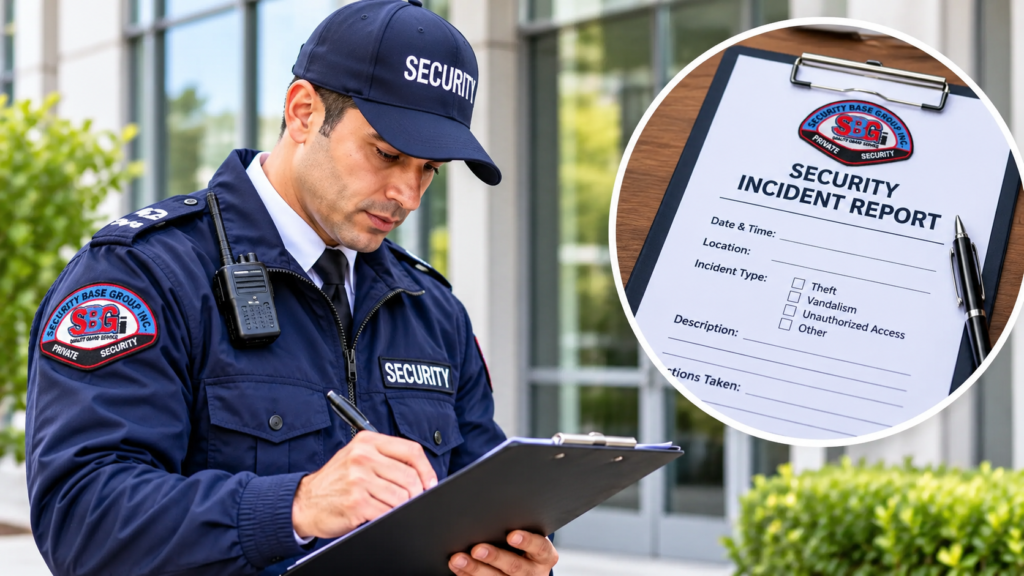
At 11:40 p.m., a guard on a routine patrol finds a glass entrance door cracked and the lobby floor littered with shards. Nobody is in sight, and the overnight camera angle doesn’t cover that door. By morning, the property manager, the security supervisor, and possibly an insurance adjuster will all want to know what the guard saw, when, and what happened next.
A well-written security guard incident report answers those questions without guesswork. It turns a stressful moment into a clear record that others can act on. This guide explains what an incident report is, what it should include, how to write one step by step, and where reports commonly go wrong. It also includes four sample reports you can adapt.
What Is a Security Guard Incident Report?
A security guard incident report is a written record of a specific event that needs attention, investigation, or follow-up. The guard who witnessed, discovered, or responded to the event prepares it, usually before the end of the shift or as soon as the situation is safe.
Typical incidents worth documenting include:
- Unauthorized entry or trespassing
- Property damage, theft, or vandalism
- Verbal or physical disturbances
- Suspicious activity
- Medical emergencies and injuries
- Fire alarms, water leaks, or safety hazards
- Policy violations and access-control failures
An incident report is different from a routine shift log. A daily activity report covers the whole shift: patrols, checks, and general observations. An incident report zooms in on one event and records it in detail.
Above all, an incident report is factual. It records what the guard saw, heard, and did. It does not include assumptions, accusations, or personal opinions. California’s Bureau of Security and Investigative Services (BSIS) includes observation and report writing in its Powers to Arrest training for security guards, and its guidance describes the guard’s role during and after an incident as observing and reporting.
Why Are Security Guard Incident Reports Important?
Good documentation does more than satisfy a procedure.
It helps in several practical ways:
- Creates an accurate record: Memory fades quickly. A report written close to the event preserves details that matter later.
- Supports communication: Guards, supervisors, and clients all work from the same facts.
- Reveals patterns: One broken gate latch is a maintenance item. Six reports about the same latch point to a larger problem.
- Documents damage and violations: Clear records support insurance claims, lease enforcement, and internal reviews.
- Supports follow-up: Investigators and managers can see what was done, by whom, and when.
- Improves accountability: Consistent reporting shows that procedures are being followed.
Example: A property manager notices that three separate reports over two weeks describe the same thing: a delivery door at the rear of a building propped open between 9 and 10 p.m. Each report lists the time, the location, and who was notified. Because the details were consistent, the manager traced the pattern to an evening cleaning crew and fixed it with a door alarm and a revised procedure. No single report revealed the problem. Together, they did.
What Information Should a Security Guard Incident Report Include?
Formats vary by company and site, but a strong report generally covers these items:
- Date and time of the incident: the time it was discovered, if different.
- Exact location: such as “north stairwell, second floor” rather than “the building.”
- Reporting guard’s name and identification: including post or badge details used by the company.
- Type of incident: such as trespass, property damage, medical, or disturbance.
- People involved: where known and appropriate, with descriptions if names are unavailable.
- A factual description: what happened, in chronological order.
- Actions taken: by the guard, including any instructions given.
- Witness details and statements: with contact information if the employer’s procedures allow.
- Evidence: such as photographs, video references, or physical items, handled per company policy.
- Notifications: including the supervisor, client contact, and any emergency services.
- Follow-up actions: the time the report was submitted.
Chronological order matters because readers need to understand the sequence of events. Completeness matters because a missing time or location can make a report hard to rely on. Accuracy matters most because everything else depends on it.
Security Guard Incident Report Examples
The following samples are illustrative only. They are not actual Security Base Group client incidents, and every name, address, and detail is invented.
Example 1: Unauthorized Entry
Incident type: Attempted unauthorized entry
Date/time: 03/14, 9:52 p.m.
Location: Rear service entrance, 400 Example Plaza
At 9:52 p.m., while on foot patrol, I observed an adult male in a gray jacket pulling on the locked rear service door. I identified myself and asked if he needed assistance. He stated he was looking for a friend who worked in the building. I explained the building was closed and asked him to leave the property. He walked toward the street at 9:56 p.m. I notified Supervisor Lopez by phone at 9:58 p.m. and completed a perimeter check. All other doors were secure. No damage was observed.
Notice what the guard includes: the exact times, observed behavior, the person’s own statement, the response, and the supervisor notification. There is no guess about the man’s intent.
Example 2: Property Damage
Incident type: Property damage discovered
Date/time discovered: 05/02, 6:15 a.m.
Location: Main lobby entrance, east door
At 6:15 a.m., during the opening patrol, I found the lower glass panel of the east lobby door cracked from corner to corner, with glass fragments on the floor inside. The door was closed and locked. I did not see anyone in the area. I photographed the damage from three angles at 6:20 a.m., placed caution signage, and notified the property manager at 6:30 a.m. The last documented patrol of this door was at 2:10 a.m., when no damage was noted.
The report states when the damage was discovered and when the door was last checked. It does not say who caused it or how.
Example 3: Verbal Conflict
Incident type: Workplace disturbance
Date/time: 07/21, 1:05 p.m.
Location: Third-floor corridor
At 1:05 p.m., I heard raised voices near Suite 310 and found two adults, one male and one female, arguing about a parking assignment. Both were speaking loudly. There was no physical contact. I asked both to lower their voices and speak with the property manager. Both agreed. One bystander, a tenant from Suite 312, stated the argument began about five minutes earlier. At 1:12 p.m., the disagreement ended. I notified my supervisor at 1:14 p.m. Additional assistance was not requested.
The guard records observable behavior and the witness statement, and notes whether backup was needed.
Example 4: Suspicious Vehicle Activity
Incident type: Suspicious activity
Date/time: 09/09, 8:30–9:45 p.m.
Location: North parking lot
At 8:30 p.m., I observed a dark sedan enter the north lot, circle once, and exit. The same vehicle returned at 8:55 p.m. and 9:20 p.m., each time driving slowly through the lot without parking. At 9:45 p.m., the vehicle returned and parked near the east fence. The driver remained inside. I recorded the plate and vehicle description and did not approach. I notified Supervisor Chen at 9:48 p.m. The vehicle left at 10:02 p.m.
The report lists what was seen and when. It does not claim criminal intent, which the guard could not know.
How to Write a Security Guard Incident Report Step by Step
Follow your post orders, employer procedures, and applicable emergency protocols. In general, the process looks like this:
- Secure the scene and follow emergency procedures: Safety comes before paperwork.
- Notify your supervisor or emergency services: the situation calls for it.
- Record the date, time, and location: right away, ideally in your notes.
- Write events in chronological order: from first observation to resolution.
- Describe only what you observed or were reliably told: Attribute statements to the person who made them.
- Record your actions and notifications: This includes who you contacted and when.
- Add witness information and supporting evidence: photographs or reference numbers.
- Review the report before submitting: Check times, spelling, names, and whether anything is missing.
Best Practices for Writing Accurate Security Incident Reports
- Use neutral, professional language: Avoid slang and emotional wording.
- Stick to facts: Leave out assumptions about motives or character.
- Be precise: Use exact times and specific locations.
- Separate observation from hearsay: Write “Mr. Diaz stated he saw…” rather than presenting it as your own observation.
- Include relevant details only: Thorough does not mean padded.
- Correct errors properly: Use your company’s approved process for amendments rather than erasing or overwriting.
- Submit promptly: company policy.
- Protect confidential and personal information: share reports only with authorized recipients.
- Follow evidence-handling procedures: keep records according to company policy.
Vague vs. professional:
|
Vague |
Professional |
| “A suspicious guy was hanging around.” |
“At 10:15 p.m., an adult male in a red hooded sweatshirt stood near the loading dock for approximately 10 minutes without entering.” |
|
“The door was broken.” |
“The east door’s lower glass panel was cracked across its full width.” |
| “He got aggressive.” |
“He raised his voice and pointed at the other person but made no physical contact.” |
Common Security Incident Reporting Mistakes to Avoid
- Delaying submission: Details fade, and decisions get postponed.
- Leaving out key details: Missing times or locations weaken the whole report.
- Using vague descriptions: “Several people” or “a while” cannot be verified.
- Assuming motives: Guessing about intent can mislead readers and create problems later.
- Recording inaccurate times: Even small errors can undermine credibility.
- Omitting witnesses: A witness statement can confirm or clarify events.
- Skipping the notification record: Readers need to know who was informed and when.
- Including opinions: Opinions distract from facts.
- Forgetting photos or supporting records: Visual evidence often settles questions that text cannot.
Security Incident Report vs. Daily Activity Report (DAR)
The two reports serve different purposes. An incident report documents one specific event that requires attention, investigation, or follow-up. A Daily Activity Report records routine shift activity: patrols, checks, visitors, and general observations.
They work best together. The DAR provides context, such as showing that a door was secure at 2:10 a.m. The incident report provides the details of what was found later. A DAR entry often points to an incident report, and an incident report is usually easier to understand when read alongside the shift record. For a closer look at the routine side of documentation, see our guide to security guard daily activity report (DAR) examples and best practices.
How Property Managers Can Improve Security Incident Reporting
Property managers and security providers can raise the quality of reporting in a few ways:
- Set clear expectations: what must be reported and how quickly.
- Use a standardized incident report format: every report covers the same fields.
- Train and supervise guards: on report writing, with feedback on real reports.
- Keep communication timely: so serious incidents reach the right people the same day.
- Review reports regularly: not only after something goes wrong.
- Follow up on recurring incidents: record what was changed.
- Keep documentation consistent: across shifts and sites.
Example: A manager reviewing a month of reports notices that four incidents involve the same side gate: twice it was found unlatched, once a visitor entered without signing in, and once a vehicle followed another through. No individual report seemed urgent, but together they show an access-control weakness. The manager has the latch repaired, adds a sign-in reminder, and asks guards to note the gate’s condition on each patrol.
Frequently Asked Questions About Security Guard Incident Reports
1. What is a security guard incident report?
It is a written, factual record of a specific event that requires attention or follow-up, prepared by the guard who witnessed or responded to it.
2. What should be included in a security guard incident report?
Include the date, time, location, guard’s name, incident type, people involved, a chronological description, actions taken, witnesses, evidence, notifications, and follow-up.
3. How do you write a professional security incident report?
Record events in order, use neutral language, include only observed or reliably reported facts, note actions and notifications, and review before submitting.
4. When should a security guard complete an incident report?
Once the situation is safe, and promptly, following the company’s policy and post orders. Safety and emergency response come first.
5. What are some examples of security guard incidents?
Unauthorized entry, property damage, verbal disputes, suspicious activity, medical emergencies, alarms, hazards, and policy violations.
6. What is the difference between an incident report and a daily activity report?
An incident report details one event. A daily activity report summarizes routine activity across a shift.
7. Why is accurate incident documentation important?
It gives clients, supervisors, and investigators a reliable record, supports follow-up, and helps identify recurring problems.
8. Can a security guard include witness statements in an incident report?
Yes, when appropriate. Record who said what, attribute statements clearly, and follow company procedures on contact information.
9. Should security guards include photographs or other evidence?
When relevant and permitted, yes. Photos and references to recordings support the written account. Follow evidence-handling procedures.
10. Who reviews a security guard incident report?
Typically a security supervisor first, then the client or property manager. Others, such as insurers or investigators, may review it as needed.
Improve Security Operations with Professional Security Reporting
Accurate incident reporting is one part of effective security operations. It works best when trained personnel, clear procedures, active supervision, and open communication support it. Reports are only useful when they are factual, timely, and read.
Security Base Group is a California security services provider. Property managers and businesses that want to discuss their security needs can contact Security Base Group at 844-999-9928 or visit securitybasegroup.com to discuss professional security services.
This article is for general informational purposes and is not legal advice. Reporting requirements and procedures vary by employer, client, and site. Check your post orders and applicable regulations, including guidance from the California Bureau of Security and Investigative Services (BSIS).
 Previous Post


