
Event Security Post Orders: How to Write Clear & Effective Post Orders for Events
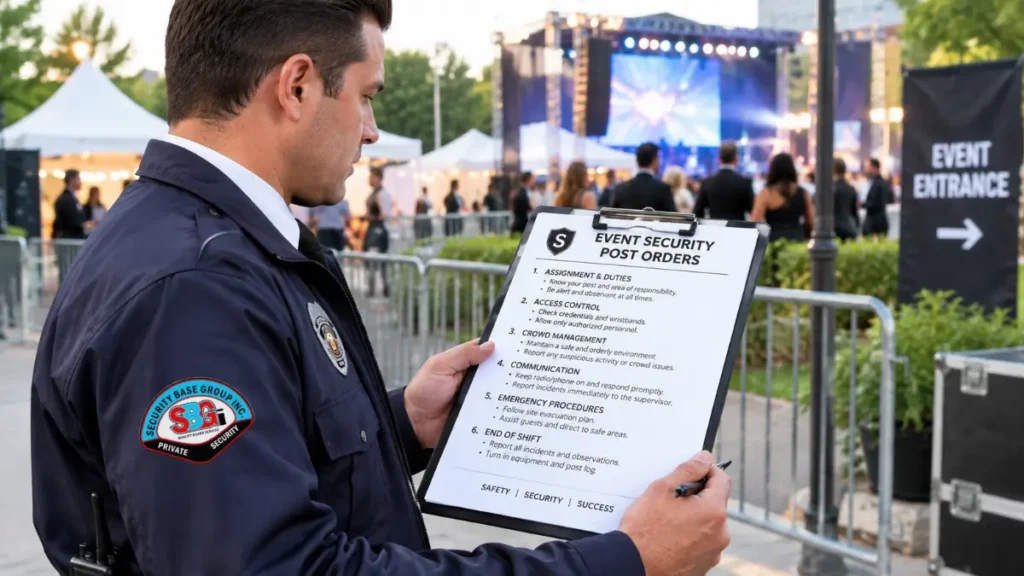
A guard arrives at a sold-out concert and is told to “watch the east gate.” Nobody explains who is allowed through, where to send ticket problems, or who to call when the line starts bunching up near the street. Within an hour, the guard is improvising, and so is everyone around them.
Clear event security post orders prevent that kind of guesswork. They are written instructions that tell each guard what a post is for, what to do, what to avoid, and who to contact when conditions change. This guide explains what event security post orders are, how they differ from routine instructions, what to include, and how to write them in plain language. You will also find good-versus-poor examples, sample instructions for six common guard positions, and two templates you can adapt.
What Are Event Security Post Orders and Why Do They Matter?
Event security post orders are written, post-specific instructions for the guards working an event. A security policy describes how a company or venue approaches security in general. Post orders translate that into daily duties: stand here, check this, report that, call this person.
Well-written orders support five things:
- Clear responsibilities: Each guard knows what the post covers and where it ends.
- Access control: Guards know who may enter, what credentials are valid, and which areas are restricted.
- Communication and reporting: Guards know how to reach a supervisor or event control, and what belongs in an incident report.
- Coordination: Guards, supervisors, and event control work from the same plan.
- Consistent responses: Foreseeable situations, like a lost credential or a blocked exit, get handled the same way by every guard.
A quick example: Vague: “Keep the backstage door secure.” Clear: “Admit only people wearing a green Crew wristband and a photo ID badge. Keep the door closed between entries. If someone without a credential insists on entry, ask them to wait and radio the Backstage Supervisor.”The second version tells the guard what to check, what to do, and who to call.
Regular Security Post Orders vs. Event Security Post Orders
Routine post orders usually cover a fixed location with stable routines. Event post orders cover a temporary environment where crowds, schedules, and layouts change within hours.
|
Factor |
Regular Post Orders | Event Post Orders |
| Location | Stable, familiar site |
Temporary or changing layout |
|
Main activity |
Routine patrols, access checks | Crowd monitoring, queue management |
|
Schedule |
Normal operating hours | Event timeline, load-in, doors, load-out, shift changes |
|
Access control |
Permanent entry points | Temporary gates, credential zones, restricted areas |
|
Reporting |
Internal supervisor or client |
Event control, medical teams, emergency responders |
Because of these differences, orders should reflect the specific venue, event type, expected crowd, and identified risks. A wedding reception, a music festival, and a corporate conference each need different instructions, even in the same building. Copying orders from another event is rarely a good shortcut.
Essential Sections Every Event Security Post Order Should Include
A practical event security post order covers the following, and each element serves a purpose.
- Event name, date, venue, hours, and assigned post: Guards need to know exactly where and when they are responsible. It also prevents confusion when several events or shifts overlap.
- Post objective and responsibilities: A one-sentence purpose, such as “control entry to the VIP lounge,” helps guards make sensible decisions in situations the orders did not predict.
- Venue maps, entry points, exits, and restricted areas: Guards can’t direct people or respond to emergencies if they don’t know the layout.
- Credential verification and access-control procedures: Specify which credentials are valid and what to do when one is missing or questionable.
- Communication methods, contacts, and chain of command: Include radio channels, phone numbers, and who to call first. Time is wasted when guards must guess.
- Emergency procedures and escalation requirements: Refer guards to the event’s approved emergency action plan and state which situations require immediate notification of event control, medical staff, or emergency services.
- Equipment and patrol requirements: List radios, flashlights, wristband scanners, vests, or other approved gear, plus patrol routes and timing.
- Incident logs, shift handovers, and reporting expectations: Accurate records support follow-up, and handovers keep the next guard informed.
- Guard authority, restrictions, approval, and version: State what guards may and may not do, who approved the orders, and the version date, so everyone works from the current document.
How to Write Clear, Actionable Event Security Post Orders
Follow this process when learning how to write event security post orders from scratch.
- Review the venue, schedule, and risk assessment: Walk the site if possible. Note entrances, bottlenecks, hazards, and the event timeline.
- Define each post’s objective and boundaries: Decide what the post covers and where neighboring posts take over, so responsibilities don’t overlap or leave gaps.
- Use action verbs and observable tasks: Write “check,” “record,” “radio,” and “direct” instead of “be aware” or “monitor.”
- Specify triggers, contacts, and escalation steps: Describe what counts as reportable and who receives the report.
- Coordinate with the organizer and supervisors: They know details that guards need, such as VIP arrival times and vendor access rules.
- Brief the guards and confirm understanding: Ask guards to explain their post back to you. Have them sign an acknowledgment.
- Review and update: When the schedule, layout, or risks change, revise the orders and brief everyone again.
Replacing vague phrases:
|
Vague |
Specific |
| “Watch the crowd.” |
“Scan your assigned section every few minutes. Radio the Stage Supervisor if people are pressed against the barrier, a person appears to be in distress, or a path to an exit is blocked.” |
|
“Keep the entrance secure.” |
“Check every guest’s ticket or credential before entry. Direct anyone without one to the Guest Services table and radio the Gate Supervisor if they refuse.” |
Good vs. Poor Event Security Post Orders: Practical Examples
Example 1: Credential verification
- Poor: “Make sure only authorized people go in.”
- Why it fails: It doesn’t say what “authorized” means or what to do when someone isn’t.
- Better: “Admit staff only with a lanyard badge and matching color wristband. Compare the badge photo to the person. If the badge doesn’t match or is missing, do not admit them. Ask them to wait to one side and radio the Gate Supervisor.”
- Escalation: Gate Supervisor for all credential disputes.
Example 2: Suspicious activity or safety hazards
- Poor: “Report anything suspicious.”
- Why it fails: Guards are left to decide what counts, and no contact is given.
- Better: “Report unattended bags, people trying to access closed areas, spills, damaged barriers, or tripping hazards. Do not touch unattended items. Keep people at a safe distance if you can do so without leaving your post. Radio event control with your location and a brief description.
- Escalation: Event control first. If there is immediate danger, follow the emergency action plan and notify emergency services as directed.
Example 3: Overcrowding or blocked access routes
- Poor: “Don’t let it get too crowded.”
- Why it fails: It sets no measurable trigger and may push guards to make decisions outside their authority.
- Better: “Keep fire lanes and exit paths clear. If a path is blocked or the crowd stops moving freely, politely ask people to move and radio your supervisor immediately. Do not close entrances or change capacity limits unless directed by event control.”
- Escalation: Supervisor, then event control, who decide on crowd-flow changes.
Event Security Post Orders Examples for Different Guard Positions
These samples show how event security guard duties differ by position. Adjust them to your venue.
1. Entrance and Gate Security Post Orders
Check each ticket or credential, keep the line moving, and keep restricted lanes closed. Refer any entry dispute to the Gate Supervisor rather than arguing at the gate.
Sample: “Scan every ticket before entry. Keep the VIP lane closed unless the supervisor opens it. If a ticket will not scan twice, send the guest to the box office window and log the time.”
2. Stage Security and Crowd Control Post Orders
Watch crowd movement near the stage, keep barrier lines and emergency access routes clear, and report developing safety concerns early.
Sample: “Keep the stage-left access lane clear at all times. Radio the Stage Supervisor if the front section becomes compressed, if guests climb barriers, or if anyone appears faint or distressed.”
3. VIP Area Security Post Orders
Allow only people on the approved access list or wearing the designated credential. Keep reports discreet and coordinate with supervisors.
Sample: “Admit guests with a gold wristband only. Do not discuss attendees or arrival times with anyone. If an unlisted person asks for entry, take no names aloud and call the VIP Supervisor.”
4. Event Parking Security Post Orders
Make sure vehicles use designated zones, keep emergency lanes open, and work with authorized traffic personnel.
Sample: “Do not allow parking in the marked fire lane. Report blocked lanes or vehicles that remain unusually long in restricted zones to event control. Follow instructions from authorized traffic staff for vehicle direction.”
5. Roaming Patrol Security Post Orders
Cover your assigned zone on a set schedule, document what you find, and stay in contact with event control.
Sample: “Walk Zone C every 30 minutes. Check that exit doors are unobstructed and restrooms are clear. Log time, location, and any hazard. Radio event control if you must leave the zone.”
6. Bag Check and Screening Post Orders
Apply approved screening steps the same way for every guest. Use the posted prohibited-item list. Send disputes to the designated supervisor.
Sample: “Ask guests to open bags for inspection. Follow the posted prohibited-items list. If a guest refuses or argues, do not escalate. Ask them to step aside and call the Screening Supervisor.”
Best Practices and Common Mistakes to Avoid
Best Practices for Effective Event Security Post Orders
- Use plain language: Short sentences are easier to follow in a noisy, busy setting.
- Make orders role-specific: A gate guard and a parking guard need different instructions.
- Keep maps current: Check that the layout reflects the final setup, not an earlier draft.
- Verify contact details: Test radio channels and confirm phone numbers before the event.
- Brief guards and get acknowledgment: A signature shows guards received and understood their orders.
- Protect sensitive details: Share deployment plans only with those who need them.
- Review after incidents and changes: Update the orders after any significant event or plan change.
Common Mistakes in Event Security Post Orders
- Vague instructions: Prevent them by using observable actions and clear triggers.
- Overlapping responsibilities: Define post boundaries and name the handoff point.
- Missing emergency contacts: Put contacts on the first page of each post’s orders.
- Outdated information: Add a version date and withdraw old copies.
- Instructions copied from unrelated venues: Start from the current venue’s layout and risks.
- Unclear escalation: Name the person to contact and the order of contacts.
- Responsibilities beyond a guard’s authority: Check each instruction against training, legal limits, and approved procedures.
Simple Event Security Post Orders Templates You Can Adapt
Customize these templates to fit your venue’s risk assessment, event plan, applicable requirements, and approved emergency procedures. They are starting points, not legal advice.
Basic Event Security Post Orders Template
EVENT SECURITY POST ORDERS
Event name/venue: ____________________
Date: ____________ Shift hours: ____________
Assigned post: ____________ Guard name: ____________
Supervisor: ____________ Phone/radio: ____________
Event control contact: ____________
PRIMARY DUTIES
- ____________________
- ____________________
- ____________________
ACCESS-CONTROL RULES
Valid credentials: ____________________
Restricted areas: ____________________
If credential is missing or disputed: ____________________
COMMUNICATION
Radio channel: ____________
Check-in schedule: ____________
Chain of command: ____________________
EMERGENCY PLAN REFERENCE
Emergency action plan location: ____________________
Immediate notification contacts: ____________________
DOCUMENTATION AND HANDOVER
Incident log location: ____________________
Shift handover procedure: ____________________
RESTRICTIONS
Guards must not: ____________________
Approved by: ____________ Version date: ____________
Guard acknowledgment (name/signature/date): ____________
Role-Specific Event Security Post Orders Template
ROLE-SPECIFIC POST ORDERS
Post name and location: ____________________
Post objective: ____________________
ROUTINE RESPONSIBILITIES
– ____________________
– ____________________
REQUIRED CHECKS AND TIMING
– Check: ____________ Frequency: ____________
– Check: ____________ Frequency: ____________
INCIDENT TRIGGERS
– ____________________
– ____________________
IMMEDIATE APPROVED ACTIONS
– ____________________
– ____________________
REPORTING AND ESCALATION
First contact: ____________ Second contact: ____________
Emergency contact: ____________
DOCUMENTATION REQUIREMENTS
Log: ____________________ Report due: ____________
AUTHORITY LIMITS AND SPECIAL INSTRUCTIONS
Guard may not: ____________________
Special notes: ____________________
Conclusion
Clear event security post orders give each guard role clarity, a reliable way to communicate, and a consistent response to common situations. They also make it easier for supervisors and event organizers to work from the same plan. Orders cannot guarantee safety, but they do improve operational readiness. Review them before deployment, brief every guard, and update them whenever the event plan changes. If you need professional support for an upcoming event, explore Security Base Group’s event security services in Los Angeles.
 Previous Post
 Next Post


