
Security Company Contract Renewal Checklist: 12 Performance Checks Property Managers Should Review
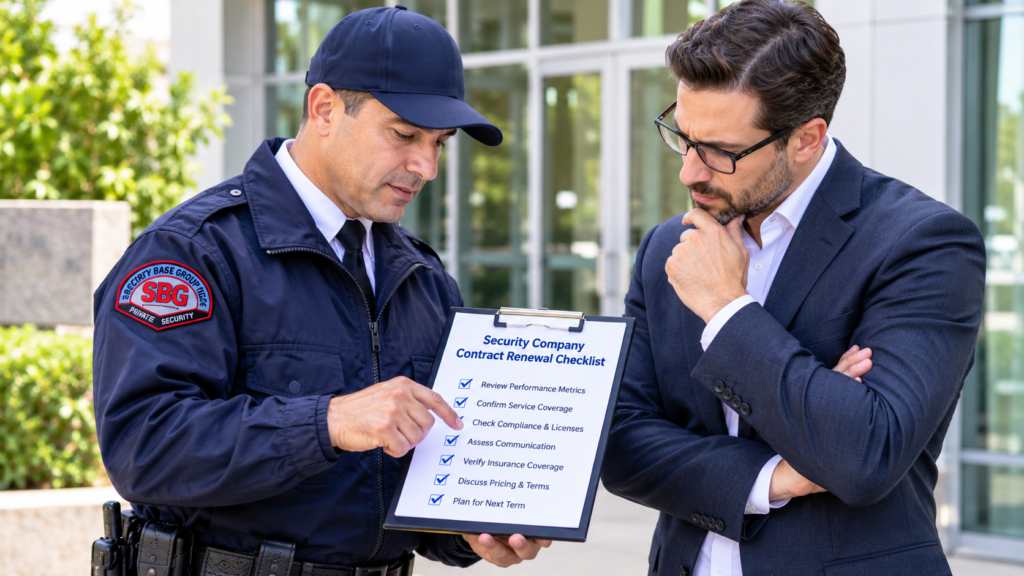
A security contract that quietly rolls over every year can hide many problems. Missed shifts, patrols that exist only on paper, thin incident reports, and a supervisor nobody has seen in months rarely show up until something goes wrong on your property.
Renewal is the one moment when you hold real leverage. Before you sign another term, compare what the contract promised with what the records show. This security company contract renewal checklist gives you 12 practical performance checks, the evidence to request for each, and a question to put to your current provider. Use it to decide whether to renew, renegotiate, or replace.
Why Property Managers Should Review Their Security Company Before Renewal
Most renewals happen by default because the guard on post seems fine and nothing dramatic has happened. But “nothing dramatic” is the same as “contract fulfilled.” A property can go months with unfilled shifts or skipped checkpoints and never register a loss, until the one night it does.
A structured security company performance evaluation replaces impressions with records, and it gives you something concrete to bring to the negotiating table.
Identifying Service Gaps and Unresolved Security Issues
Start with your own incident history. Look for repeat events at the same entrance, the same loading dock, or the same hour of the night. Repeat problems usually point to a gap in coverage, post orders, or follow-through rather than bad luck.
Evaluating Whether the Current Contract Delivers Value
Value is the gap between what you pay for and what you receive. Check billed hours against verified hours on post, and compare the scope you signed with what your property needs today. A building that added tenants, extended hours, or opened a new parking structure may have outgrown the original agreement.
12 Essential Security Company Performance Checks Before Contract Renewal
A good security vendor performance review relies on evidence, not verbal assurances. Ask for records covering at least the last six to twelve months, and request them in writing. Each check below covers what to evaluate, why it matters, what to request, and one question to ask.
1. Security Guard Attendance and Shift Coverage
Review how often posts were filled on time, how many shifts went uncovered, and how replacements were arranged. Coverage gaps leave a property exposed even when billing looks normal. Request timesheets and post-attendance logs.
Ask: “How many shifts last quarter were covered late or by a replacement, and why?”
2. Compliance With Contractual Duties and Post Orders
Compare written post orders against what officers actually do at entrances, restricted areas, and after-hours doors. Outdated orders cause inconsistent behavior. Request current post orders and the date they were last revised.
Ask: “When were our post orders last updated, and who approved the changes?”
3. Patrol Completion and Property Inspection Records
Check whether foot and vehicle patrols follow the agreed route and frequency. Timestamps and checkpoint scans show whether remote corners, stairwells, and garages are really being visited. Request patrol logs with checkpoint data.
Ask: “Which areas had the most missed checkpoints, and what changed afterward?”
4. Incident Reporting Accuracy and Documentation
Strong reports state who, what, when, where, and what action was taken. Vague or late reports weaken your position with insurers and tenants. Request a sample of daily activity reports and incident reports; our security guard daily activity report guide shows what good documentation looks like.
Ask: “How soon after an incident do you deliver the written report?”
5. Emergency Response and Escalation Procedures
Evaluate whether officers know who to call, in what order, and how quickly. Unclear escalation turns small problems into long ones. Request the written emergency procedures and any drill or after-action records.
Ask: “Walk me through what happens when an officer finds a break-in at 2 a.m.”
6. Access Control and Visitor Management
Look at how visitors are registered, how credentials are verified, and how restricted areas are protected. Lax access habits are a common source of tenant complaints. Request visitor logs and records of denied or escalated entries.
Ask: “How are unauthorized entry attempts documented and reported to us?”
7. Security Supervisor Inspections and Accountability
Supervision is what keeps standards from drifting. Check how often supervisors visit, at what hours, and what they do when they find a problem. Request supervisor visit logs and corrective-action notes.
Ask: “When was the last unannounced night-shift inspection of our site?”
8. Guard Training, Licensing and Professional Conduct
In California, security guards generally must hold a valid registration issued by the Bureau of Security and Investigative Services (BSIS), and BSIS states that guards must carry their registration card while on duty. Beyond that legal baseline, look at site-specific training and day-to-day conduct. Request proof of registration and training records.
Ask: “How are your officers trained on our property specifically?”
9. Communication With Property Management
Judge how fast and how clearly the provider communicates. Slow updates and unexplained schedule changes create extra work for your team. Request the contact list, escalation chain, and any response-time commitments in the contract.
Ask: “Who is my single point of contact, and what is the expected response time?”
10. Staff Turnover and Replacement Arrangements
Frequent officer changes mean lost site knowledge. Review how many different guards covered your post and how new officers are briefed. Request a roster history.
Ask: “How many officers have worked our post this year, and how are replacements oriented?”
11. Security Equipment and Reporting Technology
Radios, patrol-verification tools, and digital reporting systems only help if they work reliably. Check for outages, lost data, or paper logs that never reach you. Request a description of the reporting system and any downtime records.
Ask: “How do we access reports and patrol data, and how quickly?”
12. Contract Compliance and Overall Service Value
Finally, compare the contract line by line with actual delivery: hours, supervision, reporting, and any extra charges. Request invoices, change orders, and a service summary.
Ask: “Can you show me, item by item, what we were billed for versus what was delivered?”
How to Measure Security Company Performance Using a Vendor Scorecard
Turning the security company contract renewal checklist into numbers makes renewal conversations far easier. A scorecard also creates a record you can reuse year after year, which matters under any serious security contract management approach.
Key Performance Indicators Property Managers Should Track
Track a short list each month: percentage of shifts filled on time, patrol checkpoints completed, report turnaround time, supervisor visits, and open corrective actions.
Comparing Contracted Duties With Actual Service Delivery
Set the expected standard from your contract or your own policy, record the actual result, and mark each line. The figures below are illustrative examples for your own scorecard, not industry benchmarks or legal requirements.
|
Performance category |
Expected standard (example) | Actual result | Status |
| Shift coverage | All posts filled at start time | Record monthly |
Meets / Needs review / Fails |
|
Patrol completion |
All scheduled checkpoints scanned | Record monthly | Meets / Needs review / Fails |
| Report delivery | Reports sent by agreed deadline | Record monthly |
Meets / Needs review / Fails |
|
Supervisor visits |
Agreed number per month | Record monthly | Meets / Needs review / Fails |
Warning Signs Your Current Security Company May Be Underperforming
One bad week is not a pattern. Repetition is what separates a fixable hiccup from a performance problem, and repeated issues justify a formal review meeting with written follow-up.
Repeated Missed Shifts and Incomplete Patrols
Frequent late arrivals, unfilled posts, or patrol logs with gaps suggest staffing or supervision trouble. If you only learn about these from tenants, that is a warning in itself.
Poor Reporting and Delayed Communication
Reports that arrive late, lack detail, or never mention actions taken leave you unable to defend your decisions. Slow responses to your questions are another early indicator.
Recurring Security Problems Without Corrective Action
When the same incident repeats, and nothing changes in post orders, patrol routes, or staffing, the provider is documenting problems rather than solving them.
Documents to Review Before Renewing a Security Contract
Documents let you verify service delivery, regulatory compliance, and contract obligations without relying on anyone’s memory.
Daily Activity Reports and Incident Logs
Read a sample from different shifts and months. Look for consistent detail, accurate times, and evidence that issues were followed up.
Patrol Records, Attendance and Inspection Reports
Match these against the schedule in your contract. Gaps between what was promised and what was logged are the clearest sign of service shortfalls.
Licensing, Insurance and Contract Documentation
Ask for the company’s license information and a current certificate of insurance, and confirm both against the contract’s requirements. A guard’s individual registration does not by itself confirm the company’s licensing or insurance, so check each separately.
When to Renew, Renegotiate or Replace Your Security Company
Not every issue calls for a new vendor. Once you have worked through your security company contract renewal checklist, match your response to the pattern you found.
When Renewing the Existing Contract Makes Sense
Renew when records show reliable coverage, complete reporting, responsive management, and problems that were corrected quickly.
When to Renegotiate Coverage and Contract Terms
Renegotiate when service is mostly sound, but your needs have changed, or when specific gaps exist. Consider adding patrol checkpoints, supervisor visit minimums, reporting deadlines, or an adjusted staffing schedule.
When to Consider a New Security Provider
Look elsewhere when issues repeat after a formal review, corrective actions are not delivered, or the provider cannot document its performance. Give your current company a chance to respond in writing first.
Choosing a Reliable Security Company for Your Property in Los Angeles
If you do decide to switch, compare providers on evidence, not sales language.
Verify California Security Licensing and Insurance
Guards work for licensed private patrol operators in California, and BSIS offers a license verification tool on its website. Confirm the company’s license, the officers’ registrations, and the insurance certificate directly.
Evaluate Commercial Property Security Experience
Ask for experience with properties like yours, whether an office tower, an industrial park, or a warehouse. Request references and examples of reporting.
Compare Coverage Plans, Supervision and Reporting
Compare staffing models, supervisor availability, report formats, and how easily coverage can be adjusted when your needs change.
How Security Base Group Supports Commercial Property Security in Los Angeles
Security Base Group provides commercial security guard services, permanent security guard coverage, and mobile patrol services, along with access control, property monitoring, supervision, and incident reporting. Coverage is built around each property’s requirements, so the documentation and accountability points in this checklist can be built into the agreement from the start.
Property managers looking to improve their commercial security coverage can contact Security Base Group at 844-999-9928 to discuss their security requirements.
Frequently Asked Questions About Security Company Contract Renewals
How Often Should Property Managers Review a Security Contract?
Review performance at least quarterly using a scorecard, then conduct a deeper evaluation 90 to 120 days before the renewal date so there is time to negotiate or change providers.
What Should a security company contract renewal checklist include?
Include attendance, patrol records, incident reports, supervisor inspections, communication, licensing documents, and a comparison of billed services against delivered services.
What Are the Most Important KPIs for Security Guard Companies?
Key indicators include on-time shift coverage, patrol completion, report turnaround, supervisor visit frequency, response time to management requests, and resolution of corrective actions.
When Should a Property Manager Change Security Companies?
Consider changing when documented problems repeat after a formal review, and the provider fails to correct them, or cannot show records proving it delivers contracted services.
Can Property Managers Renegotiate a Security Contract Before Renewal?
Yes. Renewal is a natural point to adjust scope, reporting, supervision, and pricing, though early changes depend on the termination and amendment terms in your agreement.
Final Thoughts
The best renewal decisions come from records, not assumptions. Use this security company contract renewal checklist to check attendance, patrols, supervision, reporting, and contract compliance before you extend any agreement. Choose a provider based on accountability, consistent delivery, and your property’s changing needs, and revisit that choice every year.
 Previous Post
 Next Post


