
Warehouse Security Guards in San Jose: Distribution Centers (2026)
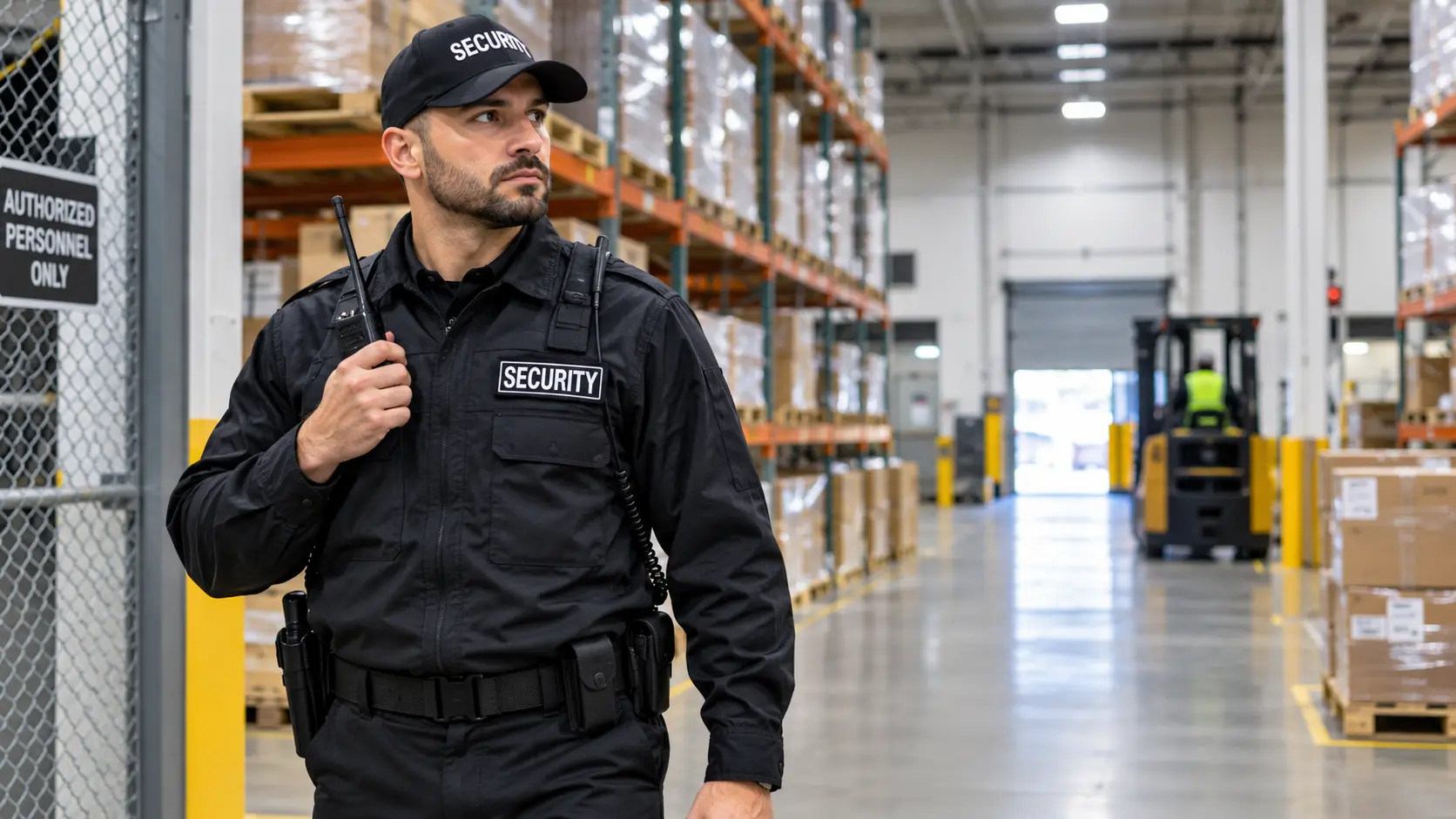
A distribution center doesn’t run like a typical office building. Trucks arrive before sunrise, forklifts move pallets across open bays, and dozens of employees, drivers, and contractors pass through the same set of doors on a single shift. Inventory sits in open racks, loading docks stay active for hours at a stretch, and the property often spans acres rather than square feet. Warehouse security guards in San Jose are trained to work inside that kind of environment, one where protecting people, cargo, and access points matters as much as protecting the building itself.
Cameras and alarm systems catch a lot, but they can’t verify a driver’s paperwork, redirect a confused visitor, or notice that a trailer has been parked at a dock for longer than it should. Security Base Group provides San Jose warehouses and distribution centers with security coverage that can include: armed guards, unarmed guards, Mobile Patrol, access control support, and overnight monitoring built around how a specific facility actually operates during the day and after hours.
Why Do Warehouses in San Jose Need Specialized Security?
Warehouses and distribution centers present a different risk profile than retail stores or corporate offices, and the security approach has to reflect that.
Large Properties and Multiple Access Points
A typical distribution center has more entry points than most people realize. There’s the employee entrance, a separate visitor entrance, vehicle gates for trucks, loading docks that double as informal access points, emergency exits that staff sometimes prop open for airflow, and perimeter fencing that runs the length of the property. Each of these needs to be accounted for, not just the front door. A facility with six or seven access points can’t rely on a single locked entrance the way a small office might.
Continuous Movement of People and Vehicles
Throughout a shift, a warehouse sees a steady flow of employees, contractors, delivery drivers, vendors, and occasional visitors, along with trucks, trailers, and forklifts moving in and out of the yard. Security personnel stationed at key points can monitor that movement, confirm that people belong where they are, and keep traffic flowing without turning every entry into a bottleneck. The goal isn’t to slow operations down; it’s to make sure the flow stays authorized.
Inventory and Cargo Exposure
Open bays, staged pallets, and trailers sitting at a dock overnight all create exposure. Risks at a distribution center can include unauthorized entry into storage areas, cargo theft from parked trailers, inventory loss during shift changes, unauthorized removal of goods, and general property damage around the loading area. None of this means every San Jose warehouse faces these problems regularly; it means the layout of a warehouse creates more opportunities for something to go wrong than a smaller, more contained facility would.
What Do Warehouse Security Guards in San Jose Actually Do?
The daily responsibilities of a warehouse security officer are more specific than a general “watch the building” job description.
Access Control at Warehouse Entrances
Guards stationed at entrances typically check identification, confirm that employees and contractors are authorized to be on-site, verify visitors against an approved list, and maintain a visitor log. This is one of the more straightforward but essential parts of warehouse protection, knowing who is inside the building at any given time.
Loading Dock and Delivery Monitoring
Shipping and receiving areas tend to be the busiest and least controlled part of a warehouse. Guards assigned to this area can monitor incoming and outgoing vehicles, observe delivery activity, watch for behavior that doesn’t match a normal drop-off or pickup, and coordinate with warehouse management when something looks off. This doesn’t mean guards handle loading or paperwork that stays within the warehouse team’s scope. Security’s role is observation, verification, and reporting.
Perimeter Security
Patrols around fences, gates, parking areas, storage yards, exterior doors, and loading areas help catch problems before they reach the building itself: a cut fence line, a propped-open exterior door, or a vehicle parked somewhere it shouldn’t be.
Incident Detection and Reporting
When something does happen suspicious activity, trespassing, an attempted theft, vandalism, or property damage guards document what they observe and escalate according to the site’s procedures. That might mean notifying warehouse management, contacting emergency services, or involving local law enforcement, depending on the severity. Security guards are trained to identify and report; investigating crimes and making arrests falls to law enforcement.
Warehouse Security Services Available for San Jose Distribution Centers
Not every distribution center needs the same setup. Coverage tends to fall into a few categories that can be combined depending on the property.
Stationary Security Guards
Fixed-post guards make sense at high-traffic points: main entrances, employee entrances, security gates, and shipping and receiving areas where consistent monitoring matters more than mobility.
Armed Guard Services
An Armed Guard is not automatically necessary for every warehouse. Whether armed coverage makes sense depends on factors like the site’s risk profile, the value and type of inventory stored, operating hours, any history of incidents at the property, specific client requirements, and applicable California licensing and training requirements for armed personnel. Many distribution centers operate securely with unarmed guards; others, particularly those handling high-value electronics or operating in more isolated industrial areas, may choose armed coverage as part of a broader security plan.
Mobile Patrol
Mobile Patrol works well for larger properties or facilities with multiple buildings, where a single fixed post can’t reasonably cover the entire perimeter. Patrol officers check parking areas, exterior structures, storage yards, and fence lines on a rotating basis, which is often more practical than stationing a guard permanently at every corner of a large industrial property.
Overnight Monitoring
Warehouse activity typically drops off after the last shift ends, but the property doesn’t stop needing protection. Overnight monitoring becomes more important when employee traffic decreases, shipping activity slows or stops entirely, and fewer people are present to notice something unusual. Overnight coverage can be scaled to the facility: a single roaming guard for a smaller site, or a combination of a fixed post and Mobile Patrol for a larger distribution hub with multiple buildings.
Common Security Risks at San Jose Warehouses and Distribution Centers
The table below outlines common risk categories and the kind of security response that can help address them. None of these responses guarantee prevention; they represent standard practices used to reduce risk and support faster incident response.
|
Security Risk |
Potential Security Response |
| Unauthorized entry through employee or visitor doors |
Access control, ID verification, visitor logs |
|
Cargo or trailer theft at loading docks |
Dock monitoring, patrol checks, incident reporting |
| Inventory loss during shift changes |
Access control, supervised entry points |
|
Perimeter intrusion through fencing or gates |
Perimeter patrols, gate monitoring |
| Vandalism to property or vehicles |
Patrols, visible security presence, incident documentation |
|
Unauthorized vehicles in parking or yard areas |
Vehicle monitoring, patrol checks |
| After-hours vulnerabilities with reduced staff |
Overnight monitoring, Mobile Patrol |
|
Suspicious activity near exterior doors |
Perimeter checks, incident reporting and escalation |
How Many Warehouse Security Guards Do You Need in San Jose?
There’s no fixed ratio of guards to square footage that applies across every distribution center, despite what some generic staffing packages suggest. The right number depends on a combination of factors specific to the property:
- Overall facility size
- Number of entrances and access points
- Number and layout of loading docks
- Operating hours, including overnight activity
- Employee headcount per shift
- Volume of vehicle and delivery traffic
- Value and type of inventory stored on-site
- Any history of security incidents at the property
- Size and condition of the perimeter
- Whether armed coverage is part of the plan
- Whether Mobile Patrol is needed to cover additional buildings or yard space
- Whether overnight monitoring is required in addition to daytime coverage
A small warehouse with a single dock and limited after-hours activity might need one guard covering entry and periodic perimeter checks. A large 3PL facility running multiple shifts with dozens of dock doors and constant truck traffic will need a different staffing model entirely, possibly a combination of stationary posts, Mobile Patrol, and dedicated overnight coverage. Rather than choosing a generic package, a site assessment that looks at the actual layout, traffic patterns, and risk factors of the property tends to produce a more accurate and more cost-effective staffing plan.
Warehouse Security Guards vs. Cameras and Alarm Systems
Technology and physical security guards serve different, complementary roles.
- Cameras provide visual monitoring, recorded footage for later review, evidence if an incident occurs, and the ability to observe areas remotely. What they can’t do is intervene, verify identity in real time, or notice context like a delivery truck that doesn’t match the scheduled shipment.
- Alarm systems are effective at flagging intrusion attempts and sending after-hours notifications when a door or window is breached, but they respond after something has already happened rather than preventing it in the moment.
- Physical security guards bring real-time observation, on-the-spot access verification, a visible presence that can discourage problems before they start, regular patrols, direct interaction with employees and visitors, and documented incident reporting tied to the site’s specific procedures.
Guards aren’t inherently better than technology, and technology isn’t a replacement for a trained person on-site. Most San Jose warehouses get the strongest results from layered security: cameras and alarms handling continuous monitoring and evidence collection, with guards handling access control, patrols, and real-time response.
Why Choose Security Base Group for Warehouse Security in San Jose?
Security Base Group works with commercial properties throughout San Jose, including warehouses and distribution centers, to build security coverage around how each facility actually operates. That means accounting for the number of entrances, the layout of loading docks, typical operating hours, perimeter size, and the type of inventory being stored rather than applying a one-size-fits-all staffing model.
Coverage options include armed and unarmed guards, Mobile Patrol for larger or multi-building properties, and overnight monitoring for facilities that scale down staffing after regular hours but still need the property watched. For businesses evaluating options, Security Base Group’s page on security guard services in San Jose outlines the broader range of commercial security services available across the city, including coverage that extends beyond warehouses to other types of commercial and industrial properties.
Because every distribution center has a different footprint, a workable security plan usually starts with a conversation about the property itself, its entrances, its busiest hours, and where the biggest gaps in coverage actually are.
How to Choose Warehouse Security Guards in San Jose
Verify Licensing and Credentials
Confirm that any security provider and its guards meet applicable California (BSIS) licensing requirements, including guard card certification and, where relevant, armed guard permitting.
Ask About Warehouse Experience
Not every security company has direct experience with distribution centers. Useful questions include: Have you protected warehouses or distribution centers before? Can you cover multiple loading docks? Can you manage access control across several entrances? Can you provide overnight coverage? Do you offer Mobile Patrol for larger properties?
Understand the Staffing Model
Ask how many officers would be assigned, whether coverage includes fixed posts, patrols, or both, how shift changes are handled, what supervision looks like, and how incidents get documented and reported.
Request a Site Assessment
A walkthrough of the actual property, its entrances, dock layout, traffic patterns, and perimeter, produces a far more accurate security plan than selecting a generic guard package off a price list.
Warehouse Security Coverage for Different San Jose Facilities
E-Commerce Warehouses
High inventory volume, heavy employee traffic during peak shipping periods, and constant outbound shipping activity make access control and dock monitoring especially important.
Technology Distribution Centers
Facilities handling high-value electronics or components often prioritize controlled access and tighter monitoring of sensitive inventory areas, given the resale value of the goods involved.
3PL Warehouses
Third-party logistics facilities typically serve multiple clients at once, with drivers, inventory, and shipments moving in and out on different schedules, which puts a premium on clear access control and accurate visitor logs.
Manufacturing Warehouses
These sites combine employees, contractors, heavy equipment, and raw materials, making perimeter security and controlled access to work areas a central concern.
Cold Storage and Specialized Facilities
Facilities that run continuously, including cold storage operations, often need consistent access control and monitoring around the clock rather than security that scales down significantly overnight.
Daytime vs. Overnight Warehouse Security
|
Factor |
Daytime | Overnight |
| Employee access | High volume, multiple shifts overlapping |
Minimal to none, depending on operations |
|
Visitor activity |
Regular visitor and contractor traffic | Rare, usually pre-scheduled only |
| Truck traffic | Frequent, tied to shipping schedules |
Reduced, sometimes limited to scheduled deliveries |
|
Loading docks |
Actively monitored during shipping/receiving | Often inactive but still require oversight |
| Perimeter monitoring | Secondary to access control |
Becomes a higher priority |
|
Patrol requirements |
Periodic checks between access duties | More frequent, since fewer eyes are on-site |
| Suspicious activity monitoring | Shared between staff and guards |
Falls mainly to security personnel |
|
Overnight monitoring |
Not applicable |
Central to the security plan |
A facility’s security priorities shift once the last shift clears out. Daytime coverage tends to center on managing high volumes of authorized movement, while overnight coverage shifts toward perimeter awareness and monitoring an otherwise quiet property.
Frequently Asked Questions
1. What do warehouse security guards in San Jose do?
They manage access control at entrances, monitor loading docks and delivery activity, patrol the perimeter, and document and report suspicious activity or incidents according to the property’s security plan and procedures.
2. Do distribution centers need armed guards?
Not always. The decision depends on the facility’s risk level, inventory value, operating hours, and history of incidents. Many warehouses use unarmed guards effectively; others choose armed coverage based on their specific circumstances.
3. Can warehouse security guards work overnight?
Yes. Overnight monitoring is common for distribution centers, especially once daytime staffing decreases. Coverage can include a stationary guard, Mobile Patrol, or a combination, depending on the property’s size and risk factors.
4. What is mobile patrol for a warehouse?
Mobile Patrol involves security officers making scheduled rounds across a property, checking the perimeter, parking areas, and exterior buildings rather than remaining at a single fixed post. It works well for larger or multi-building facilities.
5. How many guards does a distribution center need?
There’s no universal number. Staffing depends on facility size, entrances, loading docks, operating hours, inventory value, and prior incidents. A site assessment is the most reliable way to determine appropriate coverage.
6. Can Security Base Group provide warehouse security in San Jose?
Yes. Security Base Group offers armed and unarmed guards, Mobile Patrol, and overnight monitoring for San Jose warehouses and distribution centers, with coverage tailored to each facility’s layout and operating schedule.
7. How much do warehouse security guards cost in San Jose?
Cost varies based on the number of guards, hours of coverage, armed versus unarmed staffing, site size, patrol frequency, number of access points, and specific services required. A site-specific quote provides a more accurate estimate than a general price range.
Protect Your San Jose Warehouse With a Security Plan Built Around Your Facility
Warehouse security isn’t a single product; it changes based on a facility’s entrances, inventory, perimeter, and operating hours. A small distribution center with limited after-hours activity has different needs than a large 3PL facility running multiple shifts and dozens of dock doors. Physical security guards can work alongside cameras and alarm systems to cover the gaps technology alone can’t close. Security Base Group builds warehouse security plans around each property, considering armed and unarmed guard options, Mobile Patrol, and overnight monitoring based on what the facility actually requires.
Get a Free Quote for your San Jose warehouse through security guard services in San Jose to discuss coverage options tailored to your property.


