
Security Guards vs. Security Cameras: Which Is the Safest in San Francisco?
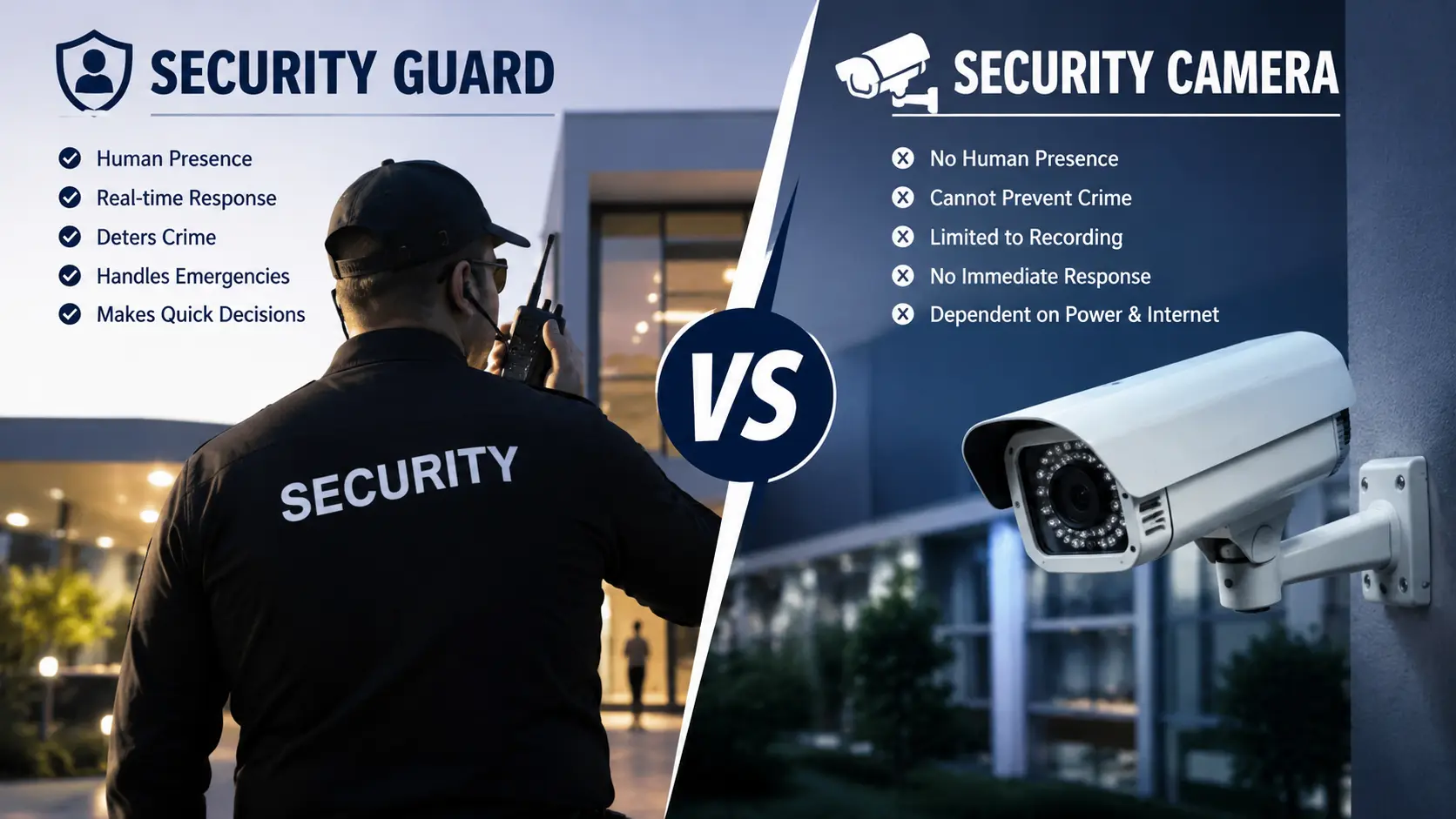
Picture a small distribution warehouse in San Francisco with four cameras covering the loading dock, the front entrance, and the parking lot. The footage is sharp, the cloud storage works fine, and the owner can pull up live feeds from her phone. Then, one night after closing, someone walks the perimeter, tests a side door, and leaves. The camera captures every second of it. But there’s no one on site to check the door, confirm the person is gone, or call it in while it’s happening.
That gap is exactly why the question of security guards vs security cameras keeps coming up among business owners. Security Guards vs. Security Cameras aren’t competing products that do the same job differently; they solve different problems. Understanding what each one actually does, and where the other falls short, is the real starting point for deciding what a specific property needs.
What Do Security Cameras Actually Protect Against?
Cameras are, first and foremost, a documentation and visibility tool. They don’t get tired, they don’t take breaks, and once they’re installed correctly, they watch the same spot around the clock without variation.
A well-placed camera system typically covers:
- Entrances and exits: who came in, who left, and at what time
- Parking areas: vehicle activity, break-ins, and after-hours loitering
- Loading and delivery areas: verifying deliveries, catching inventory discrepancies, and confirming vendor access
- Interior spaces: general activity patrol or monitoring in retail floors, hallways, or storage areas
- Remote visibility: letting an owner or manager check in on a property from anywhere, without being physically present
Cameras are also one of the most useful tools a business has after something happens. If there’s a break-in, a slip-and-fall claim, a dispute with an employee, or a theft, recorded footage can support an investigation, back up an insurance claim, or help police identify a suspect. Many systems also allow for after-hours patrol or monitoring, so unusual movement on the property overnight doesn’t go completely unnoticed.
None of this makes cameras a weak option. For a lot of businesses, a solid camera system covers most of what they actually need. The limitation is simple: a camera can show you what happened, but it can’t do anything about what’s happening.
What Can Security Guards Do That Cameras Cannot?
A security guard adds something a camera physically cannot provide: a person who can respond in real time. That distinction matters more for some businesses than others.
Guards can typically:
- Maintain a physical presence: on the property during their shift
- Conduct patrols: of interior spaces, exterior grounds, or parking areas
- Manage access control: checking IDs, verifying visitors, or controlling who enters a building or gate
- Handle visitor management: from directing deliveries to greeting tenants
- Observe activity in person: notice things a fixed camera angle might miss
- Assess a situation on site: for example, checking on an open door, an alarm trigger, or a person loitering near an entrance.
- Communicate directly: with employees, visitors, or trespassers
- Follow post orders: specific to that property, such as lock-up procedures or emergency protocols
- Document incidents: in writing, in addition to whatever a camera records
It’s worth being precise here: a security guard is not a substitute for police, and no responsible security company should suggest otherwise. Guards can help deter unwanted activity simply by being visible, and depending on their assignment, they may reduce the risk of certain incidents or respond faster than an off-site patrol or monitoring service could. But their actual authority and response depend entirely on their post orders and training; a guard’s job is to observe, deter, document, and notify, not to take on the role of law enforcement.
Security Guards vs. Security Cameras: 11 Key Differences
|
Security Need |
Security Cameras | Security Guards |
|
Recording activity |
Yes | Limited (guards may use body cameras, but this isn’t their primary function) |
| Remote patrol or monitoring | Yes |
No |
|
Physical presence |
No | Yes |
| Property patrols | No |
Yes |
|
Access control |
Passive (records entry, doesn’t control it) | Active (can verify and manage entry) |
| Visitor management | No |
Yes |
|
Human observation |
No | Yes |
| Incident documentation | Video record |
Written reports, verbal communication, and video (if applicable) |
|
Visible deterrence |
Moderate | Higher, due to physical presence |
| After-hours coverage | Continuous recording |
Depends on staffing schedule |
| Immediate physical assessment | No |
Yes |
This table isn’t meant to declare a winner. It’s meant to show that cameras and guards are built for different jobs, and a property’s specific risks determine which jobs actually matter.
Which Is Safer: Security Guards or Security Cameras?
This is the question most business owners are really asking, and there’s no honest way to answer it with a flat “guards” or “cameras.” Safety depends on what a specific property is exposed to.
A camera system may be entirely sufficient for a property where the main concern is documentation knowing who came and went, catching the occasional shoplifting incident on tape, or having evidence if something goes wrong. If the property has controlled access, limited after-hours activity, and a relatively low risk profile, cameras alone may cover the need well.
BSIS-licensed security guards become more important when a property requires physical presence, active access control, patrols of large or complex spaces, human judgment in the moment, or coverage during hours when no employees are on site. A camera can tell you someone broke a window at 2 a.m. A guard on patrol might be there to notice it happening, check the area, and notify management or emergency services immediately.
The honest answer is that “safest” isn’t about the technology or the personnel in isolation; it’s about matching the security tool to the actual risk. A property with a low-risk profile and strong camera coverage may be adequately protected. A property with valuable inventory, multiple entrances, a history of trespassing, or significant after-hours exposure is taking on more risk if it relies on cameras alone.
When Security Cameras May Be Enough
Cameras can be the right primary solution for businesses that fit a certain profile:
- Smaller properties with a single entrance and straightforward layout
- Lower-risk businesses without a history of theft or trespassing
- Properties with controlled access, such as key-card entry or locked gates
- Limited after-hours activity, where the property is largely inactive overnight
- Businesses where video documentation, not active intervention, is the primary need
- Properties that already have other security measures in place, like alarm systems, lighting, or fencing
The point isn’t that every business should default to cameras-only. It’s that some businesses genuinely don’t need more than that, and paying for guard services they don’t need doesn’t make them safer; it just adds cost without addressing an actual gap.
When Security Guards May Be the Better Choice
Other properties have risk factors that cameras alone don’t fully address.
Repeated Theft or Break-Ins
If a property has already experienced multiple incidents, a camera system clearly isn’t deterring the activity on its own. A visible, physical security presence can add a layer of deterrence and give the business someone who can respond while an incident is in progress, rather than only reviewing it afterwards.
Frequent Trespassing
Properties with large exterior areas, open perimeters, or multiple points of entry are harder to secure with cameras alone, since fixed camera angles can only cover so much ground. A guard conducting patrols can check areas that cameras might miss and respond directly to trespassers.
Valuable Inventory or Equipment
Retail stores with high-value merchandise, warehouses holding significant inventory, and construction sites with expensive tools and materials all share a common risk: a camera records theft, but it doesn’t stop it. A guard presence, particularly during off-hours, adds a layer of protection that recording alone can’t offer.
After-Hours Operations
Businesses with limited staff on site overnight or none at all often have the biggest gap between what a camera can do and what actually needs to happen if something occurs. After-hours or overnight security can fill that gap.
Access Control Requirements
There’s a real difference between a camera recording who walks through a door and a guard actively verifying who’s allowed through it. Properties that need to manage visitor access, check credentials, or restrict entry to certain areas typically need a person in that role, not just a lens.
Large or Difficult-to-Monitor Properties
Sprawling properties, multi-building complexes, or sites with a lot of blind spots benefit from guards who can physically patrol areas that fixed cameras can’t fully cover, complementing whatever camera coverage already exists.
Why Some Businesses Use Both Security Guards and Cameras
A lot of the businesses that get the most value out of security aren’t choosing one over the other; they’re layering both. Here’s a simplified example of how that might work: a camera picks up movement near a side entrance after hours. A guard on patrol or monitoring the feed is notified and goes to check the area in person. Based on what they observe, they follow the property’s established procedures, which might mean documenting the incident, contacting management, or notifying emergency services if warranted. Afterwards, both the guard’s report and the camera footage are available for review.
This is an example of how layered security can work, not a guaranteed sequence of events for every property or every incident. But it illustrates why the two tools complement each other well: cameras provide visibility and a permanent record, while guards provide physical presence, human judgment, and the ability to act on what the cameras show. Neither one replaces the other; together, they cover more of the gap than either does alone.
Which San Francisco Businesses May Need Professional Security?
Different types of properties around the city tend to run into different risk factors.
- Retail Stores: Theft, shoplifting during business hours, and vulnerability during opening and closing routines are common concerns, along with general customer safety on the sales floor.
- Warehouses: Inventory control, loading dock activity, vehicle traffic, and restricted-area access are typical priorities.
- Construction Sites: Expensive equipment and materials, open or unfenced perimeters, and elevated after-hours risk make these sites a frequent target for theft and vandalism.
- Office Buildings: Managing visitor access, verifying tenants and deliveries, and patrolling or monitoring parking structures are common needs, especially in buildings with multiple tenants.
- Apartment Communities: Controlling entrances, patrolling or monitoring common areas, addressing unauthorised visitors, and managing parking access all come up regularly in multi-unit residential properties.
- Commercial Properties: Sites with multiple tenants, buildings, or exterior areas often need a combination of coverage across several access points rather than a single security approach.
San Francisco’s mix of dense commercial corridors, older buildings with less predictable layouts, and busy street-level foot traffic tends to make access control and physical presence more relevant than they might be for a business in a quieter, more isolated location.
Do You Need Security Guards 24/7?
Full-time, around-the-clock security isn’t automatically the right call for every business, and a good security provider should be willing to say so.
Depending on the property, options include:
- Full-time on-site security, for properties with continuous risk or activity
- Part-time security, covering specific hours when risk is highest
- After-hours or overnight security, for properties that are unattended once staff leaves
- Mobile patrols, where a guard checks multiple properties on a rotating schedule rather than staying at one location full-time
- Temporary security, for short-term needs like construction phases or seasonal risk
- Event security, for one-off situations like grand openings, sales events, or private functions
The right schedule comes down to when the actual risk exists. A retail store with daytime foot traffic and an empty building overnight has very different needs than a 24-hour warehouse operation.
How Many Security Guards Does a Business Need?
Staffing levels depend on several factors specific to each property, including:
- Overall property size
- Number of entrances and access points
- Number of separate buildings on the site
- Property layout and how much of it needs to be visible or patrolled
- Operating hours and when the property is occupied versus empty
- Overall risk level, based on history and location
- Size and layout of parking areas
- Whether regular patrols are required in addition to fixed posts
- Number of distinct posts that need coverage
There’s no universal formula, like a fixed guard-per-square-foot ratio, that applies accurately across different types of properties. A retail store and a construction site of the same square footage can have completely different staffing needs.
For business owners who want a starting point, Security Base Group’s Security Guard Calculator can provide an initial estimate based on basic property details. It’s a useful first step, but it isn’t a substitute for a property-specific security assessment, which accounts for the details a quick calculation can’t.
How to Choose the Right Security Approach
A simple way to think through the decision:
Cameras may make sense when:
- Patrol or monitoring and documentation are the primary needs
- The property’s overall risk level is relatively low
- After-hours exposure is limited
- Access is already controlled through other means
Security guards may make sense when:
- Physical presence on the property is genuinely needed
- Access control requires active verification, not just recording
- Regular patrols are necessary to cover the property
- There’s a history of theft, trespassing, or after-hours incidents
- The property is large, complex, or has multiple access points
A combined approach may make sense when:
- The property has both a need for documentation and a need for physical response
- Risk is high enough that relying on one tool alone leaves a meaningful gap
- Different areas of the property have different risk levels
There isn’t a single right answer for every business, and a security provider that claims otherwise usually isn’t being straight with you. The goal is matching the level of security to the actual risk a property faces, not defaulting to the most expensive option, and not settling for less coverage than the property really needs. For businesses unsure where they land, a property-specific security assessment is usually the most reliable way to find out.
Final Thoughts
There’s no single security solution that’s automatically the safest choice for every business. Security cameras provide visibility, continuous recording, and documentation that can support investigations and insurance claims. Security guards provide something different: a physical presence, on-site judgment, patrols, access control, and the ability to respond according to a property’s specific procedures.
For some businesses, cameras alone may cover what’s needed. For others, adding professional security personnel provides an important layer that cameras can’t offer on their own. For larger or higher-risk properties, combining both often makes the most sense.
If you’re not sure whether your property needs cameras, guards, or a mix of both, it can help to talk it through with a company that works with these decisions regularly. Security Base Group works with businesses across San Francisco to evaluate their specific security needs, whether that means security guards in San Francisco, camera coverage, or a layered combination of both.


