
Security Guard Shift Handover Procedures in Los Angeles: Best Practices, Checklists & Common Mistakes
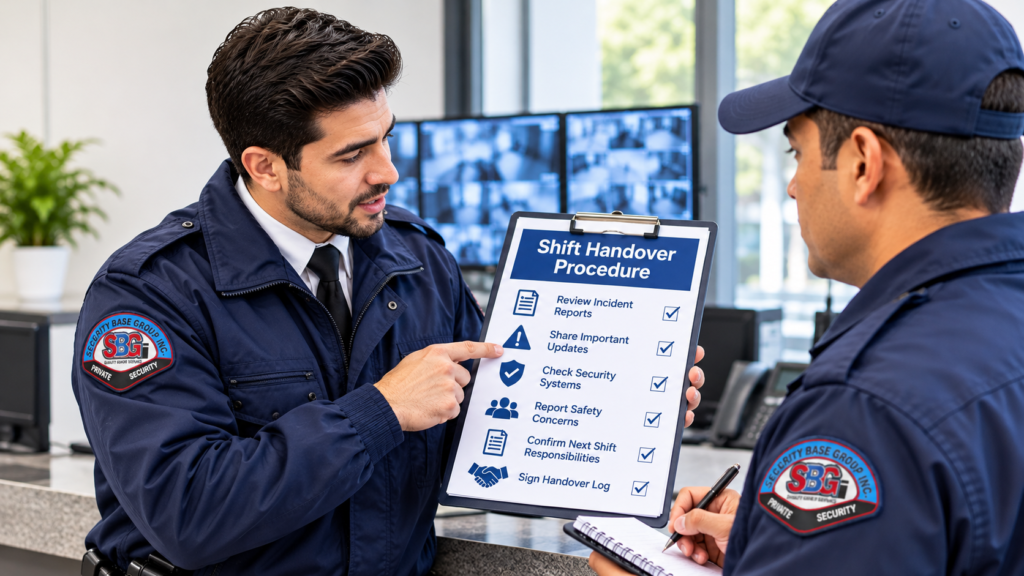
At 5:50 a.m., a night guard at a Downtown LA office tower notices the loading dock gate is sticking. He means to mention it, but his relief arrives late; he is tired, and he leaves with a quick “all quiet.” By 7 a.m., a delivery driver finds the gate stuck open, and nobody on the new shift knew it was a problem.
Nothing dramatic happened, yet a known issue vanished in the gap between two shifts. That gap is where good security coverage often breaks down.
A security guard shift handover is the structured transfer of information, equipment, and responsibility from the outgoing guard to the incoming guard. Done well, protection continues without interruption. Done poorly, it leads to missed patrols, unresolved incidents, access-control errors, and equipment faults nobody owns. This guide explains security guard shift handover procedures in Los Angeles: what to communicate, how to do it, and how to avoid the mistakes that cause problems.
Why Reliable Shift Handovers Matter for Los Angeles Properties
Los Angeles properties rarely sleep. Offices, apartment communities, warehouses, retail centers, and construction sites all need coverage across nights, weekends, and holidays, so shift changes happen constantly. Each one is a point where information can be lost.
Strong handovers support several things:
- Continuous coverage: The incoming guard knows what the outgoing guard knew, so no one starts from zero.
- Resolved concerns: A complaint about a tenant’s propped door, or a suspicious vehicle seen twice, gets followed up instead of forgotten.
- Accountability: A recorded handover shows who held responsibility and when it changed.
- Consistent supervision: Supervisors can see patterns across shifts instead of isolated snapshots.
The stakes differ by property. A Wilshire Corridor residential tower may care most about visitor logs and package rooms. A Vernon warehouse needs to know which dock doors are secured and which trucks are expected. A construction site in the Valley depends on a handover that covers fencing, equipment storage, and after-hours contractor access. Handover procedures should reflect these realities.
Core Elements of an Effective Security Guard Handover
Incident Reports and Outstanding Security Issues
The incoming guard should hear about anything that happened and anything still unresolved: suspicious activity, tenant complaints, trespass warnings, and open investigations. Include areas that need extra attention. For example, “A man was seen twice near the parking structure stairwell around 2 a.m. Watch that area on your first patrol” gives the next guard something to act on, not just something to know.
Patrol Updates and Property Inspection Status
Patrols are only reliable if everyone knows where they stand. Communicate which rounds are complete, which are pending, and what was seen along the way: a burned-out light, an unlocked utility room, graffiti on a perimeter wall. Flag anything that needs a second look so the next guard can follow up.
Access Control, Keys, and Visitor Information
Keys, fobs, and access cards must be accounted for at every transfer. The outgoing guard should also pass along expected visitors, scheduled contractors, deliveries, and any temporary authorizations. Note any door, gate, or reader that is not working properly. A single unreported broken lock can leave a building exposed for an entire shift.
Security Equipment and System Status
Cover CCTV cameras, monitoring stations, alarm panels, access-control systems, radios, flashlights, and any other assigned gear. If Camera 6 on the east lot has been offline since midnight, the next guard needs to know so they can compensate with extra patrols and make sure a repair request exists.
Special Instructions and Pending Responsibilities
Many properties have unusual requirements: a tenant moving out after hours, a temporary fence on a construction site, a VIP event, or a contractor working past normal hours. The handover should include emergency contacts, recent supervisor instructions, and any tasks left open for the next shift.
Best Practices for Los Angeles Security Operations
Conduct Face-to-Face Briefings
A short in-person briefing lets the incoming guard ask questions and lets the outgoing guard point out details that are hard to write down. Walking to a problem area together, such as the damaged gate, is often clearer than any description.
Use Standardized Handover Reports
A consistent written format keeps important details from depending on memory. Reports should include timestamps, incident descriptions, patrol status, equipment condition, and pending tasks. When every guard uses the same template, supervisors can review reports quickly and spot gaps.
Follow a Clear Shift Change Protocol
A simple sequence works well: the incoming guard arrives, the briefing happens, information is verified, both guards acknowledge the handover, and responsibility transfers. The outgoing guard is not relieved until the sequence is complete.
Communicate Property-Specific Concerns
Priorities vary. Commercial buildings emphasize visitor management and after-hours tenant access. Residential communities focus on gate operation, parking issues, and resident complaints. Warehouses prioritize dock activity, inventory areas, and vehicle movement. Construction sites require attention to fencing, materials, and equipment. Briefings should reflect what matters most at each location.
Verify Information Instead of Relying Only on Verbal Updates
Verbal updates are a starting point. The incoming guard should check patrol logs, incident reports, access records, and equipment status for themselves. If someone says all cameras are working, confirm it at the monitoring station.
Escalate Unresolved Issues to Supervisors
Some issues should never be passed along casually: a security breach, a suspected trespasser who has not been located, safety hazards, or failed critical equipment. These should be reported to a supervisor immediately, not left for the next guard to discover.
Comprehensive Security Guard Shift Handover Checklist
Use this checklist to turn security guard shift handover procedures in Los Angeles into a repeatable routine.
Before the Outgoing Guard Ends the Shift
- Update and finalize all incident reports
- Complete patrol documentation and log entries
- List unresolved security concerns
- Check radios, flashlights, and other assigned equipment
- Gather keys, access cards, and credentials for transfer
- Record pending instructions and expected visitors
During the Shift Handover
- Confirm the incoming guard’s arrival and assigned post
- Discuss incidents and unusual activity
- Review the patrol schedule and any pending inspections
- Transfer keys, radios, and access cards
- Share visitor, contractor, and delivery information
- Review equipment problems and special instructions
After the Incoming Guard Takes Over
- Verify all transferred equipment and access items
- Review recent incident and patrol records
- Inspect important security points, such as entrances, alarm panels, and monitoring stations
- Confirm understanding of pending responsibilities
- Record that the handover is complete and acknowledged
Sample Security Guard Shift Handover Record
This example is illustrative only. It does not describe an actual Security Base Group incident.
|
Field |
Details |
| Property |
Mid-rise commercial office building, Los Angeles |
|
Outgoing shift |
6:00 p.m. to 6:00 a.m. (Guard A) |
| Incoming shift |
6:00 a.m. to 6:00 p.m. (Guard B) |
|
Patrol status |
5 of 6 night patrols complete; 5:00 a.m. garage level P2 patrol delayed by a medical call |
| Recent observation |
3:15 a.m.: unfamiliar person near rear service door; left on request; no entry gained |
|
Equipment condition |
Camera 4 (north alley) offline since 1:40 a.m.; radios and keys accounted for |
| Pending action |
Complete garage P2 patrol; check Camera 4 repair request |
|
Supervisor notification |
Supervisor notified at 3:25 a.m. of rear door observation and again at 5:45 a.m. about Camera 4 |
| Handover acknowledgment |
Both guards signed at 6:05 a.m. |
Common Shift Handover Mistakes and How to Avoid Them
- Relying only on verbal communication: Spoken updates get forgotten or misunderstood, especially at the end of a long shift. Solution: require a written handover report for every shift change, with verbal briefings as a supplement.
- Leaving before the replacement arrives: Walking away creates a coverage gap. Solution: establish a relief and escalation policy so the outgoing guard knows to hold the post and call a supervisor when relief is late.
- Incomplete incident documentation: Reports without timestamps, descriptions, or follow-up notes are hard to act on. Solution: use a structured template with required fields and have supervisors review entries.
- Failing to communicate equipment problems: A malfunctioning camera, radio, alarm, or gate reader affects every shift that follows. Solution: make equipment status a mandatory line in the handover record and require a repair report whenever something fails.
- Not reviewing pending tasks: Unfinished patrols and unresolved complaints silently disappear. Solution: keep a running open-items list that stays with the post until each item is closed.
- Poor supervisor involvement: When no one checks handovers, standards slip. Solution: use regular report reviews, unannounced spot checks, and corrective coaching.
Training and Integrating Handover Standards
Security companies get consistent handovers by building them into how guards are trained and managed.
- Train guards on communication and reporting: Guards should practice writing clear incident descriptions, using timestamps, and knowing when to escalate. Scenario-based training works better than a slide deck. Security personnel should also understand their responsibilities for incident reporting and supervisory communication. The California BSIS Power to Arrest and Appropriate Use of Force Training Manual explains supervisory responsibilities and incident reporting requirements for security personnel.
- Establish standard operating procedures: Written SOPs should define what outgoing guards, incoming guards, and supervisors are each responsible for during a transition.
- Use digital reporting tools: Electronic activity logs, mobile checklists, and incident reporting systems create accurate, searchable records and reduce lost paperwork.
- Conduct regular supervisor reviews: Supervisors should read handover records, look for patterns, and provide coaching when entries are vague or missing.
- Measure handover performance: Practical indicators include documentation completion rates, reporting accuracy, timely escalation, and compliance with relief procedures. Tracking these over time shows where more training is needed.
Putting Strong Handover Procedures into Practice Across Los Angeles
- Adapt procedures to the property: A one-size-fits-all template rarely works. A retail center, a gated community, and a construction site each need different fields and different priorities in the handover.
- Make communication a shared responsibility: Guards own the accuracy of the handover, supervisors own the standard and oversight, and property management owns the information it provides, such as vendor schedules, tenant events, and access changes. When any link is weak, the whole chain suffers.
- Review and improve regularly: After any incident, ask whether the handover contributed. If a problem was known on one shift but missed on the next, update the template or the training.
- Know when professional supervision helps: Many property owners find that consistent handovers depend on trained personnel, active supervision, and reliable reporting.
An experienced provider such as Security Base Group, which delivers professional security guard services in Los Angeles, can help standardize procedures, supervise guards, and keep coverage consistent from one shift to the next.
Frequently Asked Questions
1. What are security guard shift handover procedures?
They are the steps guards follow to transfer information, equipment, and responsibility at shift change, typically a briefing, a written report, verification, and acknowledgment.
2. What information should be included in a security guard shift handover report?
Incidents and observations, patrol status, access and visitor details, key and equipment accountability, equipment problems, pending tasks, supervisor notifications, and signatures with times.
3. How long should a security guard shift handover take?
It varies by property. A simple post may need five to ten minutes, while a large or busy site may need longer. The goal is completeness, not speed.
4. What happens if a security guard does not arrive for the next shift?
The outgoing guard should stay at the post and contact a supervisor immediately. The company then arranges coverage under its relief and escalation policy.
5. Are written shift handover reports necessary for security guards in California?
Requirements depend on the client contract, post orders, and company policy. Regardless, written reports are a best practice for accountability. For specific legal questions, consult a qualified professional.
6. How can security companies prevent communication gaps between shifts?
Use standardized reports, train guards on communication, adopt digital logs, require supervisor review, and maintain clear SOPs.
7. Who is responsible for completing a security guard shift handover?
Both guards share responsibility. The outgoing guard prepares and delivers accurate information, the incoming guard verifies and acknowledges it, and supervisors oversee the process.
8. Why are shift handover procedures important for 24/7 security services in Los Angeles?
Round-the-clock coverage means frequent transitions. Strong procedures keep information, equipment, and responsibility moving without gaps across every shift.
Conclusion: Make Every Security Shift Count
Security is only as strong as its weakest transition. Clear communication, accurate documentation, proper equipment transfers, timely incident reporting, supervisor involvement, and consistent accountability all come together at shift change. Reliable security guard shift handover procedures in Los Angeles help prevent small issues from becoming expensive problems.
If you manage a property in Los Angeles, take a fresh look at how your guards hand over today. Are reports written and consistent? Is anyone reviewing them? Are equipment problems and open items tracked?
If you’d like a partner to help, Security Base Group provides professional security guard services for businesses and properties across California, with trained personnel, active supervision, and dependable reporting.
 Previous Post
 Next Post


