
Private Security vs LAPD Response Times: What Los Angeles Businesses Should Know
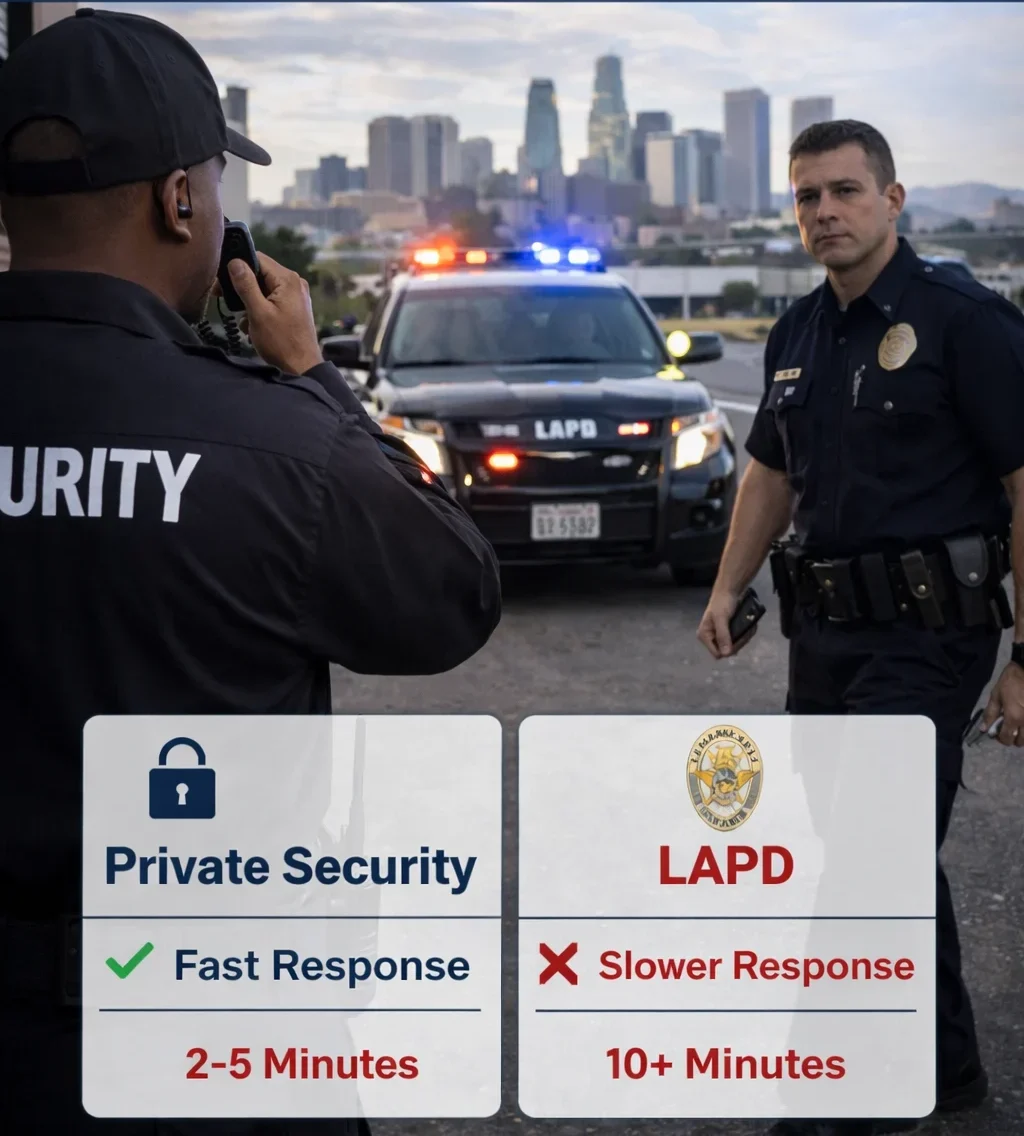
Running a business in Los Angeles can feel challenging because safety concerns are very real. Police departments deal with many calls every day, which affects how quickly the LAPD can reach different types of incidents. This is why many business owners choose to add private security in Los Angeles and keep their property protected. Here are the main points to remember:
- LAPD usually reaches high‑priority emergencies quickly, although non‑urgent calls often take much longer.
- Private security is able to respond faster because their job is to watch your location directly.
- Using both police and private security together gives the strongest protection.
- Business owners should learn how response times work, plan their security properly, and choose trustworthy vendors.
Why Response Time for Security Guards Matters: Business Impacts and Risk Model
Response time affects how much loss or damage your business experiences. Even a few extra minutes can completely change the result of an incident. Here are reasons it is important:
- Theft and Burglary Losses: When help arrives late, criminals have more time to steal items and escape.
- Property Damage: Graffiti, broken windows, and vandalism increase when no one shows up quickly to stop it.
- Employee Safety: Workers feel unsafe when they think help will take a long time.
- Insurance Costs: If a business has a history of slow response or frequent incidents, insurance prices usually go up.
- Brand Reputation: Customers avoid stores that look unsafe or chaotic.
Real examples include retail stores dealing with organized theft, restaurants facing break‑ins after closing time, and offices struggling with repeated trespassers.
LAPD Response Times: Data, Benchmarks, and How to Understand Them
The LAPD shares information about how long it takes them to respond to various calls. Businesses can look at this information to understand their risks better.
Official Data Sources and How to Access Them
You can view real LAPD numbers using:
- LAPD CompStat reports
- Los Angeles 911 response time datasets on LA GeoHub
- LAPD CAD (Computer Aided Dispatch) summaries
These resources usually include averages, medians, and percentile breakdowns.
Priority Codes and the Difference Between Dispatch and Travel Time
The LAPD uses priority levels to organize calls:
- Priority 1: Emergencies that risk someone’s life
- Priority 2: Situations that need quick attention but are not life‑threatening
- Priority 3: Non‑urgent issues such as property crime, noise, or trespassing
Each call has two main parts:
- Dispatch time: When an officer is assigned to the call
- Travel time: How long does it take the officer to reach the scene
Both parts combine to form the total response time.
Benchmarks Businesses Should Pay Attention To
Business owners should consider:
- Median response times for property crime incidents
- Delays that happen during busy periods
- Response variations based on neighborhood (Downtown, Hollywood, South LA, etc.)
- 90th percentile numbers for a realistic worst‑case scenario
Private Security Guard Capabilities: Response Models, Response Times, and Costs
Private security can help fill the gap because it focuses completely on your property.
Types of Services
- Static Guards: Stay at one location all day or night
- Mobile Patrol: Guards visit your property on scheduled or random rounds
- Remote Monitoring: Live monitoring teams watch your cameras
- Alarm Verification: Guards check alarms first before calling law enforcement
Typical Response Times (Realistic Expectations)
- Static Guards: Immediate response because they are already there
- Dedicated Mobile Patrol: Around 5 to 12 minutes
- Shared Mobile Patrol: Around 15 to 30 minutes
- Monitoring Alarm Response: Usually under 10 minutes, depending on dispatch
Factors such as traffic, distance, and the number of properties per patrol car can change these times.
Legal and Regulatory Environment for Private Security in California and Los Angeles
California manages private security through the Bureau of Security and Investigative Services (BSIS). The requirements include:
- A Guard Card license
- A Private Patrol Operator (PPO) license for companies
- Background checks and LiveScan fingerprinting
- Firearm permits for armed guards
- Certain city‑specific permits depend on the area
Security contracts must include proof of compliance and insurance coverage.
Liability, Use of Force, and Insurance Points to Consider
Businesses should understand the risks that come with private security:
- Hiring someone who is not properly trained
- Wrongful detention of individuals
- Using more force than necessary
- Damaging property during an incident
Most security guard companies in Los Angeles need general liability insurance, workers’ compensation coverage, and additional insured protection.
Operational Best Practices for Security Guards: SLAs, SOPs, and KPIs
Good security depends on proper planning and strong operating procedures.
SLA Essentials
- Clear response time expectations
- Proper reporting requirements
- Daily activity logs
- GPS verification for patrols
SOPs for Incident Handling
Guards should follow the rules about:
- Protecting evidence
- Safe detention procedures
- Communicating clearly with LAPD during handoffs
KPIs to Measure
- Median response times
- 90th percentile results
- Patrol consistency
- Time taken to resolve incidents
- False alarm frequency
Gap Analysis and Hybrid Model
A combined approach often works best. Here are the steps:
- Review past incident reports
- Compare them with LAPD response numbers
- Identify time gaps
- Add private guards to fill these gaps
- Test the plan for around ninety days
Buying Checklist for a Security Guard Company in Los Angeles
Important items to check include:
- BSIS licenses
- Proof of insurance
- Training hours completed
- Professional appearance and behavior
- GPS tracking logs
- Body camera usage
- Quality of supervision and oversight
Frequently Asked Questions
How fast does LAPD respond? LAPD responds quickly to urgent emergencies, although property‑related incidents often take much longer.
Can private security detain people? Yes, but they must only use reasonable force and follow legal rules.
How much does a guard cost in Los Angeles? The usual range is between twenty dollars and fifty‑five dollars per hour, depending on training and whether the guard is armed.
What is a verified alarm response? This is when a guard checks an alarm in person before police are called.
Conclusion and Next Steps
The LAPD and private security both play important roles in keeping businesses safe. The strongest protection usually comes from using both together. Review your risks, compare response times, follow the checklist, and choose a reliable security guard service in Los Angeles. You can also contact a vendor to request a site inspection or a detailed proposal.
 Previous Post
 Next Post

