
Hotel & Hospitality Security Services in San Diego: Guests, Staff & Assets in 2026
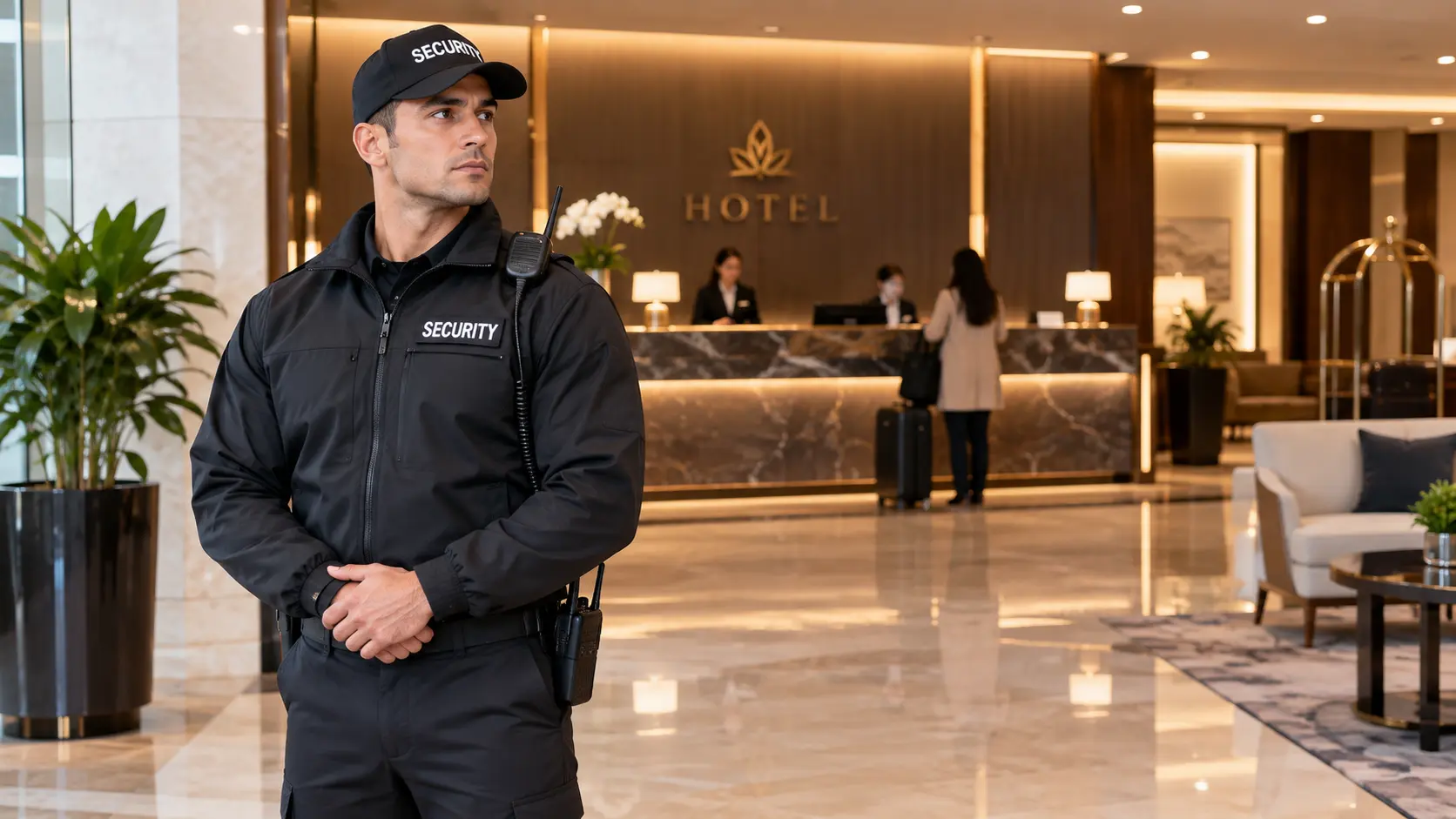
It’s 1:40 a.m. at a mid-size hotel near the waterfront. The front desk is down to one agent, housekeeping finished hours ago, and a rideshare drops off a guest who insists he’s staying in a room that isn’t his. The night auditor has no backup and no one watching the lobby camera in real time. That’s the moment hotel security stops being a line item and becomes the difference between a calm resolution and a real problem.
Hotel & Hospitality Security Services in San Diego aren’t the same as guarding a warehouse or an office after hours. A hotel is open to the public around the clock, houses hundreds of strangers overnight, and still has to feel welcoming while it’s being protected. Getting that balance right takes a plan built around how the property actually operates, not just a guard by the door.
Why Hotel Security Is Different From Other Commercial Security
Most commercial buildings close. Hotels don’t. A hotel is really several businesses stacked together and running at once: guest accommodations upstairs, a public lobby anyone can walk into, a restaurant or bar serving guests and outside customers alike, event space that might host a wedding one night and a sales conference the next, a parking structure, and a back-of-house operation that never fully stops.
That structure means constant movement: guests coming and going, employees rotating through shifts, vendors making deliveries, contractors handling repairs, and visitors meeting guests who aren’t staying at the property at all. Security personnel have to read that traffic correctly without turning the lobby into a checkpoint.
That’s why hospitality security guards need a different skill set than a typical commercial post: professional and observant, but also approachable, since guests will ask them for directions at 2 a.m. The best hotel security personnel blend into the guest experience while quietly watching everything around them. Because hotels run 24/7, coverage can’t have gaps. 3 p.m. on a Tuesday looks nothing like 3 a.m. on a Saturday during a citywide convention.
Common Security Risks Facing San Diego Hotels in 2026
Every property is different, but hotel operators tend to face a recurring set of concerns. None of these mean a property is unsafe; they’re simply part of running a business that’s open to the public around the clock.
|
Risk Area |
What It Typically Looks Like |
|
Unauthorized visitors |
Non-guests entering the lobby, elevators, or guest floors |
| Theft |
Room theft, luggage theft, or loss from public areas |
|
Guest disputes |
Noise complaints, altercations, disorderly conduct |
| Property damage |
Vandalism to rooms, furniture, or common areas |
|
Parking-area incidents |
Break-ins, loitering, disputes in garages and lots |
|
Unauthorized access |
Attempts to enter restricted or employee-only areas |
| Employee safety |
Staff working alone, especially overnight |
|
After-hours disturbances |
Disruptive behavior once management staffing is reduced |
|
Events and gatherings |
Crowding or access issues during weddings and conferences |
|
Emergencies |
Medical events, fire alarms, or other incidents |
The common thread is exposure. A hotel has more entry points, more public space, and more operating hours than almost any other commercial property, which is why security guard services in San Diego built for hospitality hold up better than a guard used to a static office lobby.
What Should Hotel & Hospitality Security Services in San Diego Include?
A well-built hotel and hospitality security program in San Diego is layered, with each layer covering a different part of the property.
Lobby and Front-Desk Security
The lobby sees the most traffic, so it’s where most incidents surface first. Security personnel near the front desk watch for unusual behavior and step in calmly if a guest interaction escalates, giving front-desk staff a trained presence nearby instead of handling a difficult moment alone.
Access Control and Restricted Areas
Employee entrances, housekeeping storage, mechanical rooms, loading docks, and administrative offices should stay off-limits to guests. That means doors, key cards, and service entrances are actually monitored, not just locked and forgotten. A property with underground parking or a separate service corridor has more of these points to manage than a boutique hotel with one entrance.
Parking Lot and Garage Patrols
Parking areas are often the least-watched part of a hotel, especially underground or set back from the main building. Regular, visible patrols help identify suspicious activity, loitering near vehicles, a propped door, or poor lighting before it turns into an actual incident. Large, multi-level garages typically need more frequent coverage than a small surface lot.
Guest and Visitor Assistance
Trained hotel security guards provide a visible safety presence guests notice even without direct interaction, and when they do interact directions, assistance, a concern the tone should support the hotel’s service culture rather than work against it. Officers are typically employed by the security company, not the hotel, and coordinate with management rather than function as hotel staff.
How Overnight Monitoring Services Help Hotels Stay Protected After Dark
Daytime and overnight operations look almost nothing alike. During the day, there’s a full front-desk team, management on-site, and a steady flow of guests that makes anything unusual easier to spot. Overnight, staffing drops to a skeleton crew, management presence disappears, guests arrive at odd hours, and entrances watched closely during business hours can become easier to slip through unnoticed.
This is where overnight monitoring services earn their value. A dedicated overnight presence means someone is actively patrolling, checking entrances, and monitoring the lobby and parking instead of reacting after something has already gone wrong. That’s the real distinction between reactive and proactive security: reactive security responds after someone reports a problem, while proactive overnight coverage is positioned to notice one developing and address it before it escalates.
Coverage shouldn’t look identical across properties. A large full-service hotel with multiple entrances and a parking structure needs more overnight presence than a boutique property with a single, well-lit entrance. The right approach comes from assessing how a specific property runs after dark, not from a generic staffing number.
When Do Hotels Need Armed Guards?
This question comes up often, and the honest answer is that it depends on the property. Not every hotel needs armed guards, and assuming otherwise usually means paying for coverage that doesn’t match the actual risk.
Armed guards are typically worth considering when a formal risk assessment identifies elevated concerns, a property regularly hosts VIP guests, a large event brings significant crowd size, or there’s a specific, identifiable threat. That’s a decision that should follow an actual evaluation, not a default setting.
For the day-to-day work most hotels need lobby presence, access control, routine patrols, guest assistance, general observation unarmed security is usually the better fit. Unarmed officers are trained to de-escalate and maintain a welcoming atmosphere while handling most of what actually happens at a hotel: noise complaints, unauthorized visitors, minor disputes. Matching the right guard type to the right task separates a well-designed plan from an unnecessarily expensive one.
Hotel Security for Events, Conferences & VIP Guests
Once a hotel starts hosting weddings, conferences, or private functions, its security needs shift, sometimes just for a weekend. A property with a predictable flow of guests might suddenly have several hundred outside visitors moving through its lobby, ballrooms, and parking areas for a single event.
Event-specific planning usually covers monitoring entrances so attendees and vendors can be distinguished from the general public, managing crowd flow during arrivals and departures, keeping back-of-house corridors off-limits to attendees, coordinating parking for a larger vehicle volume, and having a clear response plan if something goes wrong. VIP guests add another layer: closer coordination with hotel operations, discreet monitoring near their rooms, and tighter access control wherever they’re staying.
A hotel doesn’t necessarily need to staff up permanently for this. Temporary, event-specific coverage is often more practical, added for the dates and hours an event runs, then scaled back down afterward.
Security for Hotel Employees and Back-of-House Areas
It’s easy to think of hotel security purely in terms of guests, but a well-run program protects the people working there just as much. Housekeeping staff moving between floors, front-desk employees handling difficult interactions, maintenance teams working alone, night-shift workers, kitchen staff, and delivery personnel all depend on the property being secure, not just its guest-facing side.
Service entrances, employee-only corridors, loading zones, and storage areas matter as much as the lobby. An employee taking out trash at midnight or a housekeeper restocking a supply closet on an empty floor shouldn’t have to wonder whether that area is being watched. Security that patrols back-of-house spaces, not just public areas, helps staff do their jobs without unnecessary safety concerns hanging over routine tasks.
Technology + Human Security: A Better Approach to Hotel Protection
Cameras and access-control systems have gotten better, and they’re genuinely useful. But technology on its own doesn’t respond to anything; it records it. A camera can capture someone tailgating through a restricted door, but it takes a person to notice that in real time and actually respond.
The most effective programs treat technology and trained personnel as partners: Detect → Observe → Verify → Respond → Document → Improve. CCTV, access-control systems, and alarms handle detection. Trained personnel handle observation and verification, confirming whether something is actually a problem. Response requires human judgment: de-escalating, contacting management, calling for help. Documentation turns the incident into a record the property can learn from. Technology extends what a security team can see; it doesn’t replace the judgment of a trained person on-site.
How to Choose the Right Hotel Security Company in San Diego
- Verify BSIS licensing and insurance.
- Ask about hospitality experience specifically; commercial or retail experience doesn’t automatically translate to hotel operations.
- Understand guard training: de-escalation, guest interaction, emergency procedures.
- Determine armed vs. unarmed needs together, rather than the provider pushing one by default.
- Ask about overnight and 24/7 coverage and whether they can actually staff the hours you need.
- Review incident-reporting procedures.
- Check for both temporary and permanent coverage options.
- Request a customized security plan, not a generic package.
- Understand how the provider communicates with your team day-to-day.
Why Hotels Need a Customized Security Plan
There’s no single setup for hotel & hospitality security services in San Diego that works for every property. A 40-room boutique hotel with one entrance and no event space has a very different risk profile than a 300-room full-service property with underground parking and a ballroom hosting weekly events.
Building the right plan means looking at what actually shapes risk: property size, number of entrances, guest volume, parking layout, hours of operation, event schedule, existing technology, staffing, and location-specific risks. A useful framework: Identify → Assess → Plan → Deploy → Monitor → Improve. Identify the property’s vulnerabilities, assess how serious each is, build a plan around real needs, deploy the right mix of personnel and hours, monitor performance, and adjust as needs change. Planning should start with the property, not a standard package.
Security Base Group for Hotel Security Services in San Diego
Hotels evaluating hospitality security guards in San Diego are generally looking for a provider that understands how a property like theirs runs, not just one that can supply bodies for a shift. Security Base Group works with businesses and properties across San Diego to build coverage around the way they operate, offering armed and unarmed guards, patrol services, and event security, along with temporary and permanent coverage.
For a hotel, that might mean unarmed officers handling lobby presence, access control, and overnight patrols, with temporary event security added for a conference or wedding weekend, or armed coverage considered separately if a risk assessment calls for it. The starting point is always the property itself, not a one-size-fits-all package.
Hotel Security Checklist for San Diego Properties
- Lobby and entrance monitoring
- Employee-only access control
- Parking and garage patrols
- Overnight security coverage
- CCTV and alarm coordination
- Incident documentation
- Emergency response procedures
- Event security planning
- VIP or high-risk guest assessment
- Regular plan reviews
Frequently Asked Questions About Hotel Security in San Diego
1. What do hotel security guards do?
They monitor lobbies, entrances, parking areas, and restricted spaces; assist guests and staff; respond to disturbances; support access control; and document incidents. Exact duties depend on the property’s layout, hours, and security plan.
2. Do hotels need overnight security guards?
Many benefit from overnight coverage since staffing typically drops significantly after hours while the property stays open. Whether it’s necessary depends on the property’s size, layout, and overall risk profile; it isn’t automatically required everywhere.
3. When should a hotel consider armed guards?
Generally, when a risk assessment identifies a specific need: VIP guests, high-profile events, large gatherings, or an identified threat. Day-to-day duties like lobby presence and patrols are typically handled by unarmed personnel.
4. Can security guards protect hotel parking areas?
Yes. Regular patrols of lots and garages help identify suspicious activity and provide a visible deterrent. Parking is often less monitored than the main building, making dedicated patrols valuable.
5. Can hotels hire security guards for events only?
Yes. Many hotels use temporary, event-specific coverage for weddings, conferences, or large gatherings instead of raising permanent staffing.
6. How much do hotel security services cost in San Diego?
It depends on the number of guards, hours of coverage, armed versus unarmed staffing, property size, risk level, and whether coverage is temporary or ongoing. A property-specific quote is the most accurate way to understand cost.
7. How can I hire hotel security guards in San Diego?
Start by having your property’s needs assessed by a provider with hospitality experience. Security Base Group works with hotels across San Diego to build coverage around a property’s actual layout. Visit the security guard company in San Diego page to discuss options.
Need Hotel Security in San Diego?
Every hotel’s risk profile is different, and the right coverage depends on your property’s layout, guest volume, parking, and event schedule. Whether you need overnight security, routine patrols, event coverage, armed or unarmed guards, or a broader customized plan, the right starting point is a conversation about what your property actually needs.
Call Security Base Group at 844-999-9928 or visit the San Diego security guard company page to discuss your property’s security requirements.


