
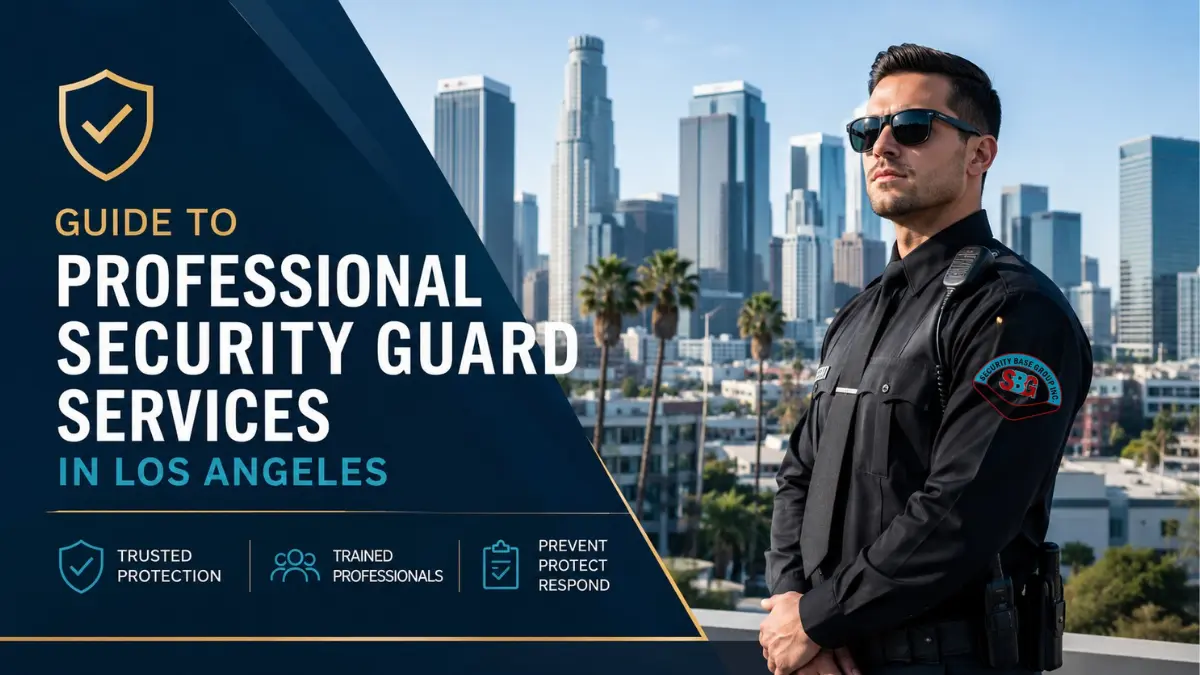
Guide to Professional Security Guard Services in Los Angeles
Introduction
Security threats facing businesses have grown more complex, and property crime, workplace violence, and liability concerns are pushing organisations to rethink how they protect people and assets. Professional security guard services in Los Angeles have become a frontline defence for companies that can no longer rely on cameras and locked doors alone. From construction sites to hospitals, the presence of a trained guard changes how a property is perceived by both visitors and potential intruders.
Choosing the right type of security service, however, is not always straightforward. Armed guards, unarmed patrols, mobile units, and specialised teams each serve different purposes, and picking the wrong fit can leave real gaps in coverage. Business owners, property managers, and event organisers need a clear understanding of what’s available before they commit to a contract.
This Guide to Professional Security Guard Services in Los Angeles walks through every major category of professional security guard services, explains which industries benefit most from each, and offers practical guidance for selecting a provider. Whether you manage a retail chain, a warehouse, or a residential community, you’ll find the information needed to make an informed security decision.
What Guide to Professional Security Guard Services in Los Angeles Refer to?
Professional security guard services refer to trained personnel hired to protect people, property, and assets through visible presence, monitoring, and rapid response. These guards are typically licensed, background-checked, and trained in areas such as conflict de-escalation, emergency procedures, and report writing. Their responsibilities range from monitoring entry points to conducting patrols and responding to incidents as they arise.
Security work generally falls into two categories: preventive and reactive. Preventive security focuses on deterring incidents before they happen, through visible patrols, access control, and consistent monitoring. Reactive security involves responding once an incident occurs, such as an alarm trigger, a disturbance, or a medical emergency.
Modern security guard services increasingly pair human personnel with technology, including surveillance cameras, alarm systems, and digital reporting tools. Even so, trained guards remain essential because they can exercise judgment, communicate with people directly, and respond to situations that technology alone cannot resolve.
Why Businesses Invest in Professional Security Services
Businesses across the country invest in professional security services for reasons that go well beyond simply having someone on-site. A visible security presence deters criminal activity before it starts, which helps protect both physical assets and the people who work in or visit a facility. Guards trained in emergency response can also act quickly during medical incidents, fires, or altercations, reducing the severity of outcomes.
Protecting valuable equipment, inventory, and infrastructure is another major driver, particularly for construction companies, warehouses, and retail operations facing theft risks. Beyond asset protection, a well-managed security program can reduce a company’s liability exposure by demonstrating that reasonable precautions were taken to prevent foreseeable harm.
Security also plays a role in customer and employee confidence. People are more likely to shop, work, or stay somewhere they perceive as safe. For industries with strict regulatory requirements, such as healthcare or financial services, professional security guard services also support compliance obligations tied to access control and incident documentation. Together, these factors make security an investment in business continuity rather than just a cost of doing business.
Types of Professional Security Guard Services
Every industry faces a different set of risks, which is why security providers offer a range of specialised services rather than a one-size-fits-all guard package. Understanding what each service actually includes helps decision-makers match coverage to their specific vulnerabilities.
Armed Security Services
Armed security guards are licensed and trained to carry firearms while on duty, typically undergoing additional certification beyond standard unarmed training. This service is best suited for locations facing higher-risk exposure, such as banks, jewellery stores, cash-handling operations, or facilities in high-crime areas. Armed guards are also common at government buildings and certain industrial sites where the potential threat level justifies the added protection.
The primary benefit of armed guard is the stronger deterrent effect against serious criminal activity, along with the capability to respond decisively if a threat escalates. Businesses considering armed security should verify that their provider maintains rigorous training standards and complies with all state-specific firearm licensing requirements.
Unarmed Security Services
Unarmed guards handle the majority of day-to-day security needs, including monitoring entrances, checking identification, conducting patrols, and de-escalating conflicts through communication rather than force. This option works well for office buildings, retail stores, apartment complexes, and hospitality venues where the focus is on visible presence and customer interaction rather than high-risk threat response.
Unarmed security tends to be more approachable for visitors and customers, since guards often serve as a point of contact for directions, building access, or general assistance. It’s frequently the right starting point for businesses without an elevated threat profile.
Mobile Patrol Security
Mobile patrol services involve guards conducting scheduled or randomised rounds across a property, often using vehicles to cover larger areas such as parking lots, business parks, or multi-building complexes. Patrols include checking for signs of forced entry, verifying that doors and gates are secured, and responding to triggered alarms.
Because the timing of patrols isn’t always predictable to outsiders, mobile patrol services add an unpredictability factor that helps deter opportunistic crime. This option is often more cost-effective than stationing a guard permanently on-site, particularly for properties that don’t require constant coverage.
Fire Watch Security
Fire watch guards are deployed when a building’s fire alarm or sprinkler system is temporarily out of service, which is often a legal requirement under local fire codes. Their role includes continuously monitoring the property for fire hazards, conducting scheduled walkthroughs, and maintaining detailed logs required by fire marshals.
This service is especially common on construction sites, where fire suppression systems may not yet be operational, or in older buildings undergoing system repairs. Fire watch security helps property owners remain compliant while protecting occupants during the outage period.
Construction Site Security
Construction sites face unique vulnerabilities, including expensive equipment left overnight, building materials that are easy to resell, and open perimeters that make trespassing simple. Security guards assigned to these sites monitor for theft, deter vandalism, and help enforce access restrictions to keep unauthorised individuals off active work areas.
Guards also contribute to worker safety by controlling who enters the site and monitoring for hazardous conditions after hours. Given the high value of stolen construction equipment nationally, this remains one of the most requested security services in the industry.
Event Security
Event security teams manage crowd flow, verify tickets or credentials at entry points, and respond quickly to any disturbances that arise during concerts, conferences, festivals, or private gatherings. Crowd management is often the most critical function, since large gatherings can quickly become unsafe without proper guidance and access control.
For higher-profile events, security teams may also provide close protection for VIPs or performers. Emergency response planning, including coordination with local law enforcement and medical personnel, is a standard part of comprehensive event security packages.
Commercial Security Services
Commercial properties, including office buildings, business parks, shopping centres, and industrial facilities, rely on security guards to manage access, monitor common areas, and respond to incidents involving tenants or visitors. Guards may staff a front desk, patrol parking structures, or monitor surveillance feeds from a central station.
Because commercial properties often house multiple tenants with different needs, security plans are typically customised to address shared spaces, after-hours access, and delivery management.
Residential Security Services
Apartment complexes, gated communities, and homeowners’ associations use residential security guards to manage visitor access, monitor common areas, and enforce community rules. Guards stationed at entry gates or patrolling common grounds help residents feel safer while reducing incidents of vandalism or unauthorised entry.
Visitor management is a particularly important function here, since residential communities need to balance security with convenience for residents expecting guests or deliveries.
Executive Protection Services
Executive protection, sometimes called close protection, involves trained personnel safeguarding high-profile individuals such as company executives, celebrities, or public figures. Services typically include threat assessments before travel, secure transportation planning, and constant situational awareness during public appearances.
This is a highly specialised field requiring guards with advanced training in threat detection and rapid response. Executive protection is most relevant for individuals facing elevated personal risk due to their visibility or role.
Retail Security Services
Retail security guards focus on preventing shoplifting, protecting employees during conflicts with difficult customers, and supporting broader loss prevention efforts. Their presence near entrances and high-theft areas serves as a visible deterrent, while their ability to intervene appropriately helps de-escalate confrontations before they turn dangerous.
Retail guards often work alongside store management and loss prevention teams to identify patterns of theft and address recurring issues.
Warehouse Security
Warehouses and distribution centres store significant amounts of inventory, making them attractive targets for theft, both from outsiders and, at times, employees. Security guards assigned to these facilities monitor loading docks, verify shipments, and control access to restricted storage areas.
Cargo security has become an increasing focus given the rise in trailer and freight theft nationwide, making consistent access control and monitoring especially valuable for logistics operations.
Healthcare Security
Hospitals and healthcare facilities require security guards trained to handle sensitive situations, including agitated patients, visitor disputes, and restricted-area access. Guards help maintain a safe environment for patients and staff while supporting compliance with facility protocols around visitor management.
Given the unpredictable nature of healthcare settings, guards in this field typically receive additional training in de-escalation and crisis intervention.
Hotel & Hospitality Security
Hotels rely on security personnel to protect guests throughout the property, including parking areas, lobbies, and hallways. Guards may also support concierge staff by responding to guest concerns or assisting with emergencies such as medical incidents or disturbances.
Because hospitality properties prioritise guest experience, security teams are often trained to maintain a professional, welcoming presence while still enforcing safety protocols.
Security Consulting & Risk Assessment
Security consultants evaluate a property’s vulnerabilities through detailed audits, identifying gaps in current security measures and recommending improvements. This can include physical security reviews, access control evaluations, and customised strategy development based on a facility’s specific risk profile.
Consulting services are often the starting point for businesses unsure of exactly what level of security guard coverage they actually need.
Industries That Benefit from Professional Security Services
Construction companies rely on security to protect expensive equipment and materials left unattended overnight. Retail businesses use guards to reduce shoplifting and support employee safety during customer disputes. Warehousing and logistics operations depend on access control and patrols to prevent inventory and cargo theft.
Manufacturing facilities often require guards to control access to hazardous areas and protect valuable machinery. Healthcare organisations need trained personnel capable of handling sensitive patient and visitor situations. Hotels use security to protect guests across large properties with multiple entry points.
Educational institutions rely on guards to monitor campus access and respond to emergencies involving students and staff. Government facilities typically require higher security clearances and often armed guard personnel due to elevated risk profiles. Financial institutions, including banks and credit unions, depend on security to protect cash handling and deter robbery attempts.
Residential communities use guards for visitor management and general community safety. Office buildings rely on security for access control and tenant protection. Special events of all sizes require dedicated teams to manage crowds and respond to incidents in real time.
How to Choose the Right Security Guard Service
Selecting a security provider starts with an honest assessment of your property’s actual risks, including crime history in the area, the value of assets on-site, and the number of people passing through daily. This assessment helps determine whether armed or unarmed guards are more appropriate, since armed coverage should be reserved for locations with a genuinely elevated threat level rather than applied by default.
Always verify that a security company’s guards hold proper state licensing and that they’ve completed required training programs. Ask about the provider’s experience in your specific industry, since a company that primarily services retail stores may not be well-suited for a hospital or construction site.
Reporting technology matters too. Look for providers offering digital incident reports, GPS-verified patrol logs, or real-time communication tools that give you visibility into what’s happening on your property. Availability and response times should also be discussed upfront, particularly for properties needing 24/7 coverage or rapid alarm response.
Finally, request a customised security plan rather than accepting a generic package. A provider willing to walk your property and tailor coverage to your specific vulnerabilities is generally a stronger long-term partner than one offering a one-size-fits-all solution.
| Factor | Armed Guard | Unarmed Security |
| Best for | High-risk locations, cash handling, elevated threat environments | General access control, customer-facing roles, day-to-day monitoring |
| Training | Firearm certification plus standard guard training | Conflict de-escalation, patrol procedures, reporting |
| Deterrent level | Higher for serious criminal activity | Effective for general deterrence and presence |
| Common industries | Banks, government facilities, high-crime areas | Retail, offices, residential communities, hospitality |
Frequently Asked Questions
1. What are professional security guard services?
Professional security guard services involve trained, licensed personnel hired to protect people, property, and assets through monitoring, patrols, and emergency response.
2. Which businesses need security guards?
Retail stores, warehouses, construction sites, healthcare facilities, hotels, offices, and residential communities all commonly use security guard services, though needs vary by risk level.
3. What is the difference between armed and unarmed security guards?
Armed guards carry firearms and undergo additional certification for higher-risk environments, while unarmed guards focus on monitoring, access control, and de-escalation without weapons.
4. When is fire watch security required?
Fire watch security is typically required when a building’s fire alarm or sprinkler system is temporarily out of service, often mandated by local fire codes during that outage period.
5. How do mobile patrol services work?
Mobile patrol guards conduct scheduled or randomised rounds across a property, often by vehicle, checking for security issues and responding to triggered alarms.
6. Are private security guards licensed?
Yes, professional security guards are generally required to hold state-issued licences, which involve background checks and completion of approved training programs.
7. Can I hire security guards for temporary events?
Yes, many security companies offer short-term contracts specifically for events such as concerts, conferences, and private gatherings.
8. What factors affect the cost of professional security services?
Cost is influenced by factors such as armed versus unarmed coverage, hours of service needed, guard experience level, and the specific risks associated with your property or event.
Conclusion
Professional security guard services have become a genuine investment in protecting people, property, and business continuity rather than an optional expense. With so many specialised options available, from armed guards to fire watch and event security, choosing the right fit depends on understanding your property’s specific risks and operational needs.
Partnering with an experienced, properly licensed security company gives businesses access to trained personnel who can adapt to whatever situation arises, backed by modern reporting technology and consistent oversight. The right provider will take the time to assess your property and build a plan around your actual vulnerabilities rather than offering a generic package.
If you’re ready to strengthen your security posture, reach out to Security Base Group for a free consultation to discuss a customised security plan tailored to your property, industry, and budget.


