
Construction Security Guards in Menifee, Hemet & More
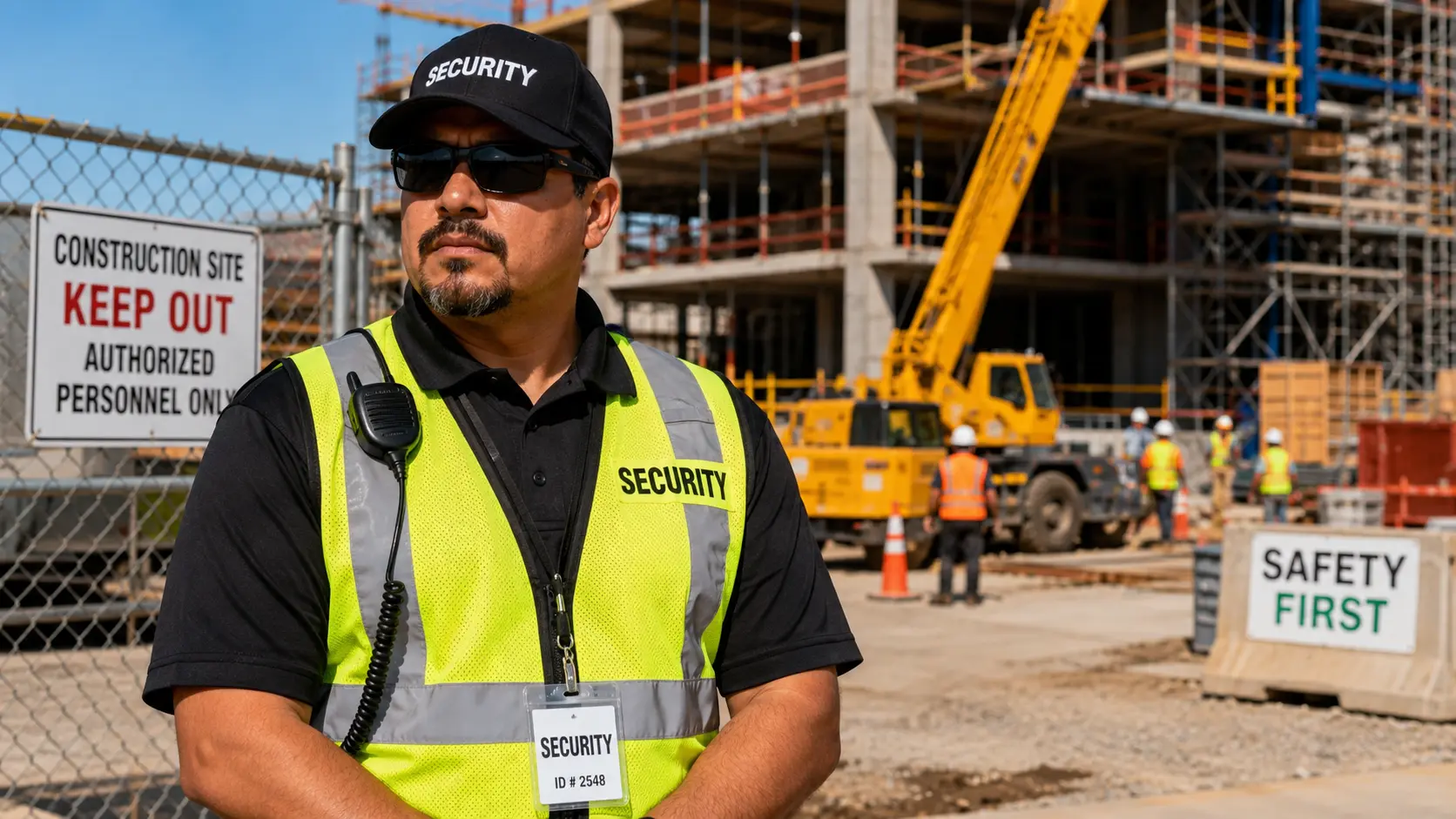
When a construction crew packs up for the day, a lot gets left behind. Heavy equipment sits in the open. Building materials are stacked outside, sometimes right next to the street. Gates that were propped open for deliveries may not get closed. Large sections of the property are unfinished, which means there’s no locked door, no alarm system, and often no one checking on the site until the crew comes back the next morning.
That gap the hours between when the last worker leaves and when the site becomes active again is where most construction-site problems happen. Unauthorized entry, theft of tools or materials, vandalism, trespassing, and unapproved vehicles pulling onto the property all tend to occur when nobody is around to notice.
Construction Security Guards in Menifee, Hemet & More give contractors and developers a way to close that gap. Instead of hoping a fence and a padlock hold up overnight, a security guard is physically present, watching the site, checking access points, and documenting anything out of the ordinary. This guide focuses specifically on construction security guards in Menifee, Hemet, Perris & Winchester, though the same approach applies anywhere across the broader Security Guard Company in Riverside County construction market.
The right approach isn’t the same for every project. A half-acre residential lot doesn’t need the same coverage as a ten-acre commercial development. The plan should be built around the site’s size, its current construction phase, how many access points it has, when work is happening, what equipment is on the ground, and what specific risks the project actually faces.
Why Construction Sites Need a Different Kind of Security
A finished commercial building has doors that lock, an alarm system, maybe a front desk. A construction site has almost none of that, and what it does have changes constantly. Fencing is often temporary and gets moved as work progresses. Multiple contractors and subcontractors come and go on different schedules, which makes it harder to know who’s supposed to be on the property at any given moment. Equipment gets delivered, staged, used, and removed in cycles. Buildings sit half-finished for weeks or months, with open framing and no functioning doors.
On top of that, construction sites go quiet in a way finished properties don’t. Nights, weekends, and any pause in the schedule mean long stretches with zero activity and zero oversight exactly when a large, open property is easiest to enter unnoticed.
Security Needs Change Throughout a Construction Project
A security plan that made sense during site preparation usually needs adjusting by the time the project reaches finishing work. Early on, the priority might be protecting excavation equipment and preventing trespassing on an open lot. During framing, the concern shifts toward lumber and material theft. Once electrical, plumbing, and finishing materials start showing up, items that are compact, valuable, and easy to carry off, access control and patrol frequency typically need to increase.
By project completion, the focus often shifts again, toward protecting finished interiors and appliances before the property changes hands. A provider that understands construction phases can adjust coverage instead of applying the same static plan from groundbreaking to final walkthrough.
What Construction Security Guards in Menifee, Hemet & More Can Actually Do
Monitor Construction Site Entrances
Most sites have more than one way in: a main gate for deliveries, a side opening for equipment, maybe a gap in temporary fencing. A guard stationed near the main entrance checks vehicles and personnel against who’s actually expected that day, logs contractor and vendor arrivals, and stops someone from walking or driving onto the property just because a gate was left open.
Conduct Scheduled or Random Patrols
Coverage at one gate doesn’t help if someone climbs a fence on the other side of the property. Patrols on foot, by vehicle, or both, depending on site size, cover the perimeter, equipment storage areas, material laydown zones, and any part of the site that’s harder to see from the entrance. Mixing scheduled patrols with random timing makes the coverage less predictable, which matters more than people tend to assume.
Protect Equipment and Materials
Excavators, skid steers, generators, and other heavy machinery represent serious capital investment sitting outdoors, often with keys nearby. Power tools, copper wiring, HVAC units, fuel, and building materials are compact enough to walk off with if no one’s watching. A guard who knows what’s supposed to be on the lot and what isn’t is more likely to catch something before it disappears than a camera reviewed after the fact.
Provide Overnight Security
Most sites sit completely unattended between roughly 6 p.m. and 6 a.m. Overnight coverage means someone actively checking the perimeter and entrances, positioned to notice if a vehicle pulls up that shouldn’t be there, which matters even more on sites without permanent lighting or fencing.
Document and Report Incidents
Every unusual event a vehicle that circled the block twice, a gate found open that should have been locked, a visitor who couldn’t explain their reason for being onsite gets written down, timestamped, and passed along to site management. That record matters if an insurance claim comes up later, and it gives a project manager an accurate picture of what’s happening on their site instead of relying on guesswork.
Common Construction-Site Security Risks in Riverside County
Every project carries some version of these risks, though the degree varies by site:
1. Unauthorized access through gates, gaps in fencing, or unfinished perimeters
2. Equipment theft, particularly smaller machinery that can be moved quickly
3. Material theft, especially copper, wiring, and finishing materials
4. Vandalism to structures, vehicles, or equipment
5. Trespassing, including foot traffic unrelated to the project
6. Property damage, whether intentional or from unauthorized use of equipment
7. Unapproved visitors who don’t have a legitimate reason to be onsite
8. After-hours activity when the site has no staff present
9. Blind spots on large perimeters that are difficult to monitor without dedicated coverage
10. Gaps during weekends or project shutdowns, when a site can sit untouched for days
Not every project faces the same exposure. A small infill lot has different risks than a ten-acre site on the edge of town with no neighboring activity. The smarter approach is evaluating the site’s actual conditions: layout, location, what’s stored there, and how long it sits unattended rather than defaulting to a generic package.
Construction Security in Menifee
Menifee has kept a steady pace of residential and commercial development, with new-home communities, commercial projects, and infrastructure work happening across different parts of the city at any given time. For contractors working these projects, the recurring issues tend to be large sites with multiple phases underway at once, staging areas that shift as work progresses, and multiple entry points that are hard to track without someone physically monitoring them.
A newer residential subdivision, for example, might have several unfinished homes standing at once, each with materials staged nearby and no permanent fencing separating one lot from the next. That layout makes overnight monitoring and regular patrols more useful than a single guard posted at one entrance. As Menifee’s development activity continues, a security presence that scales with a multi-phase project rather than a fixed arrangement that doesn’t adjust tends to serve contractors better over the life of the build.
Construction Security in Hemet
Hemet’s construction activity leans heavily toward residential building, commercial projects, and renovation work on existing properties. Renovation sites carry a slightly different risk profile than new construction: the building already has infrastructure in place, which can mean more points of entry to secure, plus materials and fixtures being swapped out that are worth taking.
For active commercial builds in Hemet, equipment protection and material storage tend to be the bigger concerns, particularly during phases when electrical and plumbing deliveries pile up faster than they can be installed. Access control matters too, especially on sites where multiple subcontractors work different schedules; a guard checking who’s actually supposed to be there cuts down on the confusion of an open, unsupervised jobsite. After-hours monitoring rounds this out, since renovation and commercial sites here often sit idle between active phases.
Construction Security in Perris
Perris has a mix of commercial development, industrial properties and infrastructure work, including road and bridge projects that add their own layer of complexity. Industrial and commercial sites here tend to run larger and more equipment-heavy than a typical residential lot, with construction vehicles, heavy machinery, and material stockpiles spread across a wide footprint.
That combination of large outdoor sites, expensive equipment, and multiple access points usually calls for a layered approach rather than a single guard checking one gate. Access control at the main entrances, regular patrols covering the full perimeter, and consistent incident reporting tend to work better together than any one piece alone, especially on sites where deliveries and equipment movement continue throughout the day.
Construction Security in Winchester
Winchester’s growth has been driven mostly by residential development, with new-home construction accounting for a large share of active projects. These sites are often large and open, without the kind of permanent structures or fencing that naturally limit access, which makes perimeter monitoring more important than it might be on a smaller infill project.
Building materials staged across an open lot, equipment left between framing phases, and long stretches of overnight inactivity are the recurring themes here. Access management at entry points, combined with overnight coverage during the phases when materials are most exposed, tends to address the bulk of what these sites face. As part of the broader Riverside County construction market, Winchester projects benefit from the same scalable coverage that applies across Menifee, Hemet and Perris, adjusted to the site rather than applied uniformly.
Should You Hire Security Guards for Your Construction Site?
A few honest questions can clarify whether a project needs dedicated security coverage: Are expensive tools or equipment stored onsite between shifts? Do materials get left overnight? Does the site have more than one entrance? Is the property large or laid out in a way that’s hard to monitor casually? Are workers onsite during irregular hours? Does construction continue on weekends? Is the project temporarily paused, leaving it unattended longer than usual? Are several contractors working different schedules at once? Does the site have a large or exposed perimeter?
Answering yes to several of these usually points toward needing more than a padlock and a fence. The specifics how many guards, what hours, patrol frequency depend on the answers, which is why a walk-through of the actual site tends to produce a more useful plan than a generic quote based on square footage alone.
Choosing the Right Construction Security Company
Not every security provider has real construction-site experience, and that gap shows up quickly once a guard is actually on a jobsite. Before hiring, it’s worth asking a few direct questions: Are guards properly BSIS-licensed, and can the company confirm it? Does the company have specific experience on construction sites, not just retail or office properties? What training do guards receive before being placed on an active jobsite? Can scheduling flex around nights and weekends? What does a typical patrol route look like for a site your size?
How are access-control procedures handled across multiple entrances? What does incident reporting look like, and how fast does site management get notified? Is a supervisor available if something comes up outside normal check-ins? Can coverage scale up or down as the project moves through different phases?
Security Base Group builds coverage around these specifics rather than offering one fixed package. A small residential lot might just need a single overnight guard and scheduled patrols. A large multi-phase development might call for gate security, several patrol points, and formal incident reporting. An industrial site tends to need access control at every entry point along with equipment-specific protection and vehicle monitoring. A weekend shutdown might only require temporary perimeter patrols for the exact window the site would otherwise sit unattended. None of these are fixed templates; they’re starting points adjusted after an actual walk-through of the site.
Frequently Asked Questions
How much do construction security guards cost?
Pricing depends on the number of guards, hours of coverage, site size, and the specific duties involved. The most accurate number comes from a quote based on the actual project rather than a flat rate.
Can construction security guards work overnight?
Yes. Overnight coverage is one of the most common requests, since that’s typically when a site sits unattended the longest.
Can guards monitor construction-site entrances?
Yes. Access control and visitor monitoring, checking who’s arriving and logging contractor and vendor traffic, are standard parts of most assignments.
Can security guards patrol a large construction site?
Yes. Patrol frequency and method can be adjusted based on the size of the property and the areas needing the most attention.
Do construction sites need security on weekends?
Often, yes. Weekends and shutdown periods can leave a site unattended for days, which is exactly the kind of window that benefits from added coverage.
Can construction security change as the project progresses?
Yes. As a project moves from site prep through framing, finishing and completion, the equipment, materials and risks onsite shift and coverage can shift with them.
Protect Your Construction Site in Menifee, Hemet & More
A construction site’s security needs come down to a handful of specifics: its size, its current phase, what equipment and materials are onsite, how many access points exist, and when the property sits unattended. Building a plan around those details rather than a generic package is what actually keeps a jobsite protected as it moves toward completion. Whether your project is one of the construction security guards in Menifee, Hemet, Perris & Winchester assignments we cover regularly, or another site elsewhere in Riverside County, the same approach applies. For more knowledge visit: Top 6 Construction Security Guard Companies in Riverside
Need Construction Security Guards for Your Project?
Contact Security Base Group to walk through your construction site, coverage requirements, and scheduling needs. Request a customized security quote today.


