
Apartment & HOA Security in Los Angeles: Stop Package Theft & Trespassing
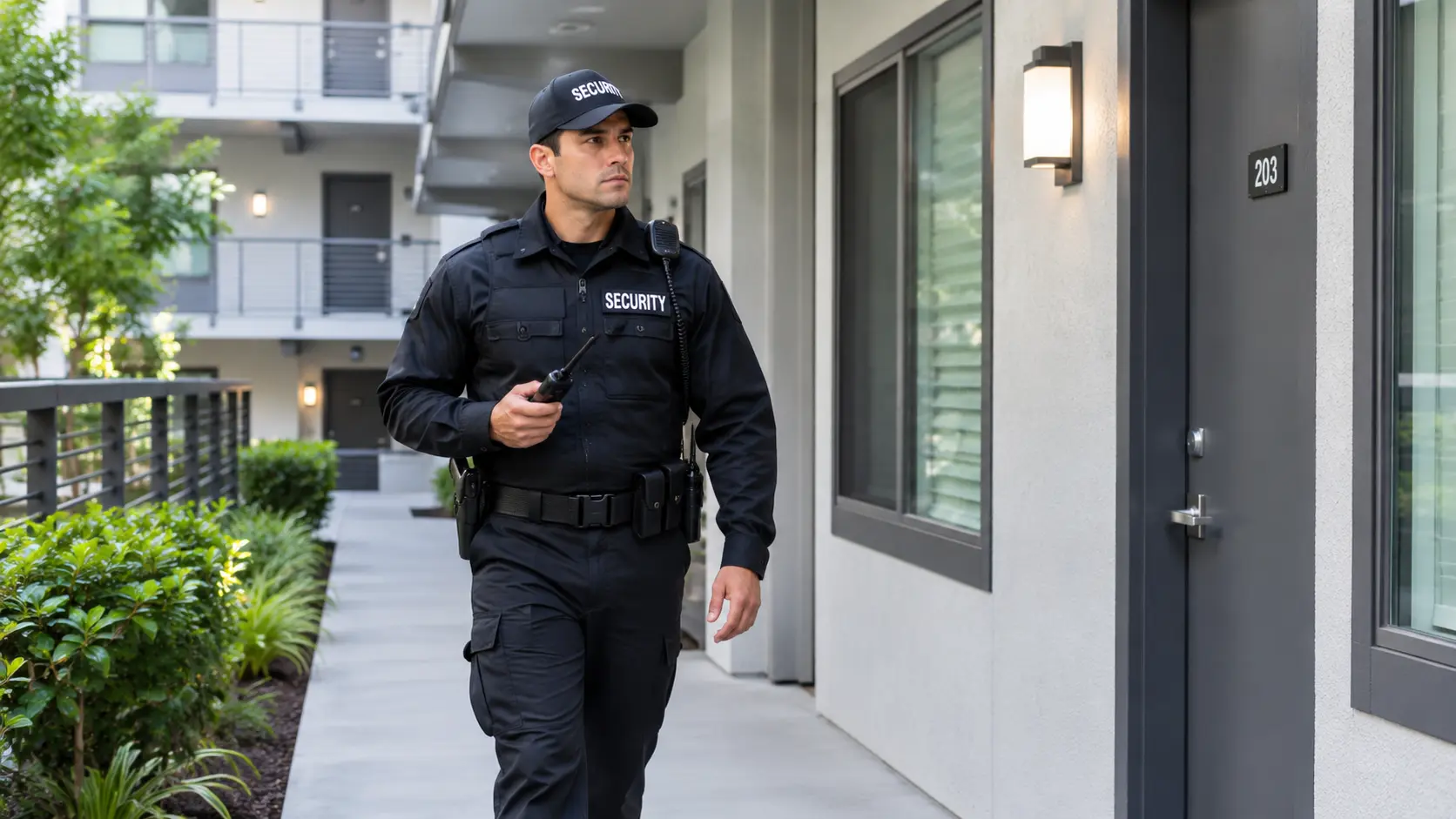
A resident comes home to find a delivery notification but no box. A stranger follows a tenant through the pedestrian gate and wanders the garage. A side door propped open for a contractor stays open all afternoon. Individually, these look like small lapses. Repeated across a building or a neighborhood of townhomes, they become the complaints that fill board meeting agendas and property manager inboxes.
Package theft, unauthorized visitors, tailgating, loitering, vandalism, and vehicle break-ins tend to cluster around the same places: mailrooms, package rooms, lobbies, garage entrances, stairwells, and poorly lit common areas. Cameras help document these problems, and access-control systems help limit them. Neither one watches a door, greets a visitor, or notices that the same unfamiliar person has been standing near the mail area for twenty minutes.
That is where professional physical security fits in. The strongest approach to Apartment & HOA Security in Los Angeles is layered: technology, procedures, and trained people working together. The sections below explain how each layer works and how to decide what your property needs.
Why Apartment & HOA Communities in Los Angeles Need Specialized Security
An office building empties at night. A retail store has one public entrance and set hours. A construction site has a defined perimeter and a limited group of authorized workers. A residential community has none of those advantages. People live there around the clock, guests arrive at all hours, and the property is meant to feel open and welcoming to the people who belong there.
Multiple Entry and Exit Points
Most multifamily properties have far more points of access than owners realize until they walk the site with security in mind. There are main entrances, pedestrian gates, vehicle gates, garage entries, side doors, service entrances, trash room exits, and emergency exits. Each one is a potential weak point, and each is often used in ways the original design never anticipated. A fire exit that opens onto an alley becomes a shortcut. A pedestrian gate that closes slowly becomes an invitation.
High Volume of Residents, Guests, Contractors and Deliveries
The bigger challenge is behavioral. On a typical day, a mid-sized apartment community sees residents, family members, food couriers, parcel carriers, maintenance vendors, cleaners, movers, and prospective tenants. Most are legitimate. The difficulty is that a well-meaning resident holding a gate for a stranger looks exactly like a tailgater getting in. Without someone who knows the property’s procedures and is paying attention, authorized and unauthorized activity blend.
Common Security Concerns
The issues property managers raise most often are consistent:
- Package theft from lobbies, doorsteps, and package rooms
- Trespassing and unauthorized access to buildings, pools, gyms, and garages
- Vehicle break-ins and unauthorized parking
- Vandalism and graffiti
- Loitering near entrances, mailboxes, and stairwells
- Suspicious activity that residents notice but have no one to report it to
Los Angeles adds its own texture: subterranean and podium-style parking, buildings with several street frontages, alley access, and large delivery volumes. Each affects where the vulnerable points are, which is why a generic approach rarely works.
How Security Guards Help Prevent Package Theft in Apartment Communities
Most package theft is opportunistic. Someone sees a pile of boxes in an unattended lobby, or a delivery left at a door, and takes the chance. The goal of a good security program is to remove that opportunity, or at least make it uncomfortable. No guard can promise to eliminate theft, but trained personnel can reduce the conditions that make it easy.
Package Room and Delivery Area Monitoring
Guards can monitor package rooms, mailrooms, lobbies, delivery entrances, and designated drop-off areas, either from a fixed post or through frequent checks. They can make sure carriers use the intended entrance, that package room doors latch properly, and that nobody lingers in the area without a reason. When deliveries peak, this attention matters most.
Access Control
Package theft often starts with a breach of access. A security officer at a lobby or gate can verify visitors, follow the property’s delivery procedures, and confirm that a person entering is a resident, a guest, or a legitimate vendor. Just as important, an officer can prevent tailgating by noticing when someone slips in behind a resident. Technology can log a door opening, but it usually cannot tell that the person walking in behind is a stranger.
Visible Security Presence
A uniformed officer sends a clear message that the property is watched. For opportunistic thieves, that visibility can be enough to move on to an easier target. It also reassures residents, many of whom report feeling more comfortable when they see someone paying attention to the property.
Incident Documentation
Consistent records are one of the most underrated benefits of professional security.
Good documentation includes:
- Incident reports with time, location, and description
- Timely communication with property management
- Coordination with available camera footage
- Identification of recurring problem areas, such as a specific door or time of day
Over weeks and months, those reports show patterns. Maybe most losses happen on weekday afternoons, or one side entrance is used repeatedly. That evidence lets a board or manager fix the actual problem rather than guess.
If package theft or trespassing has become a recurring topic at your property, a customized security assessment can help identify where the gaps are before you commit to a staffing plan.
How Apartment & HOA Security Helps Stop Trespassing
Trespassing at a residential property rarely looks dramatic. It might be someone sleeping in a stairwell, a person using the pool after hours, or an individual testing car doors in the garage. Stopping it depends on noticing early, documenting accurately, and escalating properly.
Gate and Entry Monitoring
Security personnel can monitor how residents, guests, contractors, and delivery drivers enter, and can apply consistent rules to each group. After hours, when there are fewer residents around to notice something odd, an attentive officer at a gate or lobby becomes especially valuable. Clear procedures matter: who is on the guest list, what a contractor must show, when deliveries are accepted.
Parking Garage and Perimeter Patrols
The areas where trespassers prefer to operate are usually the least visible: parking structures, stairwells, side entrances, alleys, property boundaries, and back corners of common areas. Regular patrols of these locations serve two purposes. They discourage unauthorized activity, and they catch conditions such as broken locks, propped doors, or burned-out lights before they become a problem. Unpredictable patrol timing helps too, since anyone watching the property cannot rely on a fixed schedule.
Observation, Documentation and Escalation
It is worth being clear about what security officers are and are not. Licensed security guards in California are not police officers and do not have police powers. Their job is to observe, deter, document, follow the property’s procedures, and escalate appropriately, which may mean contacting management or calling law enforcement. That is a strength rather than a limitation. A calm, professional response that follows a written protocol protects residents, the property, and the guard.
Choosing the Right Security Model for an LA Apartment or HOA
No single model fits every community. The right choice depends on the property’s size, layout, incident history, and budget.
On-Site Residential Security Guards
A dedicated guard makes sense when a property has a lobby, a single main entrance, heavy package volume, or a need for constant access control. Residential security guards in Los Angeles often handle lobby monitoring, visitor verification, package-area checks, common-area patrols, resident assistance, and incident reporting. The advantage is continuity: the officer learns the faces, the routines, and what looks out of place.
Mobile Patrol
For larger sites, a fixed post may not be the most efficient answer. Mobile patrol in Los Angeles can serve large HOAs, gated communities, multi-building developments, and properties with extensive parking or perimeter areas. A patrol officer drives or walks the property on a schedule, sometimes randomized, performing tasks such as:
- Parking inspections
- Perimeter and gate checks
- Common-area inspections
- Documented incident reporting
Because patrol officers cover ground rather than stand in one place, the coverage tends to be broader for the same budget, though the presence is less constant than a stationed guard.
Armed Security Guards
Some properties consider armed officers based on their risk profile, prior incidents, client requirements, or insurance and contract considerations. Armed guards in Los Angeles are one option among several, and not every apartment building or HOA needs them. For many properties, unarmed guards paired with strong procedures and patrol coverage are the more appropriate fit. The decision should follow a documented risk assessment and a clear security plan, not fear.
If you are weighing these models, a short security consultation can help you compare them against your actual property rather than a generic template.
A Layered Security Plan for Los Angeles Apartments & HOAs
Effective residential security is not simply placing a guard at a gate. It is a set of layers that support one another.
- Layer 1: Access Control: Entrances, gates, visitor procedures, and delivery procedures define who gets in and how. Clear rules applied consistently do more than expensive hardware used inconsistently.
- Layer 2: Physical Security Presence: Security officers, lobby coverage, and package-area monitoring supply the human judgment that technology lacks. They notice behavior, not just events.
- Layer 3: Mobile Patrol: Patrols cover parking areas, perimeters, common areas, and vulnerable locations that a fixed post cannot see.
- Layer 4: Security Technology: CCTV, access-control systems, lighting, and alarms create records and reduce blind spots. They are most effective when someone reviews and acts on what they capture.
- Layer 5: Incident Reporting and Response: Incident reports, management notification, and escalation procedures turn observations into decisions. Tracking recurring issues tells you where to adjust the other four layers.
Technology and guards are not competitors. A camera records what happened, a guard can prevent it, and a report explains what to change.
What Should an Apartment or HOA Security Plan Include?
Before signing a contract, boards and managers should expect a plan that covers the following.
- Security assessment: A walk-through that considers property layout, previous incidents, entry points, package delivery patterns, parking facilities, and vulnerable areas.
- Clearly defined guard duties: Written post orders that specify where guards are stationed, which areas they patrol, how visitors are handled, what they must report, and how incidents are escalated. Vague duties produce inconsistent results.
- Coverage schedule: Needs shifts across daytime, evenings, overnight hours, weekends, and high-delivery periods. A property may need a lobby presence during peak delivery hours and patrol-only coverage overnight.
- Reporting: Patrol logs, incident reports, management notifications, and a way to track recurring issues.
- Security plan reviews: Plans should be revisited when conditions change: new incidents, resident complaints, a renovation, a new access system, or a change in package volume. A plan that never changes eventually stops fitting the property.
How Much Security Does an Apartment or HOA Need?
There is no universal number, and anyone who offers one without seeing your property is guessing. Staffing depends on the number of units, property size, number of buildings, entrances and exits, parking structures, gate configuration, package volume, previous incidents, desired coverage hours, layout, and overall risk.
A few illustrative scenarios show how different the answers can be:
- A small community of a few dozen units with one gate might do well with scheduled mobile patrol during evening and overnight hours and a strong access procedure.
- A medium-sized apartment property with a lobby, package room, and garage might combine a stationed officer during peak hours with patrol coverage at night.
- A large multi-building HOA with several gates and extensive parking may need gate coverage, roving patrols, and a supervisory structure.
These are examples, not prescriptions. What matters is starting with the property’s real conditions.
Why Choose Security Base Group for Apartment & HOA Security in Los Angeles?
Security Base Group is a Los Angeles-based provider that serves residences, investment properties, and the families and residents who live in them. For property managers and HOA boards looking at Apartment & HOA Security in Los Angeles, several practical points stand out:
- Residential focus: The company’s work centers on protecting homes, vacation properties, and investment properties.
- Licensed and bonded: Security Base Group states that it verifies licenses, permits, and criminal records, and conducts federal-level background checks and in-person interviews for its guards.
- Trained personnel: Guards are described as continually tested and trained to make sound decisions in high-stress situations.
- Flexible options: Services can be arranged to fit different properties, including stationed and patrol coverage, with armed and unarmed choices depending on the plan.
- Communication: The company describes a notification process built to keep clients informed.
- Simple booking: Online booking and payment options make it easier to get started.
Every property is different, so we start with a conversation and a site-specific plan. To discuss your community, request a quote or security consultation.
Apartment & HOA Security in Los Angeles: What Property Managers Should Look For
When comparing providers, these questions separate a capable partner from a vendor that simply supplies bodies.
- Does the company have experience with apartment or HOA properties?
- Does it offer both armed and unarmed options?
- Does it provide mobile patrol?
- How are patrols documented, and can you see the records?
- How are incidents reported, and how quickly is management notified?
- Can coverage be customized by hour, day, and season?
- How are guards trained and assigned to your property?
- Can it provide overnight coverage?
- How are property-specific procedures written and enforced?
- Who is your point of contact, and how does the company communicate with management?
You can also check a company’s and individual guards’ license status through the California Bureau of Security and Investigative Services (BSIS), which regulates the industry in the state.
Frequently Asked Questions
1. What does apartment security in Los Angeles include?
It typically combines access control, visitor and delivery procedures, on-site guards or mobile patrol, package-area monitoring, and incident reporting. It often works alongside cameras, lighting, and alarms. The exact mix depends on the property’s size, layout, and risk profile.
2. Can security guards help prevent package theft?
Yes, though they cannot guarantee it will stop entirely. Guards can monitor package rooms and delivery areas, verify visitors, deter opportunistic thieves through visible presence, and document incidents so management can spot patterns and fix weak points.
3. Do HOAs need armed security guards?
Not necessarily. Many HOAs are well served by unarmed guards or mobile patrol. Armed officers may be considered depending on the community’s risk assessment, incident history, and contractual or insurance requirements. The decision should follow a written security plan.
4. What is mobile patrol for an HOA?
Mobile patrol means a security officer periodically checks the community by vehicle or on foot, often on a scheduled or randomized basis. Typical tasks include inspecting parking areas, checking gates and perimeters, reviewing common areas, and filing incident reports.
5. How many security guards does an apartment complex need?
There is no fixed number. It depends on units, buildings, entrances, parking, package volume, incident history, and coverage hours. A site assessment is the reliable way to determine whether stationed guards, patrol, or a combination fits.
6. How can I get Apartment & HOA Security in Los Angeles?
Start by requesting a customized security assessment. A provider should review your property, discuss your concerns, and recommend coverage options. From there, you can compare a proposed plan, coverage schedule, and pricing.
Protect Your Los Angeles Apartment or HOA From Theft & Trespassing
Package theft, unauthorized access, and trespassing are rarely solved by a single tool. They improve when access control, a visible physical presence, mobile patrol, technology, and consistent reporting are designed to work together for a specific property. The right mix depends on your buildings, your residents, and what your own incident records show.
Security Base Group works with property managers and HOA decision-makers who want a plan built around their community rather than a standard package. If you are ready to look at your options, contact us; we would be glad to talk it through.


