
After-Hours Security Guards in San Diego: 7 Ways They Protect At Closing
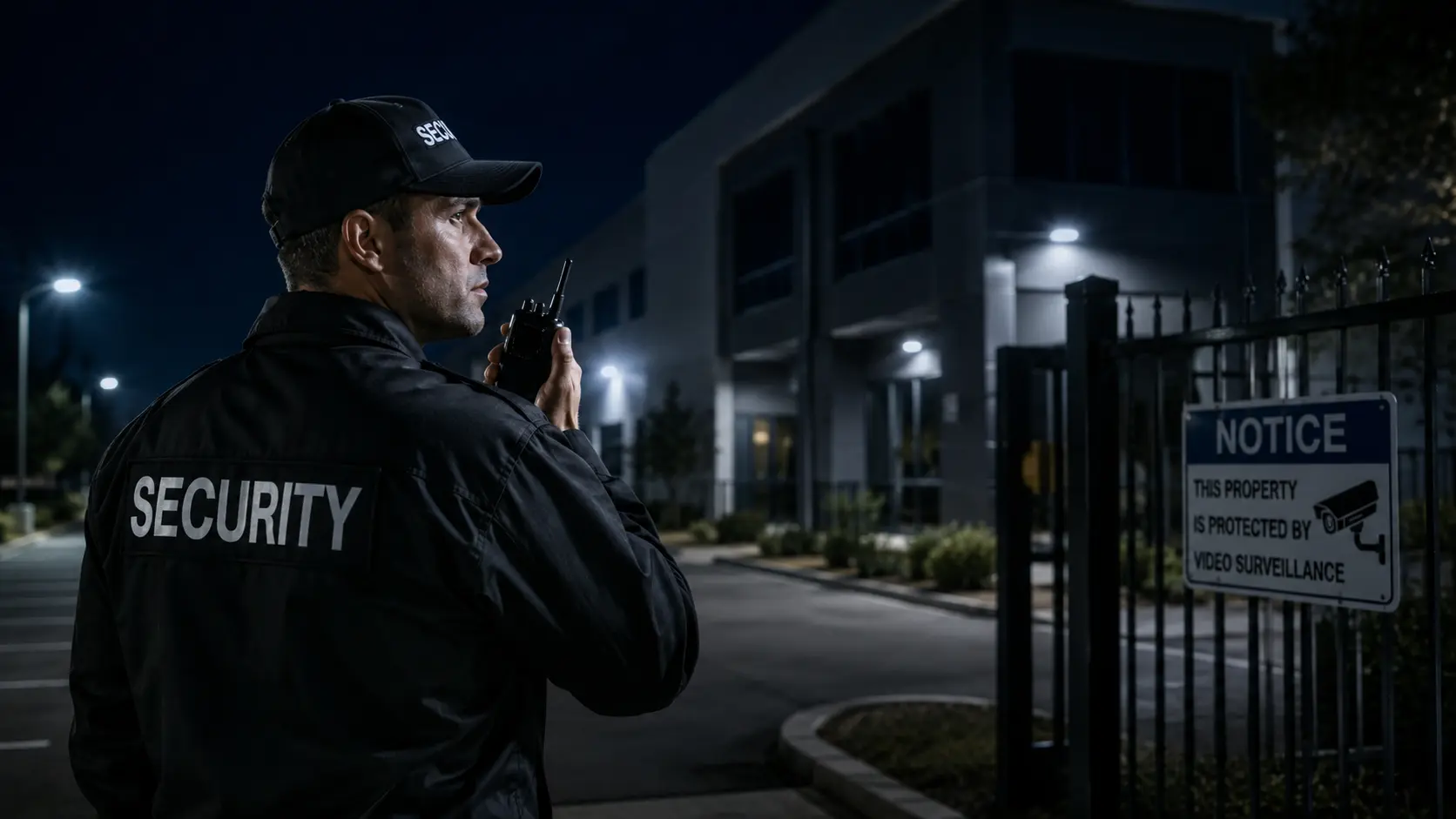
It’s 9 p.m. The last employee has locked the front door and punched in the alarm code. The lights are off except for a fixture or two near the loading dock. The parking lot is empty. But the inventory is still in the warehouse, the equipment is still in the office, and the vehicles are still parked out back. Nothing about the building’s value disappeared just because the workday ended. So who’s actually keeping an eye on things between closing time and the moment someone unlocks the door the next morning?
That’s a question a lot of San Diego business owners don’t think about until something goes wrong. After-hours security guards in San Diego businesses aren’t hired because a crime is guaranteed to happen. They’re there because risk doesn’t clock out at 5 p.m., and an empty building overnight patrol is a different security situation than a staffed one during business hours.
This article covers what an after-hours security guard company in San Diego actually do, why the hours after closing matter, and how to figure out whether your business needs this kind of coverage.
Why Do Businesses Need Security After Closing?
During business hours, a property gets a certain amount of built-in security just from having people around. Employees notice unfamiliar visitors, customers make it harder for anyone to loiter unnoticed, and managers are on-site to handle problems as they come up. Once the doors close, that layer disappears; the building is empty, or close to it, and no one’s around to notice a side door that doesn’t latch, or a car parked near the loading area for twenty minutes too long.
Commercial properties also tend to have more entry points than people realise: front entrances, side doors, loading docks, storage yards, and parking structures. Staff naturally cover these areas during the day just by moving through the building; at night, that stops happening on its own, and none of the inventory, tools, or materials on the property gets put away just because the sun went down.
The point isn’t to assume the worst will happen every night. After-hours security is really about having a plan and an appropriate presence once regular staff are gone, not a reaction to a specific threat.
What Do After-Hours Security Guards Actually Do?
Duties vary by property and post orders, but common tasks include property patrols at set intervals; entrance and exit monitoring and access control after hours; checking restricted areas to keep storage rooms or sensitive spaces secure; exterior inspections for anything out of place, like a propped-open door; watching for suspicious activity, such as unfamiliar vehicles or people who don’t belong; monitoring assigned security systems where that’s part of the post orders; incident documentation and communication with management; and contacting emergency services when a situation calls for it.
Not every guard performs every one of these on every shift. A single guard checking a retail store on an overnight patrol looks different from a mobile patrol driving past a warehouse complex three times a night. Scope depends on what the business actually needs.
7 Ways After-Hours Security Guards Protect San Diego Businesses
1. Help Deter Theft and Break-Ins
A visible security presence changes the calculation for anyone considering breaking into a property. Someone looking for an easy target is usually looking for a building that appears unwatched. A marked vehicle, a guard on patrol, or clear signage can discourage that kind of activity. To be clear, a guard on-site doesn’t eliminate theft or break-ins; a visible presence reduces opportunity and makes a property a less appealing target than one with no coverage at all.
2. Detect Suspicious Activity
Trained personnel are generally better positioned to notice things that don’t fit a property’s normal pattern, since it’s their job to pay attention. That might mean an unfamiliar vehicle parked too long near a back entrance, someone walking around a restricted area without a clear reason, or a gate left open that’s normally closed. Guards aren’t investigators or law enforcement; they’re trained to notice activity that seems out of place and respond according to the property’s procedures: documenting it, notifying management, and contacting police if warranted.
3. Help Control Unauthorised Access and Trespassing
Access control tends to matter more once regular staff leaves. During business hours, employees, vendors, and visitors move through spaces where people expect to see them. After closing, anyone on the property a late vendor, a contractor, a manager who forgot something needs an actual reason to be there, and guards can help verify that. This matters especially at loading docks and secondary entrances, which don’t always get the same attention as a main entrance.
4. Help Reduce Vandalism and Property Damage
Vandalism tends to happen specifically because no one’s around to see it. Broken windows, graffiti, damaged doors, and tampering are all more likely on a property that looks unattended overnight patrol. This applies broadly to commercial buildings, construction sites, parking structures, and vacant properties. A construction site with no overnight patrol coverage is a common target, since the loss can delay a project and cost real money to replace.
5. Conduct overnight patrol Property Patrols
Regular patrols, whether a guard walking a building’s interior and exterior or a mobile patrol on a route, cover ground a fixed camera can’t. A patrol can confirm a gate is actually locked, not just that it looks closed on camera, and can notice a car that doesn’t belong or check areas without full camera coverage. None of this guarantees that nothing will happen, but regular patrols create a stronger, more consistent presence than relying on Security Cameras alone, since a patrol actively moves through a space rather than passively recording it.
6. Respond to Alarms and Security Concerns
When an alarm goes off, or something looks off, having a guard on-site or nearby means someone can look into it directly instead of the business owner finding out the next morning. Depending on the assignment, a guard’s role is usually to assess the situation, follow established procedures, document what they find, notify management, and contact police, fire, or medical services if needed. Security guards are not a replacement for police, firefighters, or paramedics, and no legitimate company should promise a guaranteed response time. What guards provide is an added layer of awareness and a documented response process for situations that might otherwise go unnoticed until morning.
7. Document overnight patrol Incidents
Good incident reporting is one of the more underrated parts of after-hours security. When something happens during overnight patrol, even something minor, like a door found unlocked that should have been secured, a clear written record matters. A solid report typically covers what happened, when, where, what action was taken, and who was notified. That gives business owners something concrete to review the next morning, and it matters for insurance claims and for spotting patterns, like a specific entrance that keeps having issues.
Which San Diego Businesses Benefit From After-Hours Security?
Not every business has the same risk profile. Retail stores deal with inventory on shelves overnight, patrol and a real risk of vandalism or break-ins. Warehouses hold significant inventory, often with harder-to-monitor loading docks.
Construction sites are a common target because materials sit out overnight, often behind fencing that’s easier to breach than a locked building. Office buildings need coverage for shared entrances and parking, particularly in multi-tenant buildings where after-hours visitors are hard to track.
Apartment communities often need coverage for gated entrances and visitor access. Commercial properties with multiple tenants tend to have a more complex picture, and hotels deal with overnight guest activity and entrances that need to stay accessible while still being monitored. A small retail store with one entrance doesn’t need the same coverage as a multi-building commercial complex. Security needs should match the property, not a generic template.
After-Hours Security Guards vs. Security Cameras: Which Is Better?
This is a fair question, especially for owners who already have Security Cameras installed. Security Cameras and guards do different things, and neither fully replaces the other.
Security Cameras can provide continuous video monitoring, recorded footage, remote visibility, and evidence after the fact. Security guards can provide physical presence, human judgment, active patrols, access control, on-site assessment, and documented incident reports.
A camera can record a break-in as it happens, but it can’t stop it or walk over to check a suspicious vehicle. A guard can do that but doesn’t provide the continuous recorded coverage a camera system does. For a lot of San Diego businesses, the two work best together: Security Cameras extend a guard’s visibility, and a guard adds physical response that Security Cameras alone can’t provide.
How Many After-Hours Security Guards Does a Business Need?
There’s no single number that applies to every property. Staffing depends on the size of the property, how many buildings and entrances are involved, how much parking needs to be covered, general risk level, operating hours, and how many separate security posts might be needed. A single-entrance retail store might only need one guard checking the property on a schedule, while a large warehouse complex with multiple loading docks might need more coverage, or a mix of a stationed guard and mobile patrol.
If you want a sense of what your property might need, Security Base Group’s security guard calculator can give you an initial estimate. It’s a useful starting point, but actual staffing decisions should come from a closer look at your specific property and requirements.
What Type of After-Hours Security Is Right for Your Business?
On-site security guards make sense for properties that need a continuous physical presence, such as large warehouses, active construction sites, or properties with multiple access points needing consistent overnight patrol monitoring. Mobile patrol security can be a good fit where a scheduled check-in, rather than a guard stationed all night, is enough often smaller retail locations or office buildings on a patrol route.
Unarmed security covers general protection duties like access control, patrols, and monitoring, and is the right fit for most commercial properties. Armed security may be appropriate for certain higher-risk assignments, depending on circumstances; it’s not automatically the better option, and an experienced company should explain whether it’s actually warranted rather than upselling it by default.
What Should San Diego Businesses Look for in an After-Hours Security Company?
A few practical questions help: Are the guards properly BSIS licensed and trained? Does the company carry appropriate insurance? Do they have experience with similar properties? Can coverage be customised rather than sold as a one-size-fits-all package? Is there supervision during shifts, and how are incidents documented and reported to you? A company that answers these clearly, without vague or evasive responses, is generally worth taking seriously.
When Should a Business Consider After-Hours Security?
A business might want to look into additional coverage if it has experienced theft or vandalism before, stores valuable inventory, has expensive equipment, multiple hard-to-monitor entrances, a large or poorly lit parking area, a history of trespassing, overnight patrol operations, a construction site with exposed materials, or recurring after-hours incidents, even minor ones. None of these on their own means a business absolutely needs a guard stationed there every night, but they’re reasonable signs it’s worth having a real conversation about what level of coverage makes sense.
Frequently Asked Questions
What do security guards do after a business closes?
Guards typically patrol the property, monitor entrances and exits, check restricted areas, and watch for anything unusual. Depending on the assignment, they may also monitor security systems, control after-hours access, and document incidents.
Can security guards patrol a business overnight?
Yes. overnight patrol patrols are one of the most common after-hours services. Guards may walk or drive through a property at set intervals, checking doors, gates, and exteriors. Frequency depends on the property’s size and the arrangement made with the company.
Are after-hours security guards worth it?
It depends on the property and its risks. Businesses with valuable inventory, multiple entrances, a history of theft or vandalism, or overnight patrol operations often find guards worthwhile, since they add physical presence that Security Cameras alone don’t provide.
Can security guards respond to alarms?
Guards can often assess an alarm event, follow established procedures, document what they find, and notify management, contacting emergency services if needed. Guards don’t guarantee a specific response time and aren’t a substitute for police, fire, or medical responders.
Do small businesses need after-hours security?
Not every small business needs a guard on-site every night. It depends on inventory value, past incidents, and how exposed the property is after hours. Some benefit from occasional mobile patrols rather than continuous coverage.
How many security guards does a business need at night?
There’s no universal number. It depends on property size, entrances, parking areas, and risk level. A single-location retail store may need far less coverage than a multi-building complex. A security guard calculator can offer a starting estimate, but a closer property review gives a more accurate answer.
Final Thoughts: After-hours security guards in San Diego
A business doesn’t stop being vulnerable the moment employees lock up and go home. The inventory, equipment, and property are still there, and an empty building overnight patrol presents a different kind of risk than one that’s staffed and active during the day.
After-hours security guards in San Diego can help provide a visible deterrent, regular property patrols, access control, monitoring for suspicious activity, documented incident reporting, and an established process for responding when something does come up. None of this guarantees that nothing will ever happen, but it does mean someone is actually paying attention during the hours when most people aren’t.
If you’re a San Diego business owner trying to figure out what level of after-hours coverage fits your property, it’s worth taking a closer look at your specific risks, the number of entrances, the value of what’s on-site, and your property’s layout. Security Base Group works with San Diego businesses on this kind of planning, and their San Diego security guard services page is a good place to start.


