
Office Lobby Security Guards in Los Angeles: Access Control & Protection
Introduction
It is 8:50 on a Monday morning. A man in a courier jacket walks into a ten-story office lobby with a box and says it has to go to the sixth floor. He has no name, no tracking number, and no appointment. The front desk is busy, a group of employees is swiping in behind him, and the elevators are open.
What happens next depends on whether anyone owns the lobby. In a well-run building, a trained guard greets him, asks who the delivery is for, calls the recipient, and handles the package through an approved process. In a building without that structure, he simply rides up.
That gap is why office lobby security guards in Los Angeles matter. The lobby is the one place where every employee, client, vendor, and stranger passes through the same door. This guide explains what lobby guards do, how visitor screening and access control work day to day, how to choose between guard coverage options, and what to check before you hire.
Why Office Buildings in Los Angeles Need Dedicated Lobby Security
Los Angeles offices range from single-company headquarters to multi-tenant towers, professional suites above retail, and campuses with attached parking structures. What they share is a front door that serves many people with different reasons for being there.
Without dedicated lobby coverage, the same problems tend to appear:
- Unauthorized entry: Doors get propped open for convenience, and people follow badge holders inside.
- Weak visitor accountability: A paper sign-in sheet nobody reads cannot tell you who is in the building during an evacuation.
- Access-control gaps: Badge systems only work if someone notices when they are bypassed or when a lost card stays active.
- Unmanaged deliveries: Couriers, vendors, and contractors move between floors unverified.
- Employee safety: A receptionist is often alone with whatever walks in, including a disruptive visitor.
You do not need a crime statistic to see the issue: a lobby without an owner is a lobby where nobody is accountable. Multi-tenant buildings add a further layer, because the building must serve every tenant while keeping each floor private. Our guide to security guard services for multi-tenant commercial buildings covers that shared-property view. This article stays at the front door.
What Do Office Lobby Security Guards in Los Angeles Do?
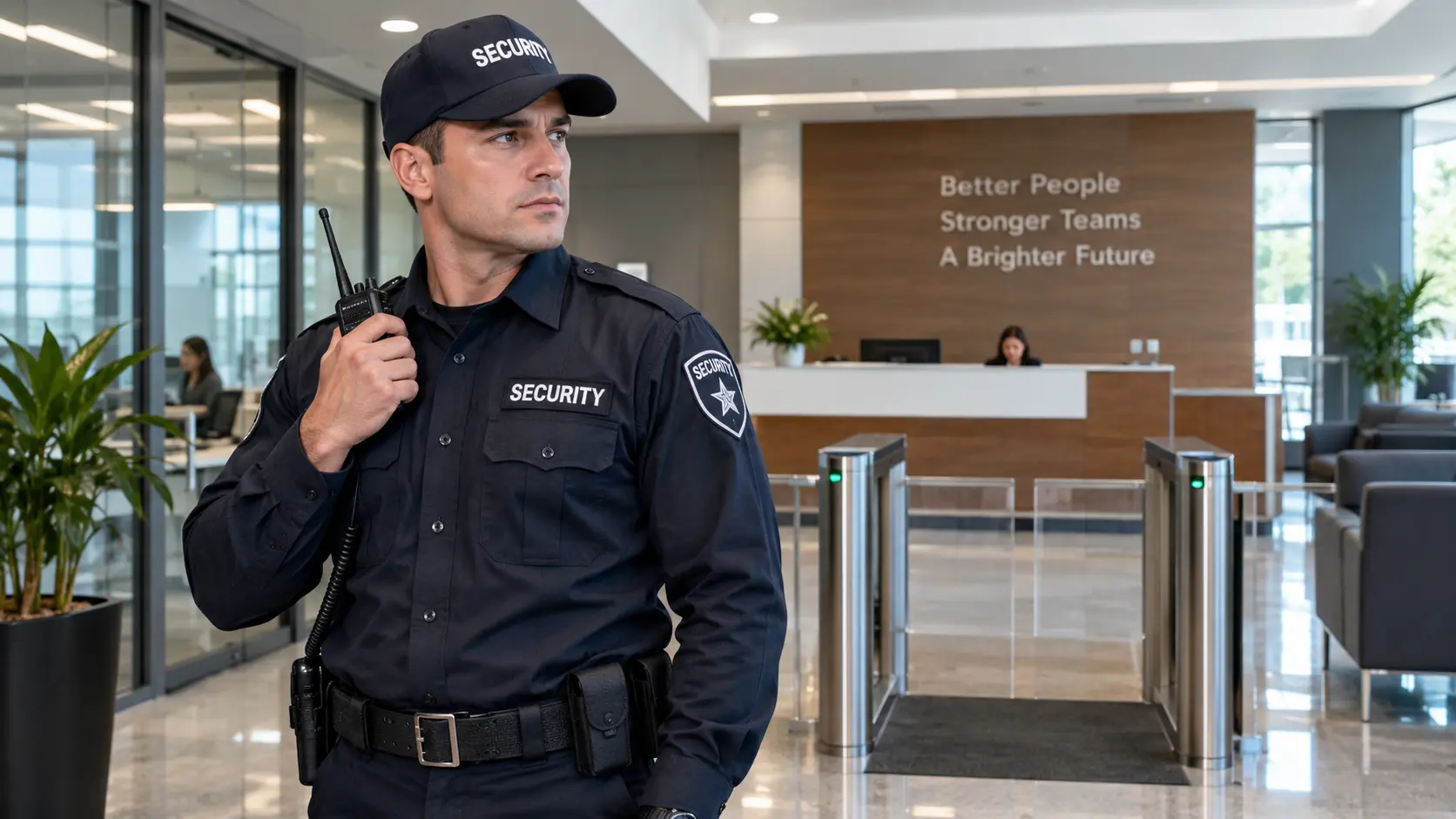
A lobby guard combines security duties with front-of-house professionalism. The work falls into four areas.
Visitor Screening and Identity Verification
Screening works best as a repeatable sequence rather than a judgment call:
- Greet the visitor and ask for their name, company, and host.
- Check the visit against the appointment list, if the tenant provided one.
- Contact the host to confirm before granting entry.
- Register the visitor in the log or visitor-management system.
- Check ID when building policy requires it.
- Issue a temporary badge and direct or escort the visitor to the right floor.
- Sign the visitor out and collect the badge on departure.
Consistency is the point. A guard who follows the same steps for the CEO’s guest and for a stranger is far harder to talk past than one who relies on instinct.
Lobby Access Control and Tailgating Prevention
Tailgating, when an unauthorized person follows a badge holder through a door or turnstile, is one of the most common ways access control fails. It is rarely malicious on the employee’s part, which is why a guard’s presence matters.
Guards manage entry by watching turnstiles and elevator banks, politely asking unbadged people to check in, and applying badge rules the same way for everyone. When someone tries to bypass the process, the guard redirects calmly rather than confronting. Persistent or suspicious attempts are logged and reported to building management. Guards also coordinate with property managers on restricted floors, after-hours entry lists, and lost or deactivated badges.
Front Desk and Reception Support
In many offices, the guard is also the company’s first impression. Duties include greeting guests, directing approved visitors, notifying employees of arrivals, and receiving scheduled deliveries. Security Base Group’s reception security guard services describe this blend: guards who answer phones, receive scheduled deliveries, and admit authorized employees while watching for people who should not be there. A lobby can be welcoming and controlled at the same time.
Incident Reporting and Emergency Coordination
Anything unusual gets written down: time, location, people involved, and actions taken. Reports help managers spot patterns and support insurance and legal needs. Guards follow set escalation steps: notify the supervisor, contact building management, and call 911 for a medical emergency, fire, threat, or crime. During an evacuation, an accurate visitor log helps account for guests.
A practical example: A visitor says he has a meeting with “someone in accounting” but cannot name the person. The guard stays polite: “I’d be glad to help. Can I get the name of the person you’re meeting, or the company you’re here to see?” When the visitor can’t answer, the guard offers to call the suite’s main number, explains that the building requires a confirmed host before entry, and invites him to wait in the lobby seating. The guard does not argue, accuse, or block the door. If the visitor grows agitated or lingers, the guard notifies the supervisor and property manager and records the encounter. The result is calm, documented, and consistent with building policy.
Unarmed Guards in Los Angeles vs. Armed Lobby Security
For routine reception, access control, and visitor management, unarmed guards in Los Angeles are commonly the practical fit. Their value in a lobby is observation, communication, de-escalation, and documentation, not force. Security Base Group’s unarmed security services describe the same duties: access control, patrols, alarm monitoring, and customer support. A visible, courteous presence also keeps the lobby welcoming for clients.
That does not mean armed coverage is never appropriate. A documented risk assessment is the right trigger, for example, repeated threats, handling of cash or high-value assets, or a specific credible threat identified with property management, insurers, or law enforcement. Many office lobbies never reach that threshold, and nothing here suggests every building needs armed personnel. Decide from evidence, not anxiety.
Permanent Security Guard, Monitoring Guards, or Mobile Patrol?
These are different tools. Matching each to the problem it solves keeps budgets sensible.
Permanent Security Guard
A permanent security guard is assigned to a post, typically the lobby, for scheduled hours. Because the same person learns the tenants, faces, routines, and layout, they notice what looks out of place sooner. Security Base Group describes permanent on-site guards as handling entry logs, visitor screening, daily patrols, and emergency coordination. For the wider case, see our overview of why commercial buildings hire permanent security guards.
Monitoring Guards
Monitoring guards watch camera feeds, respond to alarms, and escalate suspicious activity. In some arrangements,s this happens on-site, at the lobby desk or in a security office. In other cases, rs it happens remotely from a central location. On-site monitoring lets someone act in person; remote monitoring can watch more locations for less money but needs someone available to respond physically. Ask any provider which model you are actually buying.
Mobile Patrol
Mobile patrol covers what the lobby cannot see: parking garages and lots, perimeter doors, loading docks, secondary entrances, and exterior areas. Patrols are periodic by design, so they complement a lobby post rather than replace it.
|
Option |
Main purpose | Advantages | Limitations |
| Permanent security guard | Continuous lobby coverage during scheduled hours | Visitor screening, familiarity with tenants, immediate response, visible deterrent |
Covers one post; cost scales with hours |
|
Monitoring guards |
Camera and alarm observation with escalation | Widens coverage, creates a record, flags activity early |
Depends on camera quality and a responder; remote monitoring cannot act in person |
|
Mobile patrol |
Exterior and perimeter checks at intervals | Reaches parking, side entrances, and exteriors |
Not continuous; cannot screen visitors at the lobby |
Combining services makes sense when each covers a different gap. A lobby guard handles weekday visitor traffic, mobile patrol checks the parking structure and rear doors, and monitoring covers evenings and weekends. For the full menu of options, see types of security guard services for commercial properties.
How to Choose the Right Office Lobby Security Plan in Los Angeles
Work through these points before requesting quotes:
- Visitor volume and traffic: How many visitors, deliveries, and employees pass through at peak? Busy lobbies may need more than one person at peak hours.
- Entrances and restricted areas: Count street entrances, garage lobbies, loading docks, and floors that need extra control.
- Operating hours: Define business hours, after-hours entry, and weekend access separately.
- Existing tools: List cameras, access cards, intercoms, and visitor-management software. Guards should work with them, not around them.
- Previous incidents: Gather incident reports, tenant complaints, and near misses.
- Written post orders: Ask for guard post orders (step-by-step duties for your lobby) and the incident-report format. A provider that cannot show how it writes these is telling you something.
- Supervision and coverage: Ask who supervises the guards, who covers a sick call, and how quickly replacements arrive.
- Insurance: Request a certificate of insurance and confirm it meets your lease and building requirements.
- California licensing: Under state law, guards work for a licensed Private Patrol Operator and hold a registration from the Bureau of Security and Investigative Services (BSIS). Registration involves a criminal-history background check and power-to-arrest training, followed by 32 hours of skills training within the first six months and eight hours of continuing training each year. Those are legal requirements. You can check any company or guard on the BSIS “Verify a License” page.
Why Choose Security Base Group for Office Lobby Security?
Security Base Group is a Los Angeles security guard company. Its website lists background-checked guards, licensed and insured coverage, and a downtown Los Angeles office. For office lobbies, its published services include unarmed guards, permanent on-site guards, front-desk and reception officers, access control, alarm monitoring, and after-hours patrols for business properties, which are the building blocks described above. The site also displays a Private Patrol Operator license number; as with any provider, confirm it on the BSIS lookup page before signing.
A lobby assessment can usefully cover how visitor screening would work in your building, who receives deliveries, how guards coordinate with property management, and how incidents are reported. Because the company says it tailors plans to each property, expect questions about your layout, tenants, and hours rather than a one-size package. For a wider view of its commercial offerings, visit the Security Base Group.
Frequently Asked Questions
What do office lobby security guards in Los Angeles do?
They screen and register visitors, enforce badge and access rules, prevent tailgating, support the front desk, manage deliveries, and document incidents. When needed, they escalate to building management or call 911.
Are unarmed guards suitable for corporate office lobbies?
Usually, yes. Lobby work centers on observation, communication, and de-escalation. A documented risk assessment, not habit, should decide whether a building needs anything more.
Can a lobby security guard manage visitor check-ins and deliveries?
Yes, when the post orders say so. Guards can confirm visitors with hosts, issue badges, and receive scheduled deliveries. Define in writing which deliveries the guard may sign for and which go to tenant staff.
Should an office hire a permanent security guard or use mobile patrol?
Choose a permanent guard when the lobby has steady foot traffic that needs screening. Choose mobile patrol for parking areas, perimeter doors, and exteriors. Many offices use both.
How much do office lobby security guards cost in Los Angeles?
There is no single rate. Price depends on weekly hours, number of posts, shift times, armed or unarmed coverage, supervision, and technology. Request written quotes for the same scope from each provider so you can compare them fairly.
How can a business request office lobby security services from Security Base Group?
Use the quote request form, email info@securitybasegroup.com, or call 844-999-9928. Share your building type, entrances, hours, and any existing security tools so the assessment starts with the right details.


