
Overnight Security Guard in Los Angeles: Mobile Patrol vs. Static Guard
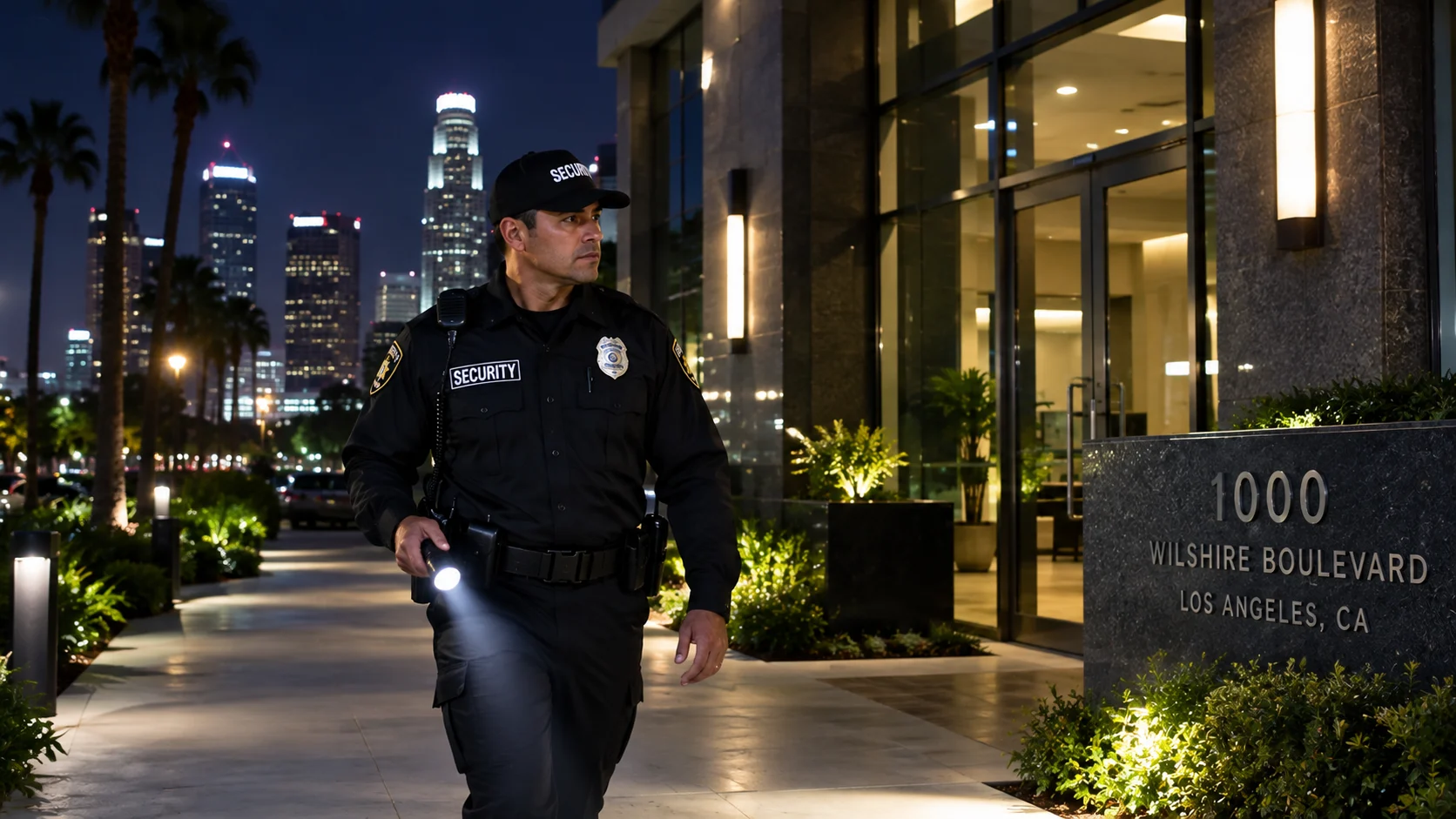
It’s 9 PM on a Tuesday, and the last employee has just locked the front door of a mid-sized distribution warehouse in the San Fernando Valley. The loading dock is empty. The parking lot lights hum over rows of parked trucks. For the next ten hours, nobody will be inside unless something goes wrong. That gap between closing time and the first employee walking back in the next morning is where most property managers start asking the same question: do we need a guard stationed at the door all night, someone patrolling the grounds periodically, or both? Getting the answer right matters, and it starts with understanding how an overnight security guard in Los Angeles actually works in practice.
Why Overnight Security Matters for Los Angeles Commercial Properties
Once a building empties, the risks change. Burglary and theft become more likely simply because there are fewer eyes on the property. Vandalism, graffiti, and vehicle break-ins tend to happen under cover of darkness, particularly in parking structures and loading areas that sit away from street visibility. Trespassing and loitering are common complaints at commercial sites near transit corridors or mixed-use blocks, where a quiet parking lot can look like an easy place to hang out unnoticed.
Unauthorized entry is another concern, especially for properties with multiple doors, gates, or dock access points that aren’t always visible from a single vantage point. Add in general property damage, unsecured equipment, or contractors leaving a site unlocked after hours, and it’s easy to see why overnight coverage isn’t a one-size-fits-all decision.
A single-tenant office building with one entrance has a very different risk profile than a multi-building industrial park with a dozen loading bays.
That’s really the core of this article: helping Los Angeles property owners and managers figure out which overnight security approach actually fits their property, instead of defaulting to whatever a neighboring business happens to use.
What Is an Overnight Security Guard in Los Angeles?
An overnight security guard is a trained officer assigned to protect a commercial property during closed hours, typically from evening closing through the next business day’s opening. The role covers a mix of observation, access control, and documentation, and the specific duties are usually shaped by the property type and the client’s post orders.
Common responsibilities include:
- Monitoring entrances and verifying that doors, gates, and windows remain secured
- Controlling access for late-arriving employees, vendors, or delivery drivers
- Conducting scheduled property inspections and checking sensitive areas
- Observing parking lots and loading zones for suspicious activity
- Responding to alarms or unusual incidents and documenting what occurred
- Coordinating with local law enforcement or emergency services when needed
- Maintaining detailed activity logs and incident reports for the client
Whether the guard is stationed at one location or moving through a property depends on the specific service model, which brings us to the two primary approaches.
What Does a Static Overnight Guard Do?
A static guard is assigned to a fixed post and remains there for the duration of the shift, though many static assignments also include periodic authorized rounds through the immediate area. The defining feature is a consistent, visible presence at a specific location rather than continuous movement across the whole property.
In practice, static guard posts often include:
- A main lobby or building entrance
- A gatehouse at a controlled-access property
- A loading dock during overnight deliveries
- A reception desk in an office building
- A single point of entry at a warehouse or industrial site
Static Guards in Los Angeles are commonly used where controlling who comes and goes matters more than covering a large physical footprint. If a property has one door that everyone must pass through, a guard stationed there provides continuous oversight of that chokepoint.
What Is Mobile Patrol in Los Angeles?
Mobile patrol works differently. Instead of remaining at a single post, a mobile patrol officer moves through a property, or between several properties, on a scheduled or randomized route. Patrols are typically conducted by vehicle for larger sites or on foot for more contained ones, with checks performed at set intervals throughout the night.
A typical mobile patrol overnight shift might involve:
- Perimeter checks along fence lines and building exteriors
- Inspecting parking lots and structures for unauthorized vehicles or activity
- Verifying that gates, doors, and windows are locked and undamaged
- Walking or driving between multiple buildings on a single site
- Responding to triggered alarms and documenting the response
- Logging each patrol stop with time-stamped reports
Mobile patrol does not provide the same continuous physical presence as a guard stationed at a fixed post. That’s not a knock against it. It’s simply a different tool, designed for covering ground rather than holding a single position. For properties where the risk is spread across a large area rather than concentrated at one entrance, that trade-off often makes sense.
Static Guards in Los Angeles vs. Mobile Patrol in Los Angeles
This is the comparison most property managers actually need to see side by side before making a decision.
| Factor | Static Guard | Mobile Patrol |
| Continuous physical presence | Yes, at the assigned post | No, presence is periodic |
| Entrance monitoring | Strong, especially at a single access point | Limited to scheduled check times |
| Access control | Handles verification directly | Not typically responsible for access control |
| Large-property coverage | Limited to post and nearby area | Covers wide areas efficiently |
| Parking lot checks | Occasional, if post allows | Core part of the patrol route |
| Perimeter inspections | Limited unless rounds are scheduled | Regular and systematic |
| Multiple buildings | Not practical for one guard | Well suited to multi-building sites |
| Visible deterrence | High at the specific post | Present but intermittent |
| Alarm response | Immediate if on-site | Depends on patrol proximity and route |
| Ideal property type | Single entrance, office lobby, gatehouse | Large lots, industrial parks, multi-site coverage |
Neither option is universally better. A static guard offers constant presence but limited coverage area. Mobile patrol covers more ground but doesn’t hold one location continuously. The right fit depends on: the property’s layout, its access points, the value of what’s stored on-site, operating hours, and how much staffing the client is prepared to invest in nighttime coverage.
When Should a Los Angeles Business Choose a Static Overnight Guard?
Static coverage tends to make the most sense when a property has a defined chokepoint that needs constant attention. A gated business park with a single vehicle entrance, a warehouse with one primary dock door, or an office building where after-hours visitors need to sign in are all good candidates.
Properties holding valuable inventory, sensitive equipment, or proprietary materials often benefit from a guard who can verify every person entering rather than relying on periodic checks. The same applies to sites that have had prior security incidents, where continuous observation helps prevent repeat issues rather than just detecting them after the fact.
Some of these assignments call for armed guards in Los Angeles, particularly where the property’s risk profile, asset value, or client requirements justify it. That said, armed coverage isn’t automatically the right answer for every overnight post. Whether a guard should be armed or unarmed depends on the specific assignment, the nature of the property, client policy, and California’s licensing regulations, not on assumption. A qualified security provider will walk through those factors with a client rather than defaulting to one option.
When Is Mobile Patrol in Los Angeles a Better Fit?
Mobile patrol tends to work better for properties where the security concern isn’t concentrated at one door but spread across a wider footprint. Large industrial facilities, office campuses with several buildings, shopping centers with expansive parking areas, and construction sites with shifting equipment all fall into this category.
A single static guard can’t realistically watch every corner of a five-acre lot or check on three separate buildings at once. Scheduled patrols, by contrast, allow one or two officers to cover far more physical territory over the course of a night, checking fence lines, dock doors, and parking structures on a rotating basis.
The trade-off is coverage gaps between patrol stops. If someone attempts entry a few minutes after an officer has left a checkpoint, there’s a window before the next pass. That’s a fair limitation to acknowledge. Mobile patrol is a practical, cost-effective option for large or multi-building sites, but it doesn’t replace a stationed presence when continuous, real-time observation of a specific point is what the property actually needs.
Should Your Business Use Both Static Guards and Mobile Patrol?
For many Los Angeles commercial properties, the honest answer is a combination of both. Take a large warehouse with a manned front entrance, a separate loading area, and a surrounding lot used for trailer storage. A static guard at the main entrance handles access control and verifies deliveries or late arrivals, while a mobile patrol officer checks the perimeter, the parking areas, and the loading zone on a set rotation throughout the night.
This layered approach lets each service do what it’s actually good at. The static guard maintains a fixed, reliable presence where access needs to be controlled. The patrol covers the ground that a single stationed guard physically can’t watch. Incident reporting and alarm response get built into both roles, so if something happens at the gate or somewhere along the fence line, there’s a documented process for how it gets handled.
Security Base Group works with Los Angeles property owners to figure out whether a hybrid model, a single static post, or patrol-only coverage fits a given site, rather than pushing a standard package that doesn’t match the property’s actual layout.
How to Choose the Right Overnight Security Solution for Your Los Angeles Property
Before deciding on a service type, it helps to walk through a handful of practical factors:
- Property size: A small retail storefront has different needs than a ten-acre logistics yard.
- Number of entrances: More access points generally mean more coverage is required, whether through static posts or patrol routes.
- Operating hours: Properties with staggered shifts or early-morning deliveries may need coverage that spans unusual hours.
- Previous security incidents: A site with a history of break-ins or trespassing often benefits from a stronger, more visible presence.
- Value of assets on-site: Inventory, machinery, and equipment worth protecting can justify continuous static coverage.
- Parking and perimeter size: Large lots and long fence lines typically favor patrol coverage over a single fixed post.
- Need for continuous access control: If someone must verify identity at all hours, that points toward a static guard.
It also helps to ask direct questions before signing a contract:
- Does this property need someone physically present at all times?
- Are there multiple buildings to account for?
- Who is responsible for controlling access after midnight?
- How large is the parking footprint, and how often should it be checked?
- Should the assignment be armed or unarmed?
- What does incident reporting look like, and who actually responds if something happens on-site?
A provider who can answer these clearly, rather than giving generic reassurances, is worth taking seriously.
What to Look for in an Overnight Security Company in Los Angeles
Not every security company operates the same way, and the differences matter once a property is relying on that coverage every night. Start with licensing. California requires security guard companies and individual guards to be properly registered through the Bureau of Security and Investigative Services (BSIS), and any provider operating in Los Angeles should be able to confirm that status without hesitation.
Beyond licensing, look for a company with real experience across different commercial environments, not just one property type. A provider that regularly staffs warehouses, office buildings, retail centers, and construction sites will understand the operational differences between them.
Ask whether guards receive property-specific training, whether the company offers both armed and unarmed options, and whether mobile patrol is available as a standalone service or as part of a combined plan.
Clear reporting procedures matter too. Property managers should know exactly how incidents get documented, how quickly they’re notified, and who they can reach if a guard needs backup or a situation escalates.
Reliable scheduling, direct supervisor communication, and a willingness to build a customized plan rather than a generic package are all reasonable things to expect from a serious provider.
Why Businesses Choose Security Base Group for Overnight Security
Security Base Group provides commercial property security across Los Angeles, including overnight static guards, mobile patrol, and combined coverage models built around each property’s actual layout and risk factors. The company offers both armed and unarmed security options, with assignments determined by the specific site rather than a one-size-fits-all default.
For property managers evaluating overnight coverage, Security Base Group works through the same practical questions outlined above: how large the property is, how many access points need to be managed, what assets are on-site, and how coverage should be structured across static posts and patrol routes. Incident reporting and ongoing communication are part of the standard process, not an add-on. Businesses considering overnight security often reach out simply to get a clear-eyed assessment of what their property actually needs before committing to a specific service.
Frequently Asked Questions
What does an overnight security guard do?
An overnight security guard monitors entrances, controls access, inspects the property, watches parking and loading areas, and documents incidents throughout the night. Specific duties vary by property type, but the role centers on maintaining a secure, observed environment while a business is closed.
Is a static guard better than mobile patrol for a commercial property?
Neither is universally better. Static guards suit properties with a single critical access point needing constant oversight, while mobile patrol fits larger sites with multiple buildings or parking areas. The right choice depends on the property’s layout and risk profile.
How does mobile patrol work overnight?
A mobile patrol officer moves through a property or between sites on a scheduled route, checking perimeters, parking lots, gates, and doors at set intervals. Each stop is logged, and officers respond to alarms, but coverage isn’t continuous between checks.
Do Los Angeles businesses need armed guards?
Not automatically. Whether armed guards in Los Angeles are appropriate depends on the property’s risk exposure, asset value, and client requirements, along with California licensing rules. A qualified provider should assess this rather than defaulting to one option.
Can a business use both a static guard and mobile patrol?
Yes, and many larger commercial properties do. A static guard can manage a main entrance while mobile patrol covers the perimeter, parking areas, and additional buildings, giving the property both fixed presence and broader ground coverage.
How do I choose an overnight security service in Los Angeles?
Evaluate property size, entrances, asset value, and past incidents, then look for a licensed provider with commercial experience, clear reporting practices, and both static and mobile patrol capabilities. A customized plan usually outperforms a generic package.
Protect Your Commercial Property Overnight
The decision between a static guard and mobile patrol ultimately comes down to what a specific property needs. A static guard provides continuous, fixed presence at a critical access point. Mobile patrol covers more physical ground through scheduled, flexible checks. Many Los Angeles properties end up better served by a hybrid model that uses both, matching the coverage type to where the actual risk sits.
There’s no universal answer, only the one that fits a property’s layout, access points, asset value, and operating schedule. If you’re a Los Angeles business owner or property manager trying to work through that decision, Security Base Group can walk through your property’s specific requirements and help determine the right overnight security guard in Los Angeles for your situation.
Security Base Group | Phone: 844-999-9928


