
How Many Security Guards Does a Business Need in San Diego? (2026)
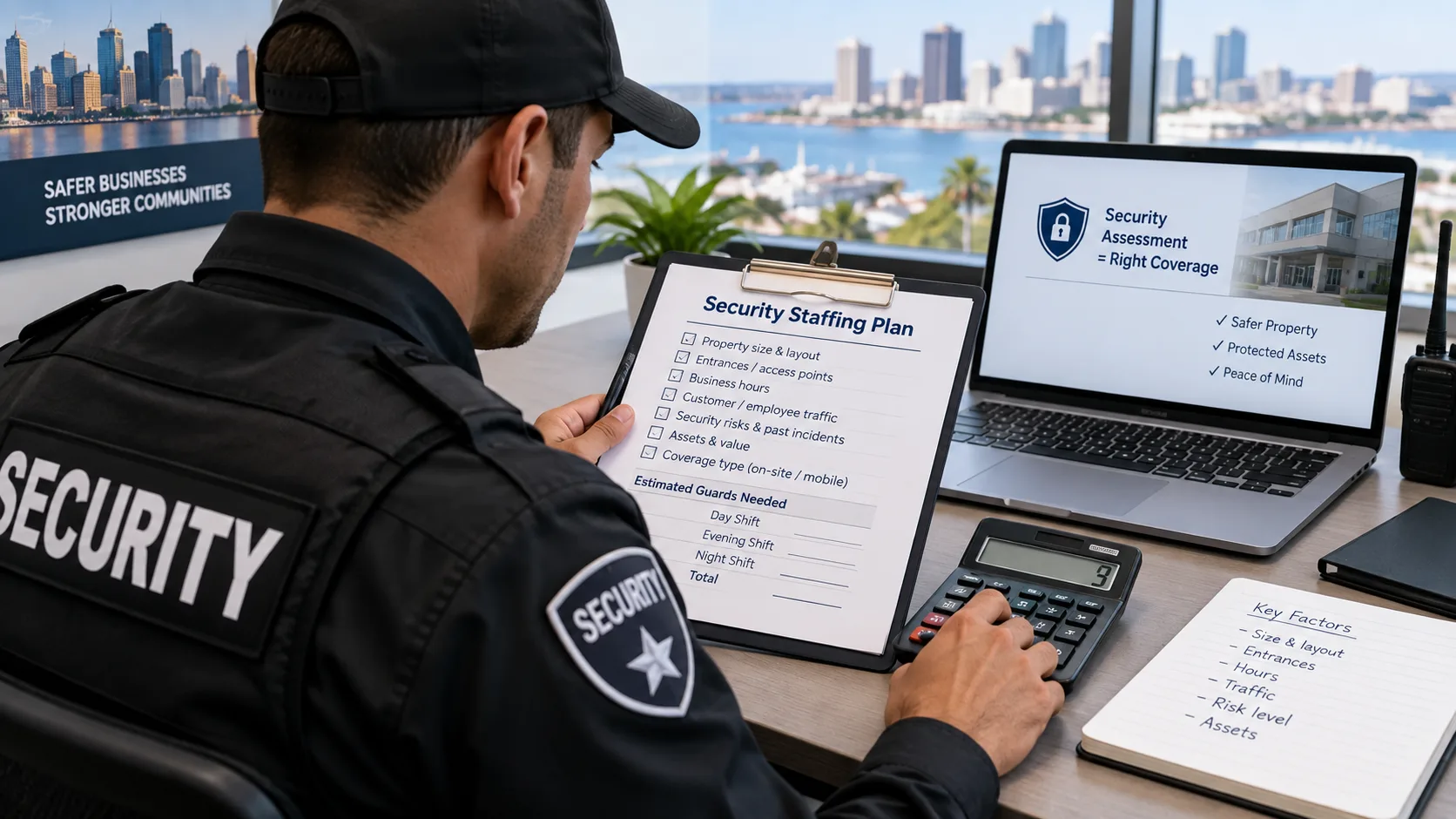
Most San Diego businesses need somewhere between one guard for basic coverage and multiple officers for larger or higher-risk properties, but there’s no single number that applies to every business. How many security guards does a business need? It actually depends on your property’s size, layout, hours of operation, foot traffic, and the level of risk your business faces.
A small office with one entrance and no history of incidents has very different needs than a warehouse with multiple loading docks running overnight shifts. Property size, number of entrances, customer and employee traffic, valuable assets, parking and perimeter size, and whether you need overnight or 24/7 coverage all factor into the equation.
Security Base Group works with San Diego business owners to look at these variables directly and recommend coverage that fits the property, rather than applying a one-size-fits-all number.
How Many Security Guards Does a Business Need Does a Business Usually Need?
How Many Security Guards Does a Business Need does a business need in San Diego?
The number depends on the property’s size, layout, operating hours, number of entrances, risk level, customer traffic, and required coverage, but with the Security Guard Calculator of Security Base, it’s easy to calculate how many guards your firm needs. A small business may need one guard during selected hours, while a larger or higher-risk property may require multiple officers or a combination of on-site security and mobile patrol.
The examples below are general starting points, not fixed rules. Every property should still go through its own security assessment.
Small Businesses
Small offices, small retail stores, and other low-traffic professional businesses often get by with one security guard, and sometimes only during specific hours, closing time, weekend shifts, or periods when the location is otherwise unstaffed.
Medium-Sized Businesses
Larger retail stores, warehouses, and commercial office buildings with more foot traffic or multiple access points often need one to two officers at a time, depending on the layout. A property with a single entrance and a small parking lot needs less coverage than one with a loading dock, a public lobby, and an employee entrance running at the same time.
Large or High-Risk Businesses
Large warehouses, distribution centers, high-value retail locations, construction sites, and expansive commercial properties frequently require multiple posts or officers working simultaneously. These properties tend to have more ground to cover, more points of entry, and often more valuable inventory or equipment on-site.
None of these figures are industry-mandated minimums. The right number for your business comes out of a proper assessment of your specific property.
What Determines How Many Security Guards Does a Business Need in San Diego?
Property Size and Layout
Square footage matters, but so does layout. A single large building is easier to cover than a campus with multiple structures, outdoor areas, and long distances between them. Parking lots, loading areas, and blind spots created by landscaping or architecture can all add coverage needs that square footage alone doesn’t reflect.
Number of Entrances and Access Points
Every additional entrance a main door, employee entrance, loading dock, vehicle gate, or restricted area is a point that needs to be monitored or controlled. A property with one entrance is straightforward. A property with four or five active access points usually needs more than one guard just to keep them all covered.
Business Hours and Security Schedule
There’s an important distinction between how many guards you need at a given moment and how many total staff you need to maintain that coverage across a full schedule. A business that wants one guard on-site 24/7 doesn’t need one guard; it needs enough staff to cover multiple shifts, seven days a week, accounting for time off and scheduling gaps. Businesses open only during standard hours have simpler staffing needs than those requiring overnight or weekend coverage.
Theft, Trespassing and Previous Security Incidents
A history of shoplifting, burglary, trespassing, vandalism, unauthorized access, or workplace disturbances is a reasonable factor in deciding how much coverage a property needs. This should be based on your own business history and documented incidents, not assumptions about any particular neighborhood.
Employees, Customers and Visitors
Higher foot traffic, whether from employees, customers, or visitors, increases the demand on access control, observation, and incident response. A quiet office with a handful of employees has very different needs than a retail location with a steady stream of customers throughout the day.
Valuable Assets and Business Risk
Inventory, cash handling, specialized equipment, sensitive information, and high-value materials all raise the stakes of a security gap. Businesses with more to protect often benefit from more attentive coverage, even if the physical footprint of the property is modest.
A Simple Security Guard Staffing Guide for San Diego Businesses
| Business Situation | Possible Starting Coverage | Factors That May Increase Coverage |
| Small office | One guard, business hours or closing shift | After-hours access, valuable equipment |
| Small retail store | One guard during peak hours | Multiple entrances, high theft exposure |
| Medium commercial property | One to two guards | Employee and visitor entrances, large parking area |
| Large warehouse | Two or more guards, shift-based | Loading docks, overnight operations, high-value inventory |
| Construction site | One guard plus mobile patrol | Multiple access points, equipment theft risk, after-hours exposure |
| High-value facility | Two or more guards, possibly armed | Cash handling, sensitive materials, prior incidents |
| Large event or business campus | Multiple guards across posts | Crowd size, number of buildings, vehicle traffic |
| Large property with a broad perimeter | On-site guard plus mobile patrol | Distance between buildings, limited sightlines, after-hours risk |
These are general planning examples, not fixed staffing requirements. Your actual coverage should come from a site-specific assessment.
When Does a Business Need More Than One Security Guard?
Multiple Entrances
One guard can’t watch a front door, a loading dock, and an employee entrance at the same time. Once a property has more than one active access point, coverage gaps start to appear with a single officer.
Large Parking Lots or Outdoor Areas
Outdoor spaces such as parking lots, courtyards, and storage yards extend the area a guard needs to observe well beyond the building itself. A single officer stationed at a front desk isn’t positioned to also monitor a large lot.
High Customer Traffic
Busier locations generate more situations that need attention at once: assisting customers, monitoring for theft, and responding to incidents. One guard managing all of that simultaneously has less capacity to respond quickly to any single issue.
Multiple Buildings
Properties with more than one building create physical separation that a single guard simply can’t overcome. If an incident happens in one building while the guard is in another, there’s no way to be in both places.
24/7 Coverage
Round-the-clock coverage requires multiple officers across shifts, not one person working continuously. This is where the difference between guards needed at one time and total guards required to maintain coverage becomes most important. A business wanting 24/7 protection with one guard on-site at any given moment still needs a rotating team of several officers to fill that schedule properly.
Do I Need Armed Guards or Unarmed Security Guards?
Unarmed security guards are a common and appropriate choice for many businesses: offices, retail stores, access control points, general deterrence, and customer-facing environments where the primary need is visibility, monitoring, and a professional point of contact.
Armed guards may be worth considering in higher-risk environments, certain high-value facilities, situations where a client or insurer has specific requirements, or properties where the assessed risk calls for a higher level of protection. Armed security isn’t automatically the “better” option; it depends on the actual risk profile of the site, applicable regulations, and having properly BSIS licensed and trained personnel in place.
Security Base Group provides both armed and unarmed security guards in San Diego and can help business owners think through which option fits their property.
Can Mobile Patrol Reduce the Number of Guards Needed?
Mobile patrol can supplement and sometimes reduce reliance on a fully staffed on-site presence, particularly for large properties, parking lots, multi-building sites, construction sites, low-traffic areas, and after-hours locations with broad perimeters.
There’s a real difference between the two approaches:
- Fixed security: a continuous physical presence at a designated post.
- Mobile patrol: scheduled movement through designated areas at set intervals.
Mobile patrol doesn’t automatically replace an on-site guard; a property with high foot traffic or an active front desk still benefits from a fixed presence. But many businesses combine the two: a guard covers the main entrance during business hours, while mobile patrol checks the parking lot, perimeter, or secondary buildings overnight. Security Base Group offers mobile patrol in San Diego as part of that kind of layered approach.
Example Security Guard Staffing Plans for San Diego Businesses
These are hypothetical scenarios meant to illustrate how the factors above play out, not official recommendations.
Example 1: Small Retail Store
A single storefront with one main entrance and moderate foot traffic might reasonably start with one unarmed guard during business hours, focused on customer safety and theft deterrence.
Example 2: Medium Commercial Building
An office building with a main entrance, an employee entrance, and an attached parking area might call for one guard managing access during the day, potentially two during peak visitor hours.
Example 3: Large Warehouse
A warehouse with loading docks, significant inventory, and overnight operations could require coverage across multiple shifts, possibly paired with mobile patrol checking the perimeter and parking areas after hours.
Example 4: Higher-Risk Business
A business with valuable assets and a documented history of incidents might warrant additional measures: more guards during vulnerable hours, armed coverage if the risk assessment supports it, and tighter access control at entry points.
How to Calculate Your Business’s Security Guard Coverage
- Step 1: Identify areas requiring physical coverage. Walk the property and list every entrance, parking area, and space that needs to be observed or controlled.
- Step 2: Determine operating hours and high-risk periods. Note when the business is open, when it’s most vulnerable (closing, overnight, weekends), and when foot traffic peaks.
- Step 3: Identify security risks and previous incidents. Review any past theft, trespassing, or disturbances specific to your business.
- Step 4: Determine whether fixed security, mobile patrol, or a combination is appropriate. Match the coverage type to the layout and risk profile you’ve identified.
- Step 5: Have a qualified security provider assess the property. A site visit from an experienced provider will catch gaps that are easy to miss from a written checklist alone.
How Much Does Business Security Cost in San Diego?
Security pricing varies based on several factors: the number of guards required, whether coverage is armed or unarmed, the hours and shift structure, whether coverage needs to be 24/7, the risk level of the site, any specialized duties involved, and whether the need is temporary or ongoing. Mobile patrol arrangements are typically priced differently than fixed, on-site coverage.
Because of this, comparing security proposals on hourly rate alone can be misleading. Two quotes with different hourly numbers might represent very different levels of actual coverage. It’s worth asking what’s included: staffing levels, supervision, reporting, and equipment before choosing based on price. Security Base Group provides quotes based on the coverage a property actually needs, which is generally a more useful comparison point than rate alone.
Why Businesses in San Diego Choose Security Base Group
Security Base Group provides armed and unarmed security guards, business security, mobile patrol, and both temporary and permanent security staffing for businesses in the San Diego area. The company works with clients to build a security plan around their specific property rather than applying a standard package to every site.
For business owners who want a closer look at services available locally, the security guard company in San Diego page outlines the coverage options available in the area.
Frequently Asked Questions
How Many Security Guards Does a Business Need does a small business need in San Diego?
Many small businesses start with one guard, often during specific hours like closing time or peak traffic periods. The right number still depends on layout, entrances, and any history of incidents, so it’s worth confirming with a site assessment rather than assuming one guard covers every situation.
How many guards do I need for 24/7 business security?
Round-the-clock coverage requires more than one guard total, even if only one is on-site at a time. You’ll need enough staff to fill day, evening, and overnight shifts across seven days, which usually means a rotating team of several officers rather than a single person.
Does my business need armed guards?
Not necessarily. Many businesses are well served by unarmed guards for deterrence, access control, and customer interaction. Armed coverage becomes a more relevant question for higher-risk environments or specific client requirements, and should be based on an actual risk assessment.
Can one security guard protect a large commercial property?
It depends on the property. A single guard can struggle to cover multiple entrances, large parking areas, or separate buildings at once. Larger or more spread-out properties typically need multiple officers or a combination of fixed security and mobile patrol.
Can mobile patrol replace an on-site security guard?
Sometimes, but not always. Mobile patrol works well for large perimeters, parking lots, and after-hours coverage, but businesses with high foot traffic or an active entrance often still benefit from a guard physically stationed on-site.
How do I determine the right number of security guards for my business?
Start by mapping your property’s entrances, hours, and risk factors, then match that to the type of coverage you need. A professional security assessment is the most reliable way to confirm the plan fits your actual property rather than a general estimate.
Can Security Base Group create a customized security plan?
Yes. Security Base Group works with San Diego business owners to assess their property and build a staffing plan including armed, unarmed, and mobile patrol options based on the specific risks and layout involved.
Get the Right Security Coverage for Your San Diego Business
There’s no universal number of security guards that fits every business. Business size is only one part of the picture; property layout, number of entrances, operating hours, past incidents, the value of what you’re protecting, and how much customer or employee traffic moves through your space all shape what adequate coverage actually looks like. Getting the staffing plan right matters in both directions: too little coverage leaves gaps, and too much adds cost without a clear benefit.
Need help determining the right security coverage for your San Diego business? Contact Security Base Group to discuss a customized security plan.


