
24/7 mobile patrol security in Moreno Valley for Distribution Centres
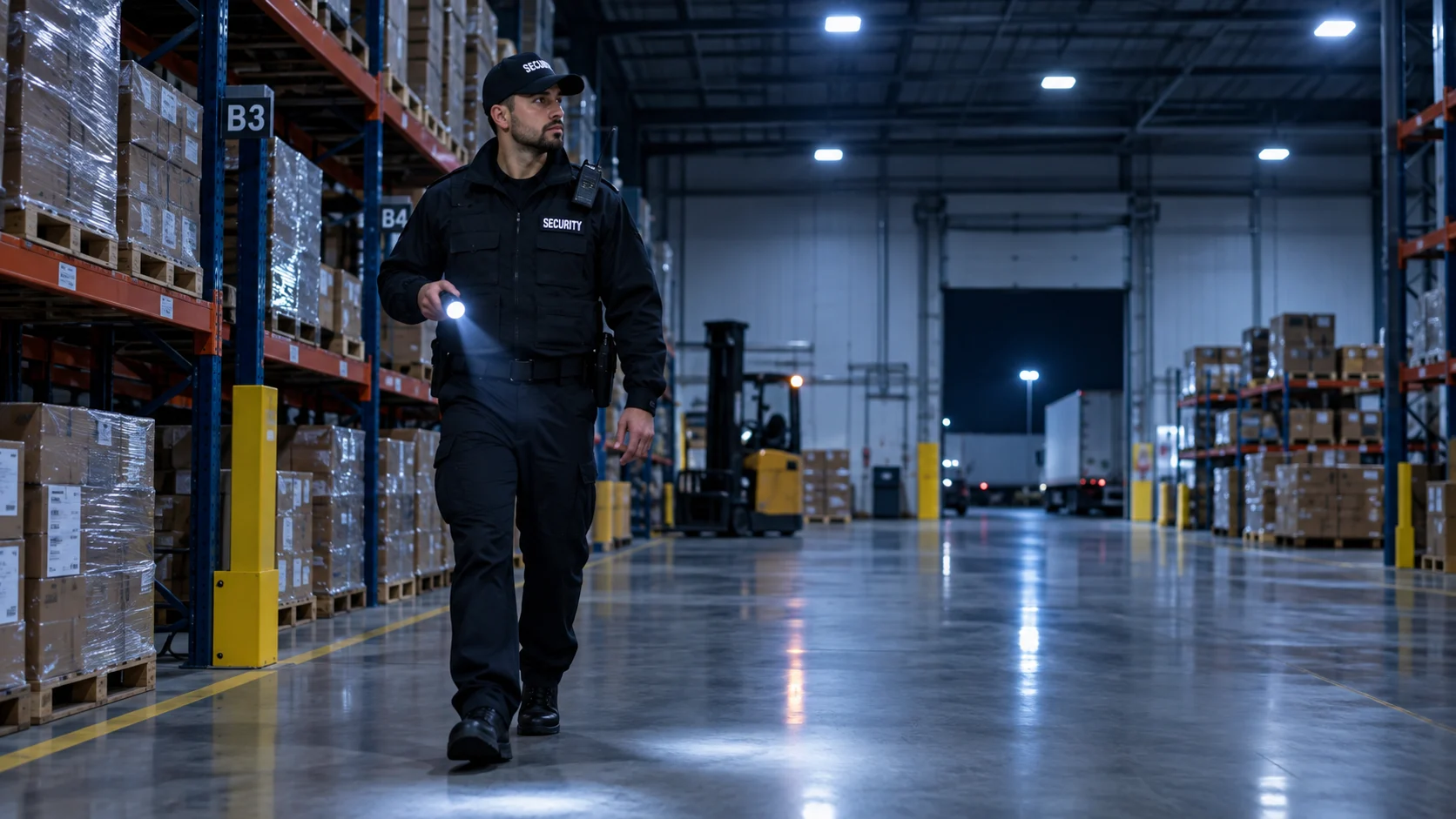
A ten-acre distribution yard with six gates, forty trailer spots, and a skeleton crew after 10 p.m. is a different security problem than a retail storefront with one door and an alarm panel.
Warehouse operators in Moreno Valley know this firsthand: the loading dock busy with inbound freight at 2 p.m. is often empty and dark by midnight, while the perimeter fence still stretches the same quarter-mile it did in daylight. Fewer people are on-site overnight, but the property and inventory don’t get any smaller.
That gap between daytime staffing and around-the-clock exposure is why many facility managers look at 24/7 mobile patrol security in Moreno Valley as part of their protection plan. A marked patrol vehicle moving through the property, checking gates, docks, and parking areas at varied intervals, gives a distribution centre a visible, mobile presence that a single fixed guard station can’t always match.
It isn’t a replacement for cameras, access control, or on-site staff; it’s one practical layer among several, and this guide covers how it works, what it should cover, and how to decide if it fits your property.
Why Distribution Centres in Moreno Valley Face Unique Security Challenges
A distribution centre isn’t secured like a typical commercial property. The scale, traffic, and shift patterns all change what “coverage” actually means.
Large Perimeters and Multiple Access Points
Most distribution facilities in Moreno Valley sit on properties with fencing that runs for hundreds of yards, several vehicle gates for trucks and passenger cars, pedestrian entrances, and emergency exits that need to stay clear but secure. Each of those points is a place someone could enter without authorization, and a single guard posted at the front lobby can’t see the truck gate on the far side of the yard at the same time.
High-Value Inventory and Constant Cargo Movement
Freight doesn’t stop moving when the sun goes down. Trailers arrive and depart at odd hours, drivers and contractors come and go, and vendors show up for deliveries that don’t match a nine-to-five schedule, creating more touchpoints to monitor than a typical office building.
Overnight and Low-Activity Hours
When staffing drops for the night shift, the ratio of square footage to people on-site changes dramatically. This is where overnight patrol earns its keep: a trained officer checking the property on a schedule can catch a propped door, an unfamiliar vehicle, or a gate left open long before anyone notices it the next morning.
What Are 24/7 Mobile Patrol Security in Moreno Valley?
Mobile patrol security is a service where trained officers use marked patrol vehicles to conduct scheduled and randomized checks of a property, rather than staying at a single fixed post. The officer moves through the site, checking the perimeter, gates, parking lot, and loading areas, and documents what they find along the way.
A typical mobile patrol visit can include:
- Perimeter and fence-line inspections
- Gate and access-point checks
- Parking-lot sweeps for unauthorized vehicles
- Loading-dock and trailer-yard checks
- Observation for suspicious activity
- Written incident and observation reporting
- Alarm response coordination where applicable
Mobile Patrol vs. Static Security Guard
These two services solve different problems, and many distribution centres use both. A static guard holds a fixed post at a front gate, guard shack, or reception area with continuous oversight of that one location. A mobile patrol covers ground instead, moving across the property so far corners or a secondary gate aren’t left unchecked for a whole shift. A small property may only need a static guard; a sprawling facility with multiple gates and a large truck yard benefits from patrol coverage a stationary post can’t provide.
7 Ways Mobile Patrol Security Protects Distribution Centres
1. Deters Unauthorized Entry
A marked patrol vehicle circling the property at unpredictable times signals someone is actively watching the site, making it harder for anyone to time a move around a schedule they can’t anticipate.
2. Protects Truck Yards and Loading Areas
Trailer yards and loading docks are where freight changes hands, and they’re often the busiest part of a distribution property. Regular checks of staging areas, dock doors, and parked trailers help confirm everything lines up with what’s supposed to be there.
3. Strengthens Overnight Security
Overnight is when a property most feels the staffing gap. A patrol officer checking gates and parking areas during low-activity hours can flag an open gate or unlocked door before it becomes a problem on the day shift.
4. Monitors Large Parking and Perimeter Areas
Employee parking lots and long perimeter fences are hard for one fixed post to cover at once. A mobile patrol can move between these zones instead of leaving them unchecked between rounds.
5. Identifies Security Problems Before They Escalate
Much of what a patrol officer looks for isn’t dramatic; it’s maintenance and access issues that quietly create risk: damaged fencing, a burned-out light, a door propped open, an unlatched gate, or a vehicle parked somewhere it shouldn’t be.
6. Creates Documented Patrol Activity
Every patrol visit should leave a record of what was checked, when, and what the officer observed, giving facility managers a paper trail to review or reference if an incident occurs.
7. Complements Cameras, Alarms and Access Control
Technology can detect an issue, but it can’t assess it. A camera might flag motion at 3 a.m., but a trained officer can drive to that location and evaluate what’s actually happening. Layering patrols with cameras, alarms, and access control generally gives a property more complete coverage than any single measure alone.
What Should an Overnight Patrol Cover at a Moreno Valley Distribution Centre?
Every property is laid out differently, but a solid overnight patrol route typically checks:
- Main entrance and lobby areas
- Employee entrances
- Truck gates and driveways
- Loading docks and dock doors
- Trailer parking and staging areas
- Perimeter fencing and fence lines
- Emergency exits
- Employee and visitor parking areas
- Restricted or high-security zones
- Poorly lit corners of the property
- Storage yards and outdoor storage areas
- Utility areas, including electrical and mechanical rooms
- Active construction or maintenance zones
A generic checklist is a starting point, not a finished plan. The actual patrol route should come from a site walk-through that identifies the vulnerable points on that specific property.
Scheduled vs. Randomized Patrols
A patrol that runs at the same time every night becomes predictable, and predictability works against deterrence. A mix of scheduled checks so critical points are confirmed at set intervals, combined with randomized timing between rounds, tends to provide a stronger deterrent than a fixed routine alone. Still, no patrol pattern can guarantee prevention; the goal is to reduce exposure and improve the odds of catching a problem early.
Should Distribution Centres Hire Armed Guards or Mobile Patrols?
This depends on the property, the inventory, and the risk profile; neither option is automatically better than the other.
When Mobile Patrol May Be Appropriate
Mobile patrol tends to fit properties where the main need is broad coverage rather than a fixed presence: large sites with multiple areas to check, overnight gate and perimeter monitoring, parking and yard oversight, or a supplemental layer on top of existing cameras and access control.
When Armed Guards May Be Considered
Armed guards may be worth considering where a facility has documented elevated risk, holds particularly high-value assets, has received specific threats, or runs sensitive operations. This isn’t a default setting; it’s a decision that should follow a real risk assessment, not an assumption that more firepower automatically means more safety.
When a Hybrid Security Model Makes Sense
Many distribution centres combine approaches: a static guard at the main entrance, a mobile patrol covering the rest of the property, cameras on key zones, and access control managing the gates. Deployment decisions should follow a professional risk assessment, site-specific requirements, and applicable California regulations, not a one-size-fits-all package.
Security Services in Moreno Valley for Distribution Centres: What Should You Look For?
Choosing a provider for security services in Moreno Valley for distribution centres comes down to more than a quoted hourly rate.
Look for:
- Real experience securing large commercial and industrial properties
- Genuine 24/7 availability, not just daytime coverage with an answering service
- Properly trained and BSIS-licensed personnel
- Actual mobile patrol capability, not just static guarding
- Clear, consistent incident reporting
- Reliable supervision of officers in the field
- Post orders customized to the specific property, not a generic template
- Coverage that can scale up or down as needs change
- Open communication and accountability when something goes wrong
The cheapest bid on paper isn’t always the best value once you factor in supervision quality, reporting consistency, and how a provider performs overnight when no one from management is on-site.
Why Choose Security Base Group for Distribution Centre Patrols in Moreno Valley?
Security Base Group provides vehicle patrol security services across California, using marked patrol vehicles and trained officers to cover properties that need mobile coverage rather than or alongside a fixed guard post. That patrol capability sits within a broader range of services, including armed and unarmed guard services, commercial security, and permanent on-site security programs, which makes it possible to build a layered plan rather than a single standalone service.
For a distribution centre, that typically means pairing a marked patrol vehicle checking gates, docks, and perimeter fencing with a static guard presence where the property calls for one, and adjusting that mix as the facility’s needs change. Security planning is handled property by property, starting with an assessment of the site’s layout, access points, and operating hours rather than a fixed package applied to every client. If your distribution centre needs a plan built around its specific gates, dock schedule, and shift patterns, that’s worth a direct conversation with the team.
How to Build a 24/7 Security Plan for a Distribution Centre
Step 1: Conduct a Site Security Assessment
Start with an honest look at the property’s vulnerable points, how people and vehicles move through it, and where current coverage falls short.
Step 2: Map the Property and Vulnerable Areas
Turn that assessment into a map of gates, dock doors, dark corners, and restricted zones so patrol routes are built around real conditions, not guesswork.
Step 3: Identify High-Risk Hours
Look at when staffing drops and the property is most exposed, so coverage weighs toward the hours that need it most.
Step 4: Select the Right Security Model
Decide what mix of mobile patrol, static guards, armed guards, unarmed guards, or hybrid coverage fits the property, based on the assessment rather than a default package.
Step 5: Establish Patrol Procedures
Set clear routes, checkpoints, and timing guidelines, including scheduled and randomized rounds, so officers know exactly what to check and when.
Step 6: Define Reporting Requirements
Agree on how incidents get documented and how quickly that information reaches facility management.
Step 7: Review and Adjust the Security Plan
Revisit the plan periodically. Facilities change: new tenants, new equipment, seasonal freight surges, and a two-year-old plan may no longer match the property.
Mobile Patrol vs. Full-Time On-Site Security for Distribution Centres
|
Coverage Factor |
Mobile Patrol | Full-Time On-Site Security |
|
Large perimeter coverage |
Strong coverage across the site |
Limited to the guard’s fixed position |
|
Gate access control |
Periodic checks | Continuous, direct oversight |
| Overnight checks | Scheduled and randomized rounds |
Continuous presence |
|
Loading dock monitoring |
Included on patrol route | Only if guard is posted nearby |
| Fixed security presence | Not continuous at any one point |
Yes, at the assigned post |
|
Coverage flexibility |
High: can adjust routes and frequency | Lower; tied to a fixed location |
| Multiple-area monitoring | Well suited |
Requires multiple guards |
Neither option is universally cheaper or automatically better; the right fit depends on the property’s layout, operating schedule, and risk profile. Many distribution centres find that combining both delivers stronger coverage than choosing one over the other.
Frequently Asked Questions About Distribution Centre Security in Moreno Valley
1. What are 24/7 Mobile Patrol Security Services in Moreno Valley?
A service where trained officers use marked patrol vehicles to check a property around the clock on scheduled and randomized visits, covering perimeters, gates, parking areas, and loading docks rather than staying at one fixed post.
2. Why do distribution centres need overnight patrol?
Staffing typically drops overnight while the property stays the same size. Overnight patrol closes that gap by checking gates, fencing, and parking areas during the hours with the least direct oversight.
3. Do distribution centres need armed guards?
Not automatically. Armed guards may be appropriate for facilities with documented elevated risk or high-value assets, but the decision should follow a proper risk assessment rather than a default assumption.
4. What does a mobile security patrol check?
A typical patrol checks entrances, gates, fencing, parking lots, loading docks, trailer yards, and any restricted or poorly lit areas, documenting observations along the way.
5. Can mobile patrol work with CCTV and alarm systems?
Yes. Mobile patrol is generally used alongside cameras, alarms, and access control rather than in place of them, giving a property both automated detection and a trained officer who can respond in person.
6. How can I arrange security services for my Moreno Valley distribution centre?
Start with a site assessment to identify the property’s specific needs, then work with a provider to build a patrol schedule and, if applicable, a hybrid plan combining mobile patrol with static or armed coverage.
Protect Your Moreno Valley Distribution Centre 24/7
A distribution centre with multiple gates, a busy loading dock, and hours of reduced staffing usually needs more than a camera system and a single guard at the front door. Mobile patrols give a large property visible, moving coverage across its perimeter and parking areas, help flag issues overnight, and work alongside cameras and access control rather than replacing them. Whether armed or unarmed personnel make sense for your site comes down to documented risk and specific requirements, not a default choice.
If you need a customized security plan for a distribution centre in Moreno Valley, contact Security Base Group to discuss your property’s patrol, guard, and security requirements.


