
How Mobile Patrol Security Guards in Eastvale Are Used by HOAs and Gated Communities
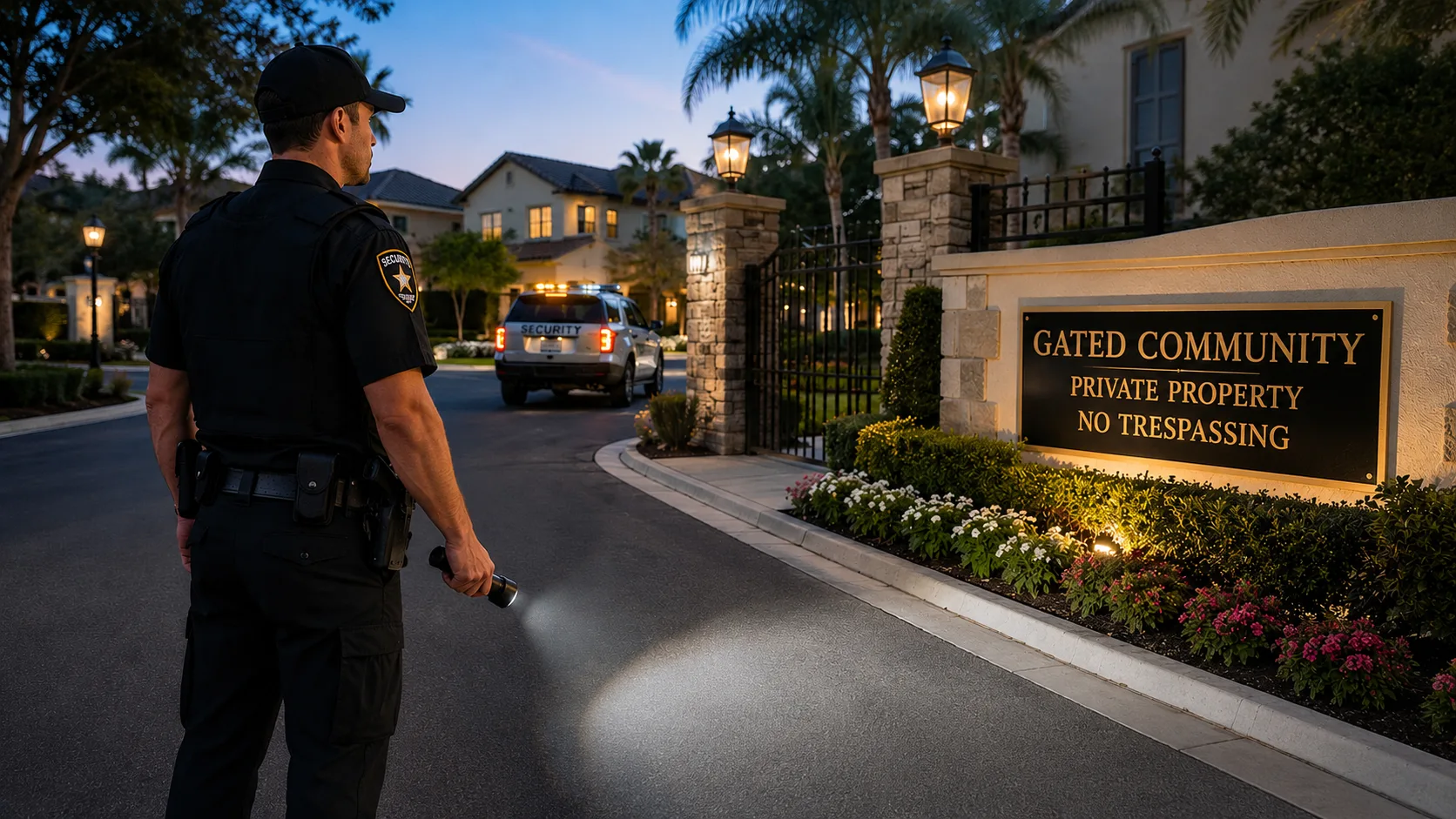
Most Eastvale HOAs already have gates, cameras, and access codes in place. So why do so many boards still end up calling a security company? Usually because technology alone doesn’t cover everything that happens after dark or beyond the reach of a fixed camera. That’s the gap Mobile Patrol Security Guards in Eastvale are built to fill: a physical presence that moves through the property instead of watching it from one spot. For HOA boards weighing whether their community needs a live set of eyes on the ground, understanding how mobile patrol actually works is the place to start.
What Are Mobile Patrol Security Guards?
Mobile patrol security is exactly what it sounds like: a uniformed officer drives a marked patrol vehicle through a property on a set route, checking entrances, common areas, and anywhere trouble tends to start. That’s the core service behind Mobile Patrol Security Guards in Eastvale. Instead of standing at one gate all shift, the officer covers ground: streets, parking areas, perimeters, clubhouses, and anywhere else the HOA wants documented.
A typical patrol shift includes:
- Checking that gates, entry points, and perimeter fencing are secure
- Driving residential streets and parking areas
- Observing common areas like pools, parks, and clubhouses
- Looking for suspicious vehicles or activity
- Writing up incident reports for anything out of the ordinary
Some communities schedule patrols at the same times every day; others prefer randomized timing so the pattern isn’t predictable to anyone watching from outside. Both approaches have a place, and many HOAs end up using a mix of the two.
It helps to see how mobile patrol compares to a guard stationed at a single post:
| Feature | Mobile Patrol | Stationary Guard |
| Coverage area | Entire property, multiple locations | One fixed post |
| Visibility | Appears at varying times and locations | Predictable, fixed location |
| Best suited for | Large or spread-out communities | Single high-traffic entry point |
| Vehicle presence | Yes, marked patrol vehicle | Typically none |
Neither option is automatically “better.” A gated community with one main entrance and constant foot traffic at the gatehouse might benefit from a stationary officer there, while Mobile Patrol Security Guards in Eastvale tend to make more sense for communities with multiple entrances, long perimeters, or amenities spread across several acres.
Why Eastvale HOAs and Gated Communities Use Mobile Patrol
Eastvale is a city built largely around planned residential communities, many with multiple entry points, internal loop streets, parks, and shared recreation facilities rather than a single dense core. That layout is where mobile patrol earns its keep. A guard fixed at one gate simply can’t see what’s happening at the community pool three streets away or along a walking path near the perimeter fence.
For an HOA managing several amenities under one roof a clubhouse, a pool, a couple of parks, and resident parking areas a patrol vehicle making rounds provides broader coverage than a single guard could offer from a stationary post. It also gives the board something a camera can’t: an officer who can walk up to a locked gate, check a broken light fixture, or note a propped-open common-area door, then document it immediately.
This is where the value of a dedicated Security Guard in HOAs and Gated Communities becomes clear. The officer isn’t just present; they’re actively checking locations the board has identified as priorities, on a schedule the community controls.
What Does a Security Guard in HOAs and Gated Communities Actually Do?
Conduct Routine Community Patrols
The core of the job is driving a set route through the property: checking entrances and exits, looking down residential streets, and confirming parking areas don’t have anything unusual sitting in them. Route checks are logged so the HOA can see exactly when and where the officer went.
Monitor Common Areas
Clubhouses, pools, mailrooms, and package areas are frequent targets for both petty theft and vandalism simply because they see less regular foot traffic than a resident’s own front porch. A patrol officer checking these spaces on rounds adds a layer of oversight that residents themselves usually can’t provide consistently.
Deter Trespassing and Suspicious Activity
A marked patrol vehicle and a visible uniform tend to discourage casual trespassing or loitering, not because a guard has special legal authority, but because most people looking to cause trouble prefer not to be seen doing it. No patrol service can promise it will prevent every incident; deterrence lowers risk, it doesn’t eliminate it.
Document and Report Incidents
When something does happen a broken gate, a suspicious vehicle parked overnight, graffiti, or a resident dispute the officer’s job is to document it clearly and pass it along to HOA management or the appropriate authorities. Good incident reporting gives the board a paper trail it can actually use, whether that’s for insurance purposes or simply tracking recurring problems.
Support Existing Security Technology
Mobile patrol isn’t meant to replace cameras, access-control systems, or lighting; it’s meant to work alongside them. An officer can physically respond to something a camera only records, check on an access-control malfunction, or confirm that a motion light that keeps tripping is actually a real issue and not a system glitch.
How Overnight Security Can Benefit Eastvale Communities
Nighttime changes the security picture for almost every residential community. Amenities close, foot traffic drops off, and parking areas and walking paths that are busy during the day sit empty and dimly lit after hours. That combination of low visibility, low activity, and closed common areas is when unauthorized access, vandalism, or vehicle break-ins are more likely to go unnoticed until morning.
Overnight Security through mobile patrol addresses this by having an officer check vacant amenity areas, walk perimeter fencing, and look for vehicles that don’t belong on the property, all during the hours when a community is otherwise unmonitored. As with daytime patrols, HOAs can choose scheduled overnight rounds at consistent intervals or randomized timing to avoid a predictable pattern. Some communities do a mix of a scheduled first pass early in the night and a randomized check later on.
It’s worth being direct about what Overnight Security does and doesn’t do: a patrol that passes through every 45 minutes can catch a lot, but it can’t be everywhere at once. Overnight coverage reduces the window of opportunity for problems; it isn’t a guarantee against them.
When Should an HOA Consider an Armed Guard?
Not every gated community needs an Armed Guard, and jumping to the most heavily equipped option isn’t always the right call. Whether armed coverage makes sense comes down to a few factors: the property’s risk profile, whether there have been prior serious incidents, the value of assets on-site, and what a professional security assessment turns up.
An Armed Guard may be worth considering for communities with a history of serious incidents, proximity to higher-risk commercial areas, or specific concerns flagged during a walk-through with a provider. For most day-to-day HOA needs, patrol checks, common-area monitoring, incident reporting, and deterrence, unarmed mobile patrol is typically sufficient. In California, armed officers must be licensed through the state’s Bureau of Security and Investigative Services and complete firearms and use-of-force training beyond standard guard certification, so this isn’t a decision to make without guidance from a licensed provider.
Mobile Patrol vs. Cameras and Gated Access
Security works best as a layered system where each piece does something the others can’t:
- Cameras: can observe and record activity, but they can’t physically respond to it.
- Gate and access-control systems: can regulate who enters, but they can’t confirm what’s happening once someone is inside.
- Lighting: improves visibility but doesn’t monitor anything on its own.
- Mobile patrol: provides a physical security presence throughout the property, capable of responding, checking, and documenting in real time.
None of these is universally superior. A community with strong cameras and access control still benefits from mobile patrol, since a guard can physically investigate what the camera flags and confirm a locked gate is actually staying locked.
How an HOA Can Build an Effective Mobile Patrol Security Plan
A patrol plan built around a specific community tends to work better than a generic schedule applied to every property the same way:
Step 1: Identify Security Concerns: Start with what the board and residents actually worry about, whether that’s package theft, vehicle break-ins, or after-hours access.
Step 2: Map Entrances, Common Areas, and Vulnerable Locations: Walk the property with the provider and mark every entry point, amenity, and low-visibility spot.
Step 3: Determine Patrol Frequency: Decide how often the property needs a pass: hourly, every few hours, or a set number per shift.
Step 4: Decide Between Scheduled and Randomized Patrols: Choose predictable timing, randomized timing, or a mix, based on the risk assessment.
Step 5: Establish Officer Responsibilities: Spell out what the officer checks, logs, and reports on each pass.
Step 6: Create Incident Reporting Procedures: Set a clear process for how incidents get documented and who gets notified.
Step 7: Review and Adjust: Revisit the plan periodically and adjust frequency, routes, or hours based on what the reports show.
How to Choose a Security Company for an Eastvale HOA
Before signing a contract, evaluate a provider on more than price.
Worth checking:
- California licensing and BSIS compliance
- Officer training and background-check standards
- Experience with residential and HOA properties specifically
- Mobile patrol capabilities and vehicle presence
- Availability of both armed and unarmed options
- Overnight coverage and scheduling flexibility
- Communication procedures and how quickly the board hears about incidents
- Quality and consistency of patrol documentation
- Insurance coverage
- Professional appearance and conduct standards
- Emergency escalation procedures
Questions worth asking: How are patrol routes documented? What happens if an officer flags an issue overnight? Can the schedule flex around events? How is officer training verified?
Why Consider Security Base Group for HOA and Gated Community Security?
Security Base Group works with residential communities across Southern California on patrol and on-site coverage built around how each property operates, not a one-size-fits-all package. That means factoring in a community’s layout, entrance count, amenity hours, and any risk concerns the board has flagged before recommending a schedule.
Depending on what an Eastvale HOA needs, that can include mobile patrol and residential security, unarmed guards for routine coverage, armed officers where a risk assessment supports it, and scheduled Overnight Security for communities with vacant amenities or dark parking areas after hours. If your Eastvale HOA or gated community is evaluating mobile patrol coverage, contact Security Base Group to talk through a plan based on your property’s layout, schedule, and specific concerns.
Frequently Asked Questions
1. What do mobile patrol security guards do in an HOA?
They drive scheduled or randomized routes through the property, checking entrances, common areas, and parking lots for anything unusual, then document rounds and report incidents to HOA management a physical presence beyond what cameras or gates alone provide.
2. Are mobile patrol guards better than stationary guards for gated communities?
It depends on layout. Communities with multiple entrances, spread-out amenities, or long perimeters usually benefit more from mobile patrol, while a single busy entry point may be better served by a stationary officer at that gate.
3. Can mobile patrol provide overnight security?
Yes. Overnight Security through mobile patrol checks vacant amenities, dark parking areas, and perimeter fencing during hours when a community typically has the least activity and visibility, using scheduled or randomized rounds.
4. Does every HOA need an armed guard?
No. An Armed Guard is worth considering for communities with specific risk factors or prior serious incidents, but most HOAs are well served by unarmed mobile patrol for routine monitoring, deterrence, and reporting.
5. Can mobile patrol work with security cameras and gated access?
Yes. Mobile patrol is meant to complement existing technology, not replace it. An officer can physically investigate what a camera flags or confirm that an access-control system is functioning as intended.
6. How often should an HOA schedule mobile patrols?
It depends on the property’s size, layout, and identified concerns. Some communities need only a few passes per shift, while larger properties with multiple entrances may need more frequent coverage. For most Eastvale HOAs, a security assessment is the best way to determine how much Mobile Patrol Security Guards in Eastvale coverage the property actually needs.
Conclusion
HOAs and gated communities don’t have to choose between technology and physical security; the two work best together. Cameras and access control handle observation and entry regulation, but Mobile Patrol Security Guards in Eastvale add the piece neither can: an officer who can actually walk the property, check on what looks wrong, and document it. If your Eastvale HOA or gated community is evaluating mobile patrol coverage, contact Security Base Group to discuss a security plan based on your property’s layout, schedule, and specific concerns.


