
Patrol Security vs Static Security in San Francisco: Which Do You Need?
Why This Matters for San Francisco Businesses
San Francisco is a very unique city with a mix of busy commercial zones, tourist‑heavy districts, and residential neighborhoods that all experience different security problems. Because the city has high foot traffic, rising commercial activity, and frequent public disturbances in certain areas, businesses cannot afford to choose the wrong security model. Picking between patrol security and static security becomes important for reducing crime, preventing loss, and improving safety for customers and staff.
San Francisco Crime & Neighborhood Variance: Why Local Context Changes Your Choice
San Francisco’s crime patterns change a lot depending on the neighborhood. For example:
- Union Square: High shoplifting, organized retail theft, and pickpocketing.
- Financial District: Office building access control issues, tailgating, and lobby security needs.
- Mission District: Vandalism, public disturbances, and loitering issues.
- Tenderloin: Higher levels of disorder, street activity, and trespassing.
- Marina & Noe Valley: Mostly car break‑ins and nighttime suspicious activity.
Because every area faces different threats, businesses rely on security guard services in San Francisco that understand local risks and can tailor protection accordingly.
Different Types of Sites in San Francisco and the Security Problems They Face
Common locations in San Francisco and their usual challenges include:
- Retail stores: Theft, aggressive behavior, inventory loss, security blind spots.
- Office buildings: Unauthorized access, package theft, delivery screening, lobby management.
- Residential complexes: Parking lot break‑ins, trespassing, noise complaints, suspicious behavior.
- Parking lots and garages: Car break‑ins, catalytic converter theft, late‑night loitering.
- Events and gatherings: Crowd management, emergency response, and entry screening.
Because these issues are different at every site, choosing the right type of security becomes extremely important for long-term safety and cost‑efficiency.
Static Security vs Patrol Security in San Francisco – Definitions & Core Differences
Before choosing the right service, you must clearly understand what each type of security means.
What Is Static (Posted) Security?
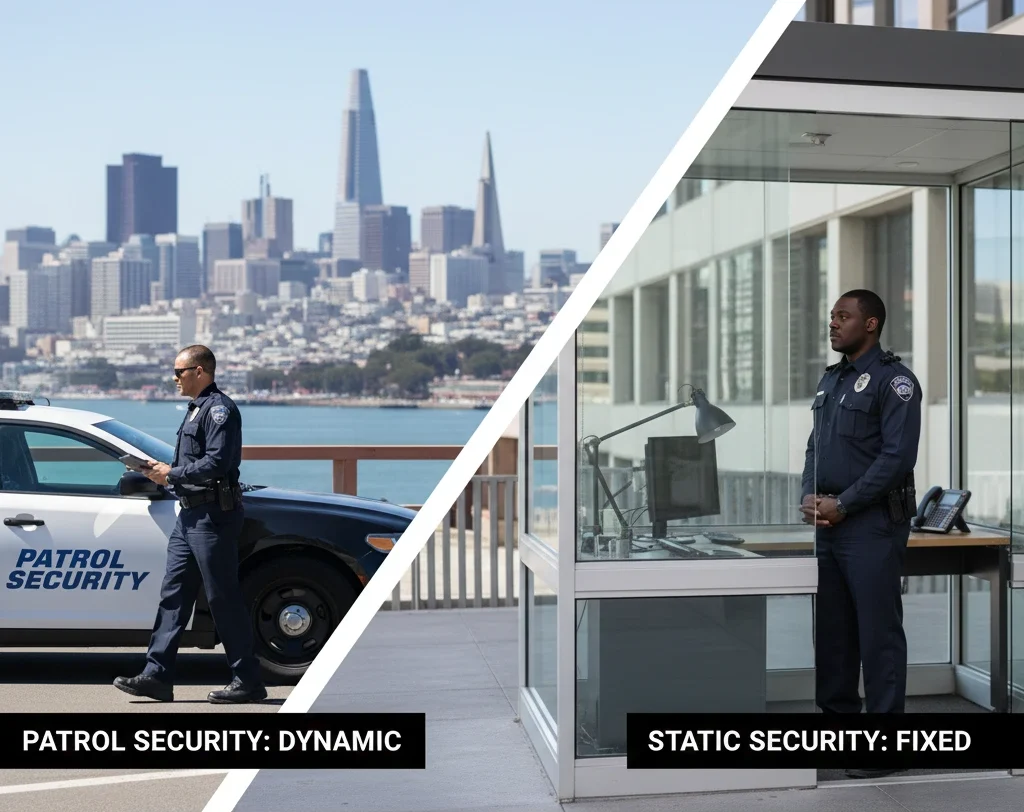
Static security means a guard stays at one fixed location. These guards are usually at entrances, reception desks, gates, or important rooms. Their common duties include:
- Checking IDs or visitor passes
- Monitoring entry and exit points
- Watching security cameras
- Helping customers or guests
- Responding quickly to incidents at the site
Static security is best when you need a strong presence and control at one specific spot.
What Is Patrol (Mobile) Security?
Patrol security means guards move around a property on foot, by car, or on a bike. Patrols can be scheduled or random. Their job is to check multiple areas, look for suspicious behavior, and respond to alarms.
Common duties include:
- Checking parking areas
- Inspecting doors and gates
- Responding to alarms or emergencies
- Reporting unusual activity
Quick Comparative Table
| Point | Static Security | Patrol Security |
| Presence | Always at one spot | Moves around many spots |
| Coverage | Small area | Large area |
| Response | Fast at the guard post | Fast across the property |
| Cost | Usually higher | More budget-friendly |
| Best Use | Entrances, access control | Parking lots, multi-site checks |
When to Choose Static Security in San Francisco
Static security is helpful when you want control in one place and need strong visibility.
Best Site Types for Static Guards
Static security works best for:
- Office building front desks
- Retail store entrances
- Banks and cash-handling centers
- Events and concerts
- Residential buildings with access control
Required Duties / SOP Examples
A static guard usually follows a fixed routine called an SOP (Standard Operating Procedure). Common SOPs include:
- Checking visitors and allowing entry only to approved people
- Observing CCTV cameras
- Watching for suspicious behavior
- Managing deliveries
- Responding first during an incident
- Keeping logs of daily activities
KPIs & SLAs to Demand
When hiring a guard through a security guard company in San Francisco, you should ask for clear performance measures, like:
- Response times to incidents
- Quality and detail of incident reports
- Professional behavior and communication with customers
- Attendance and punctuality
- Main security results (fewer thefts, fewer incidents)
When to Choose Patrol Security in San Francisco
Patrol security covers bigger areas and is great for locations that do not need a guard standing in one place all day.
Best Site Types for Patrols
Patrol guards are ideal for:
- Apartment communities
- Parking lots
- Warehouses
- Overnight business protection
- Large outdoor areas
- Multi‑building properties
Patrol Models: Scheduled & Random
There are different types of patrols:
- Scheduled patrols: Guards come at fixed times.
- Random patrols: Guards come at unpredictable hours.
- Alarm response patrols: Guards come when an alarm rings.
- Vehicle patrols: For large spaces.
- Foot patrols: For smaller spaces.
Technology That Helps Patrol Guards
Modern patrols use:
- GPS check‑ins
- Photo or video proof
- App‑based reports
- Alarm monitoring tools
These tools help businesses track every patrol visit.
KPIs & SLAs for Patrols
Important things to check:
- How many patrol visits do you get per night
- How quickly guards respond to alarms
- How clear and helpful the reports are
- Whether guards follow all required routes
Cost Comparison & Pricing Models
Security pricing in San Francisco depends on many factors.
Typical Pricing Drivers
Some things that affect price:
- Guard’s hourly wage
- Training and licensing level
- Vehicle costs for patrols
- Holiday or overtime charges
- Night shift rates
- Location and risk level
Sample Pricing Scenarios
- A small retail store may need a static guard during business hours.
- A residential community may use night patrols only.
- A business campus may mix both static and patrol services.
It is best to compare multiple companies to understand security guard pricing in San Francisco.
Legal, Licensing & Insurance for Security Guards in San Francisco
San Francisco security companies must follow California laws.
California BSIS Requirements
Every guard must have:
- A BSIS Guard Card
- Training certifications
- A license for carrying weapons (if armed)
- A PPO license for the security company
Always ask for license numbers and verify them using the state website.
Armed vs Unarmed
Armed guards follow extra rules and require extra insurance. Many businesses choose unarmed guards unless they deal with high‑value assets.
San Francisco Municipal Considerations
SF has rules about:
- Guards working on public sidewalks
- Guards dealing with homeless activity
- Guards monitoring public vs private property
Understanding these rules avoids legal issues.
Hybrid Models: Combining Patrol & Static Security
Some businesses need both types of security.
Common Hybrid Patterns
- Static guard during business hours
- Patrol guard at night
- Static guard at the gate + patrol guard for the whole area
How to Structure Flow
- Use static guards for entry control
- Use patrol guards to cover blind spots
- Set escalation rules for emergencies
- Use a shared reporting portal
FAQs
What’s the difference between patrol and static security in San Francisco?
Static stays in one place; patrol moves around.
How much does a security guard cost in SF?
Cost depends on training, hours, and risk level.
Can patrol guards detain someone in California?
Yes, under certain rules, but police must be contacted.
Do I need an armed guard for my SF retail store?
Most retail stores only need unarmed guards.
How fast do patrol units respond to alarms?
Usually, within a few minutes, depending on the distance.
Conclusion & Next Steps
Choosing between static and patrol security depends on your business type, location, and daily challenges. It is always helpful to talk to a trusted security guard company in San Francisco to understand your exact needs.
A simple checklist:
- Do you need control at one main entrance? → choose static security.
- Do you need wide‑area coverage? → choose patrol security.
- Do you want both? → choose a hybrid model.
 Next Post

